THE SHORT ANSWER
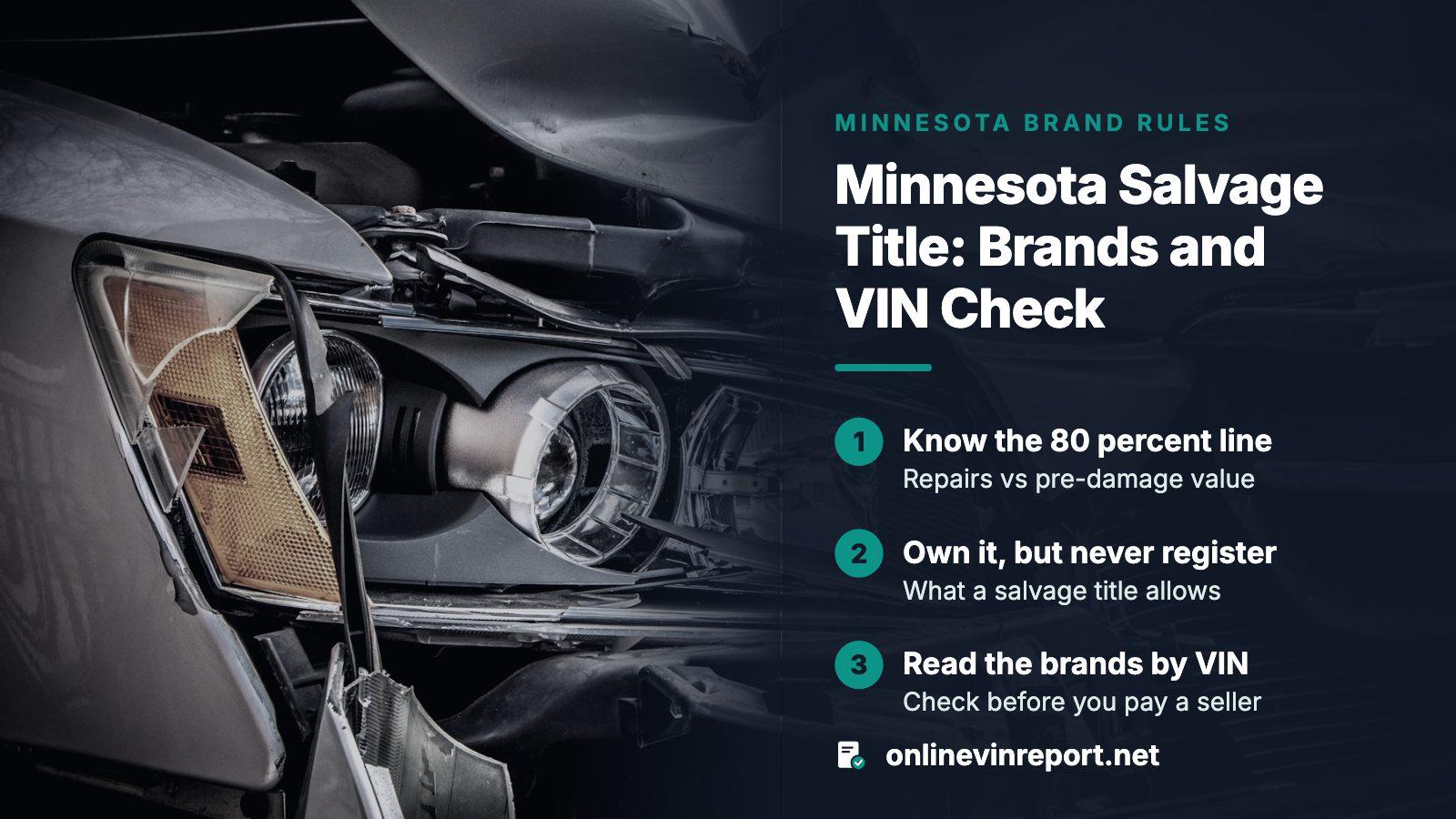
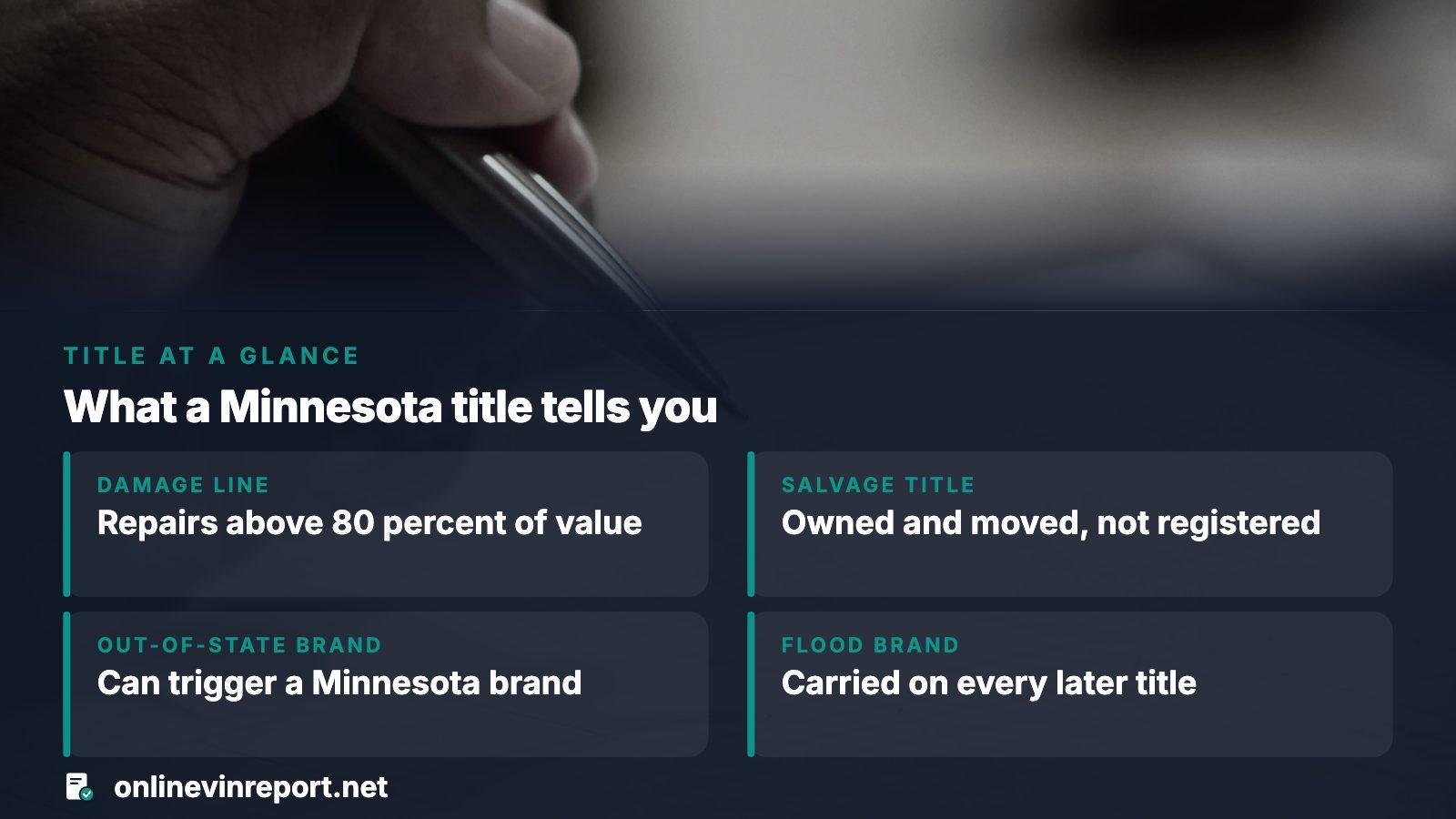
In Minnesota, a car declared a total loss or damaged beyond 80 percent of its pre-damage value gets a salvage brand if it is recent or high-value, while others get prior salvage. A salvage title lets you own and transport the car but not register it. Later titles carry prior salvage, and a VIN check reads those brands before you pay.
- Damage line
- Repairs above 80 percent of pre-damage value
- Salvage title
- Can be owned and moved, not registered
- Inspection fee
- $35 before the inspected car is retitled
- Title check
- Free preview, then a one-time paid report
The brands a Minnesota title can carry
Minnesota prints a brand on the face of the title, set apart from the surrounding text so a clerk or buyer cannot miss it. The list that matters for wrecks is short: flood damaged, salvage, prior salvage and reconstructed. A fifth brand exists for homes contaminated by methamphetamine production and applies to vehicles used that way.
Notice what is missing. Searchers type rebuilt title, but the statutes name no brand with that word. A car that was totaled, repaired and inspected is titled prior salvage from then on. Reconstructed is its own label, meant for a vehicle whose essential parts were taken out, added or exchanged so heavily that it no longer matches how it was built, with new or used components.
Salvage or prior salvage: age and value decide
Two definitions split the cases. Age comes first: the statute counts a model year as recent when it lands five calendar years back from today or later, so with a 2026 calendar that means 2021 and newer. Value comes second: the car was worth more than $9,000 before the crash, or it is a truck rated above 26,000 pounds and too old to count as recent.
| Damaged vehicle is | Brand an insurer applies for | Brand on later titles |
|---|---|---|
| Recent or high-value | Salvage | Prior salvage, once the inspection step is done |
| Older and under the value line | Prior salvage | Prior salvage |
| Recovered intact after a theft payout | None required | None required |
In practice, a ten-year-old sedan hit hard enough to be totaled may never carry the bare word salvage, yet its title still says prior salvage. Read the exact wording and ask what happened.
Who has to apply, and when
A licensed insurer that pays damages and takes the car must apply at once for the brand and tell the department within ten days. The paperwork moving the car to the insurer needs no notary and can be signed electronically, which speeds the process along.
A private buyer has duties too. Someone who takes on a damaged recent or high-value car must file for a salvage title at once if any one of these is true:
- an insurer took the car after paying a claim
- fixing it will run past what the wreck is worth
- the only proof of ownership is an out-of-state salvage title
- the title says damaged, repairable, salvage or a similar word
For older cars, prior salvage is required when the title carries those words or rebuilt, or when any other state ever put a salvage title or brand on the car. A self-insured owner faces the same rule once damage passes 80 percent of the car's cash value.
What a salvage title lets you do
A salvage brand permits ownership, towing the car and selling it onward. Registering it is off the table, so plates and public-road use wait until the car is retitled. Whoever buys a salvage vehicle must keep a title stamped salvage or prior salvage in hand and produce it whenever an authority asks.
Junking certificate
A car judged an unrepairable total loss receives a junking certificate rather than a title. The holder may keep it and move it, nothing more. The one sale route runs from a salvage pool or insurer to a licensed parts dealer or scrap processor. A car in that category should never turn up in a private listing as a daily driver.
A dealer who buys a car for scrap or parts keeps the old title for three years, and Minnesota never issues a new one for that vehicle.
Getting a repaired car titled again
For a recent or high-value car on a salvage title, the prior salvage title cannot be issued without an inspection certificate on the department's own form attached to the application. The state collects a $35 inspection fee ahead of issuing that title; beyond it, the statute permits only the regular filing fee.
Minnesota Driver and Vehicle Services pages for the current form name and process did not open when this guide was prepared, so confirm the steps and any added costs with the department directly. The statute sets the inspection requirement and the fee, not appointment details.
Once retitled, the prior salvage brand follows the car to every later owner. It does not expire with a sale or a clean repair invoice.
Where a seller's disclosure stops short
A seller who actually knows the car took damage past 80 percent of its cash value must disclose it to the buyer, written either into the title application or into a different transfer document. The statute's form has the seller state, to the best of their knowledge, whether the car did or did not suffer that much damage. Repair cost is taken from the retail price on a full written estimate or invoice.
Licensed dealers owe more. During a sales presentation they hand over a written notice, plus a spoken one unless the sale happens online, on past damage, any brand they know of, and any time a car in stock sat in water deeper than the lowest part of the dash. You sign the notice and the dealer files it. Whoever receives a flood notice must pass the same notice to the next buyer.
The knowledge loophole
Every duty above hangs on what the seller knows. A car fixed without a recorded insurance payout, or sold by someone who never learned its history, can arrive with a clean-looking title and no warning. Records held outside the seller's head are your check.
Running an online title check by VIN
Begin with the number on the car itself, and check it against the title in the seller's hand. Then run it through a title history report. NMVTIS, the federal title database run by the Justice Department, was created to shield shoppers from title fraud and dangerous cars while blocking resale of stolen ones.
You can start with the VIN preview at no charge; the pricing page explains how the one-time report purchase works. Check the brand lines first, then any salvage or auction entries, then the odometer readings on each side of a damage record.
- Copy the VIN from the dash and doorjamb, and match it to the title.
- Run the preview and write down any brand it flags.
- Pay for the full report once a car makes your short list.
- Hold the report's brand lines against the wording printed on the paper title.
- Put every mismatch to the seller before money moves.

Red flags specific to Minnesota cars
- A title from another state that carries salvage, damaged or repairable wording, since Minnesota treats an out-of-state salvage brand as a trigger for its own brand.
- A recent model-year car with prior salvage and no word on the inspection step.
- A seller who calls the car rebuilt in an ad while the title says something different.
- A flood-damaged brand, which Minnesota records on that title and all that follow.
- A report showing an insurer or salvage auction handling the car while the title looks ordinary.
None of these ends a deal on its own. A properly repaired car with a branded title can be priced fairly, and the brand then belongs in the price you offer. What you cannot afford is learning the brand after you have paid.
Where this information comes from
- Minnesota Statutes 168A.151: Salvage title and junking certificate — who applies for salvage or prior salvage and the junking certificate
- Minnesota Statutes 168A.152: Use of title and inspection fee — no registration on salvage, inspection step and fee
- Minnesota Statutes 168A.01: Definitions — late-model, high-value, salvage and recovered intact definitions
- Minnesota Statutes 325F.6642: Title branding — which brand lands on which title
- Minnesota Statutes 325F.6641: Disclosure of vehicle damage — seller and dealer disclosure duties
- VehicleHistory.gov: NMVTIS — federal title database purpose
Sources and photos: Facts checked against the sources above in November 2026. Photos by Clark Van Der Beken, Anastasiia Nelen and Masjid MABA on Unsplash; diagrams by OnlineVINReport.
Keep reading
- Salvage title VIN check: run it online before you payrun a VIN check for a salvage brand
- What is a rebuilt title? What it means and what a VIN title check showswhat rebuilt means in states that use the word
- Rebuilt title inspection: what the state checks and what a VIN title check addshow inspections after repair usually work
- Total loss threshold by state and what it means for a VIN title checkhow other states set the damage line
Frequently asked questions
Can I register a car with a Minnesota salvage title?
No. Under the statute, a salvage title covers holding, hauling and selling the car, but not registering it. For a recent or high-value car, the application for the next title needs an inspection certificate before prior salvage can be issued.
Does Minnesota have a rebuilt title?
Not as a named brand in the statutes. A repaired car moves to prior salvage on later titles, while reconstructed is a separate brand for heavily altered builds. Sellers still say rebuilt in ads, so read the title wording itself.
What percent of damage makes a car salvage in Minnesota?
The definition has two doors. One is repair cost over 80 percent of the car's worth right before the damage. The other is an insurer's total-loss ruling or payout, whatever the repair estimate says. Recovered intact vehicles after a theft payout are excluded.
Does a salvage brand ever come off the title?
The statutes describe the brand moving from salvage to prior salvage on later titles, not disappearing. Prior salvage is recorded on all subsequent certificates. Plan on the brand staying with the car through every future sale.
Can I tell whether a car in Minnesota was ever salvage?
Put its VIN through a title history report and read the brand and salvage entries, then compare them to the paper title. Our VIN preview carries no charge, and the report itself is bought once. Rely on records over talk, because a seller's own statement only reflects what that seller happens to know.
Now check the car itself
The guide explains what to look for. The report shows what this VIN has on record.