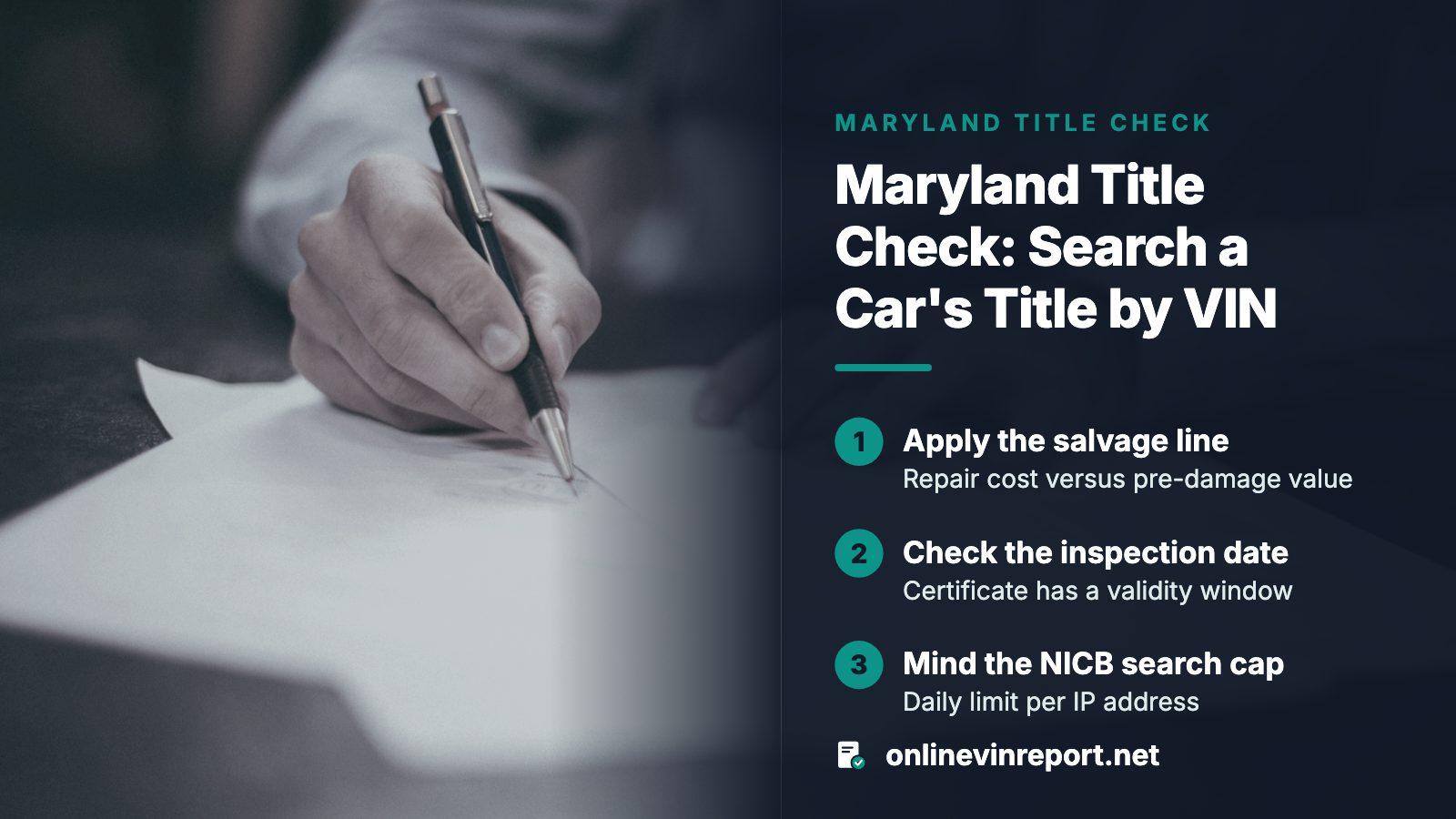
THE SHORT ANSWER
To check a Maryland car's title, copy its 17-character VIN, run an online title check for brands, total-loss and salvage entries, odometer readings and the latest title state, then hold the result against the paper title. Maryland titles can read rebuilt salvage or Flood Damaged, and a brand from another state should carry over, so any wording that is missing or unexplained is a reason to stop and ask.
- Maryland salvage line
- Repairs above 75% of pre-damage value
- Inspection certificate
- Valid 90 days from issue
- NICB VINCheck limit
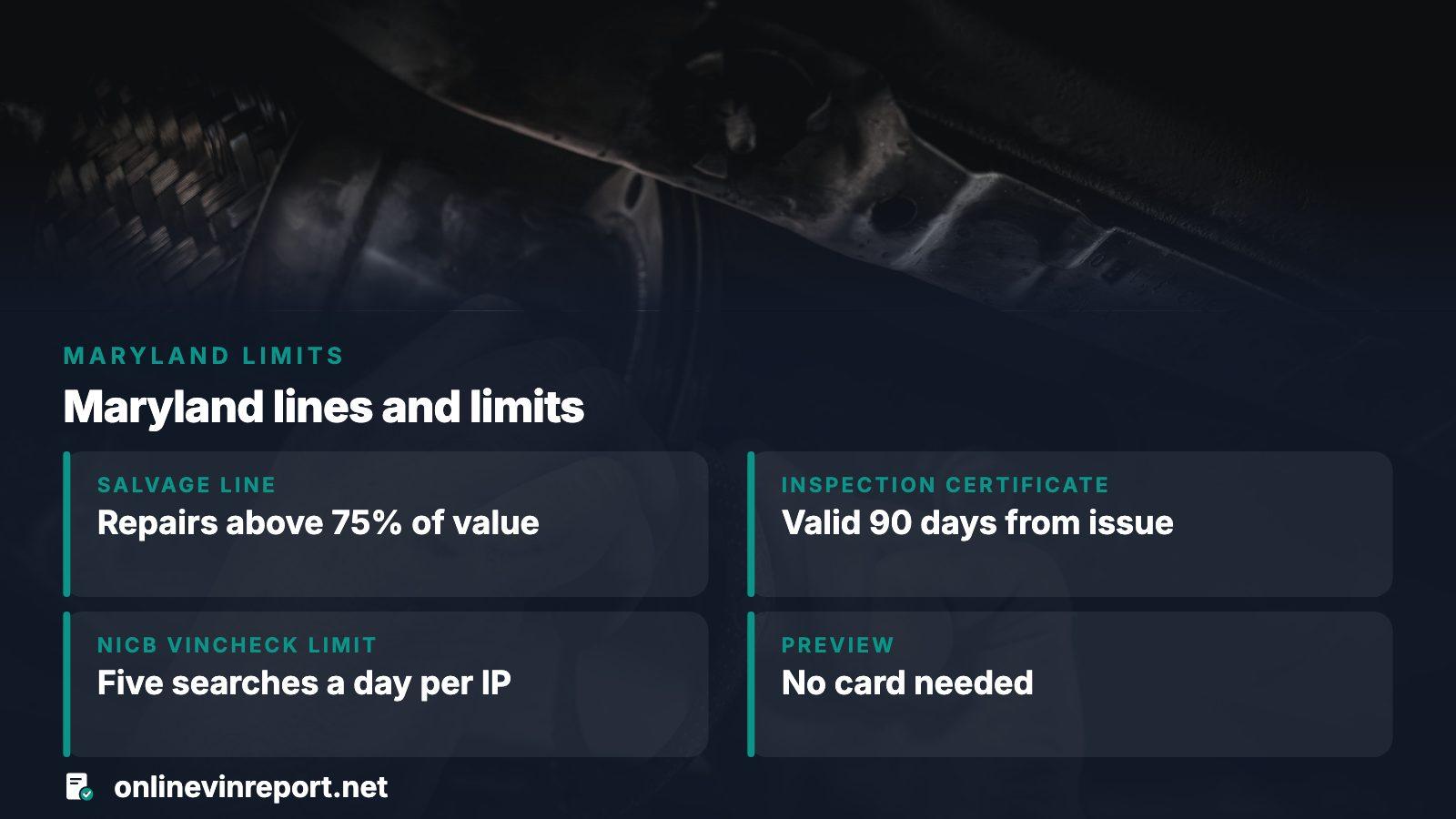
- Five searches a day per IP address
- Preview
- Free, no card needed
Five places to look, and what each one can see
No single record holds a car's whole past, so a Maryland title check is really a stack of small ones. The MVA keeps the Maryland file and issues the paper. A federal database collects what state agencies, scrapyards and insurers report. An insurer-backed lookup covers theft and write-offs. Every layer has a blind spot, spelled out in the last column.
| Where you look | What it shows | What it misses |
|---|---|---|
| The paper title | Owner, VIN, any lender named, the brand wording Maryland printed | Whatever another state recorded that never reached this document |
| Online title check by VIN | Brands from any state, total-loss and salvage entries, the latest odometer reading, current title state and date | Repairs, recalls, and any state or yard that has not reported |
| NICB VINCheck | Thefts never recovered, plus salvage and flood claims from insurers that take part | Police records, insurers that opt out, everything else |
| NHTSA recall lookup | Safety recalls still waiting for a repair on that VIN | Brands, damage, recalls already fixed |
| A mechanic's inspection | Hidden damage and real condition | Paperwork and brand history |
Run the check in six steps, with the car in front of you
Order matters here. The VIN comes from the car, and the paper comes last.
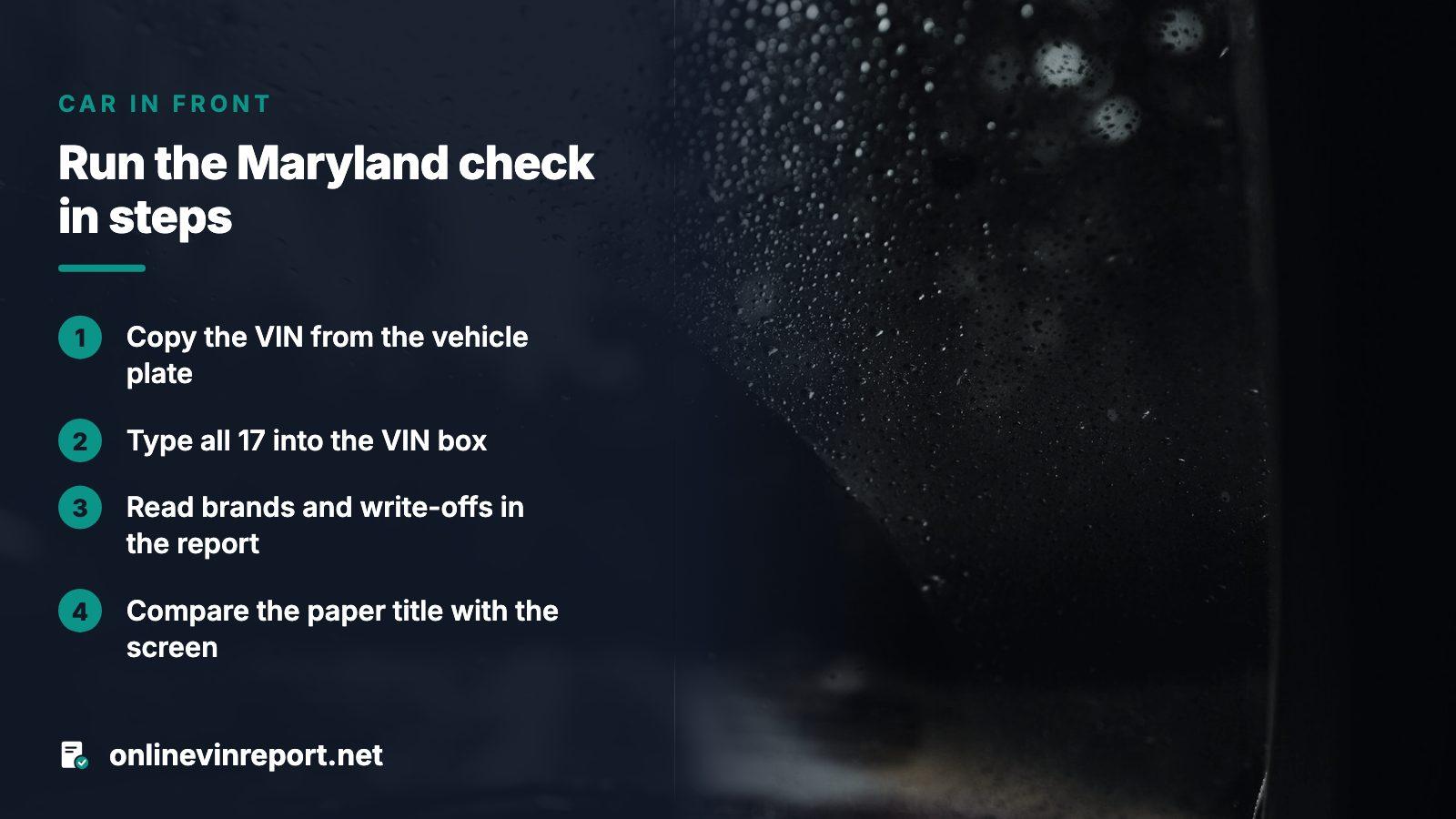
- Take the VIN from the vehicle, not the advert: copy it from the plate at the windshield's edge and photograph it. The same 17 characters must appear on the title.
- Type all 17 into the VIN box here. A preview costs nothing, so check each car on the list.
- Pay for the report on cars still in contention, and read brands and write-offs first.
- Add NICB's VINCheck as a second opinion. Each IP address gets five lookups a day, so ration them for the finalists.
- Check open recalls for the same VIN on NHTSA's site, and ask the seller for repair paperwork.
- Set the paper title beside the screen: names, VIN, lender, brand wording. Book a mechanic before any money moves.
Maryland's salvage line and the wording it puts on a title
In Maryland a wreck becomes a salvage case when the repairs needed would cost more than 75% of its value before the damage. An insurer has 10 days from taking over a car in a settlement to request the certificate. Towing, storage, rental and cosmetic work are left out of the repair math.
What shows up on a later document depends on how the car got back on the road.
| On the paper | What it means | What to ask for |
|---|---|---|
| Salvage certificate, no title | An ownership paper only; the car cannot be titled or registered for the road while it is in this form | The repair and inspection record; price it as a project |
| Rebuilt salvage title | Issued after repair, with an inspection certificate from a police agency and a separate state safety certificate | Both certificates and the repair receipts |
| Flood Damaged title | A flood notation on the certificate carries into the title wording | The flood history in writing, plus an independent inspection |
| Another state's brand, none on the Maryland title | Maryland says an outside document for a similar rebuilt car should produce a similar notation | An explanation and the earlier title |
Reading the result line by line
A salvage brand from one state may not exist in the next, because each state writes its own rules. Once a state applies a brand, though, it stays in the federal file. That makes the online result a sturdier guide to an out-of-state past than the paper in the seller's hand.
| Line in the result | How to read it | Next move |
|---|---|---|
| Salvage, junk or flood brand | Some state applied it, and the federal file keeps it even if a later title leaves it off | Price the car as branded; ask for repair papers |
| Write-off entry but no brand | An insurer declared a total loss. Theft with no recovery after 30 days can draw the same label, and it sticks once the car turns up | Ask the seller what happened |
| Title state different from the seller's | The car moved, or the move shed a brand | Request the earlier title |
| Odometer reading above the dash figure | The mileage story does not hold together | Treat as a deal-breaker until explained |
| No entries | Encouraging, but not every state, yard or insurer reports, so a search can miss history | Inspect anyway |
Checklist for the paper title before any money moves
Run the screen first, then hold the document against it. Maryland adds its own rules on top of whatever the history says.
- The seller's name matches the title, and every listed owner is there to sign.
- The VIN on the title agrees with the car and the report.
- If a lender appears on the title, get its release on paper. An open loan is the seller's to clear.
- Any rebuilt salvage or Flood Damaged wording is already reflected in the asking price.
- A salvage certificate is not a title. If that is what is offered, the car cannot be registered for the road as it stands.
- The odometer figure on the title fits the readings in the report.
Inspection rules, and the cars an owner kept after a payout
Maryland wants a valid inspection certificate before it titles and registers a used vehicle, with historic Class L vehicles excepted. A certificate lasts 90 days from issue. A car transferred within 30 days of a certificate already on file with the MVA does not need a fresh one. Dealer stock follows a separate clock.
A buyer who applies without a certificate can receive temporary registration, but the car must pass within 60 days. A seller's old certificate, or the lack of one, shows who carries the repair bill.
Owner-kept cars follow a separate path. When an insurer settles and the owner keeps the car, the MVA records a salvage declaration, and the owner of a repairable car has 90 days from the notice to prove a safety inspection or lose the registration. Ask whether the car ever had an insurance payout, then compare the answer with the report.
Different questions
An inspection certificate says the car was sound on test day. It says nothing about brands, odometer or lenders, so run the title check and the inspection both.
Pricing, and where to go after the result
A preview is free to run. The report itself is bought once, in a pack if you are weighing several cars, and no renewal follows. Rates are listed on the pricing page.
- Clean result and matching papers: book the inspection, then agree the price.
- A brand you can live with: negotiate for it and get repair and inspection records in writing.
- A brand in the report that the title does not show: pause the deal until the seller gives a clear account.
- Unexplained odometer gap or open lender claim: walk away, or have the seller fix it first.
Where this information comes from
- Maryland Transportation Article 13-506: salvage certificates — The 75 percent salvage ground, the insurer's 10-day application and what a certificate does and does not allow.
- Maryland Transportation Article 13-506.1: owner-retained salvage — What the MVA records when the owner keeps the car, and the 90-day inspection window.
- Maryland Transportation Article 13-507: title after repair — Inspection certificates for a rebuilt car, the title wording and the carry-over of outside brands.
- Maryland Transportation Article 23-107: used-vehicle inspection — When a used vehicle needs an inspection certificate, how long it lasts and the temporary registration window.
- NMVTIS: consumer information — How brands persist in the federal record, what a total-loss label can mean and why a search can miss history.
- NICB: VINCheck — What the insurer-backed lookup covers, its daily search limit and what it cannot see.
- NHTSA: check for recalls — A VIN lookup that lists only unrepaired safety recalls.
Sources and photos: Facts checked against the sources above in November 2026. Photos by Scott Graham, Justin Cron and Martin Fennema on Unsplash; diagrams by OnlineVINReport.
Keep reading
- Title washing: how a brand vanishes and what a VIN title check can showHow a brand can vanish from a paper title when a car crosses a state line.
- Total loss threshold by state and what it means for a VIN title checkHow the percentage that makes a car salvage differs from state to state.
- Rebuilt title inspection: what the state checks and what a VIN title check addsWhat a rebuilt-title inspection covers and what it leaves unchecked.
- PricingReport options, pack sizes and the single payment, with no subscription.
Frequently asked questions
Is there a free Maryland title check by VIN?
Partly. The preview here costs nothing, and NICB's VINCheck screens salvage, flood and unrecovered-theft claims from member insurers at no charge, up to five searches a day per IP address. The full brand and title history from every reporting state needs a paid report, so use the free steps first and pay only for cars that survive them.
Does Maryland use a salvage title?
Maryland issues a salvage certificate rather than a title when a car is declared salvage, and the certificate serves as an ownership document only. After repairs and two inspections, the owner can apply for a rebuilt salvage title. Flood cases get Flood Damaged wording, and some certificates carry a notation that bars any title.
When does Maryland treat a car as salvage?
Among other triggers, when fixing crash, fire, flood or similar damage would cost over 75% of the car's pre-damage value. A car an insurer takes over in a claim settlement also qualifies. Towing, storage, rental and cosmetic work do not count toward the repair figure.
Can a title check show a lien on a Maryland car?
Treat the paper title and a written release from the lender as the proof. Reports center on brands, total-loss and salvage entries, odometers and the title state, so do not count on one to settle a loan. If the seller still owes money, the payoff has to happen before the sale, and the lender can confirm it.
Does a clean result prove the car never crashed?
No. Federal title data depends on states, yards and insurers reporting, and damage repaired without a write-off or a state brand may never appear. A clean result is encouraging, nothing more. Follow it with a recall check, then pay a mechanic of your own picking to look the car over.
Now check the car itself
The guide explains what to look for. The report shows what this VIN has on record.