THE SHORT ANSWER
Maryland treats a car as salvage when repair costs top 75% of its fair market value before the damage, when an insurer acquired it through a claim, or when a dismantler took it for rebuilding or parts. After repairs and two inspections the owner can apply for a title marked rebuilt salvage. A VIN title check shows if that brand is on the record.
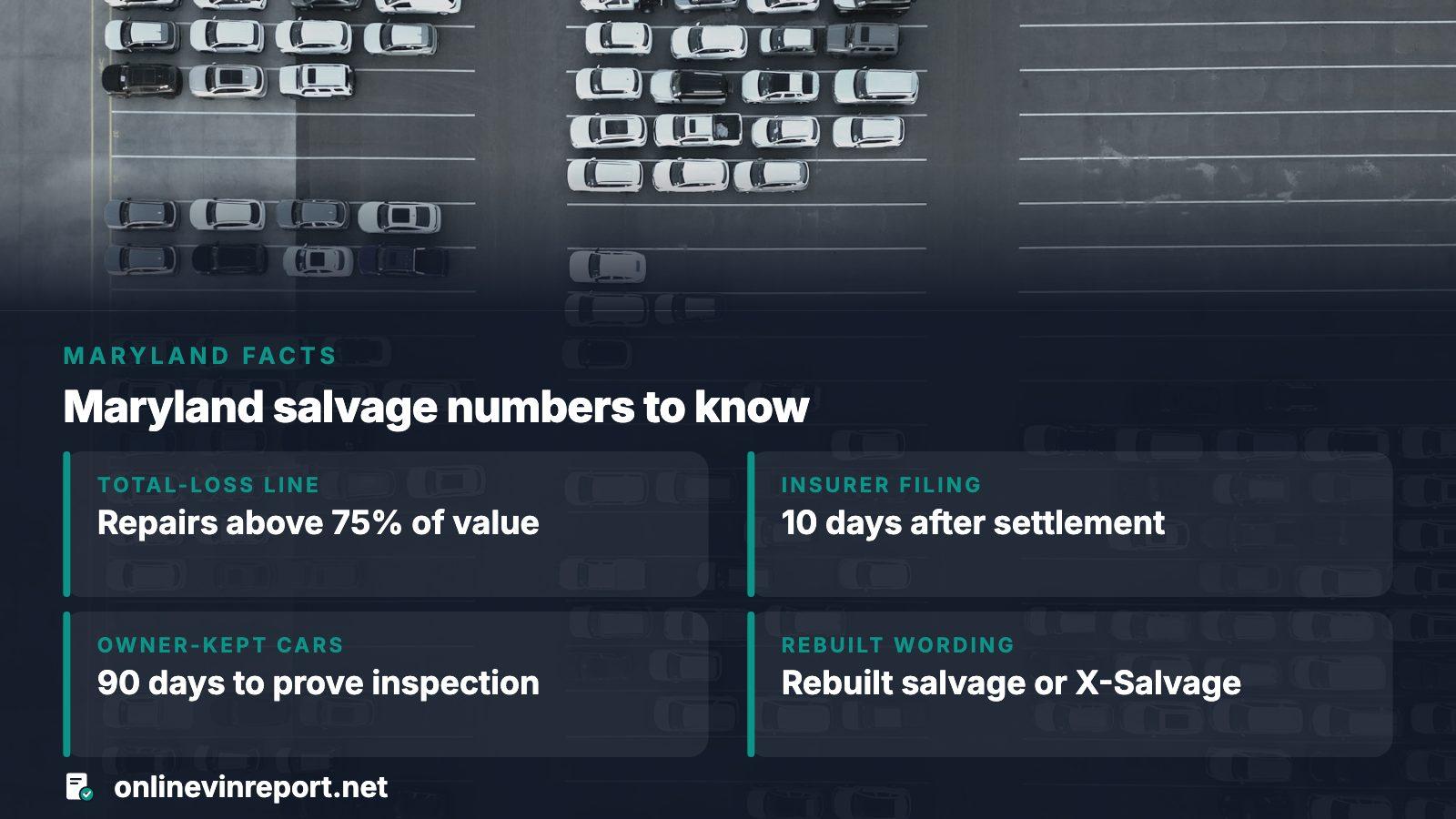
- Total-loss line
- Repair cost above 75% of pre-damage market value
- Insurer filing window
- 10 days after the settlement date
- Owner-kept cars
- 90 days to prove a safety inspection or lose registration
- Rebuilt title wording
- Rebuilt salvage, Flood Damaged or X-Salvage
Three ways a Maryland car ends up salvage
The state's definition is broader than the damage-percentage rule most buyers have heard about. Any one of three facts is enough. Collision, fire, flood or similar damage can push the cost of making the car legal for the road past 75% of its value right before it was damaged. An insurer can acquire the car by settling a claim. Or an automotive dismantler and recycler can take it in as an abandoned vehicle, for rebuilding, or for parts only.
One carve-out matters to owners. If you keep your car after the insurer settles, the law says the insurer has not acquired it. Salvage can still be declared on it, but the paperwork takes another path, covered further down.
What goes into the repair-cost math
Not every dollar on an estimate counts. Maryland's statute says the calculation may not include towing, storage, a rental car, or repairs to cosmetic damage. A car with a crumpled hood and a big tow bill can therefore land on the right side of the line, while one with hidden structural or electrical damage may not.
The line also does not force anyone's hand. An insurer or an owner can still decide against repairing a vehicle for economic or safety reasons, whatever the arithmetic says. So a car that was never formally declared a write-off is not proof of a clean past, and a declared one is not automatically a wreck.
Who applies for the salvage certificate
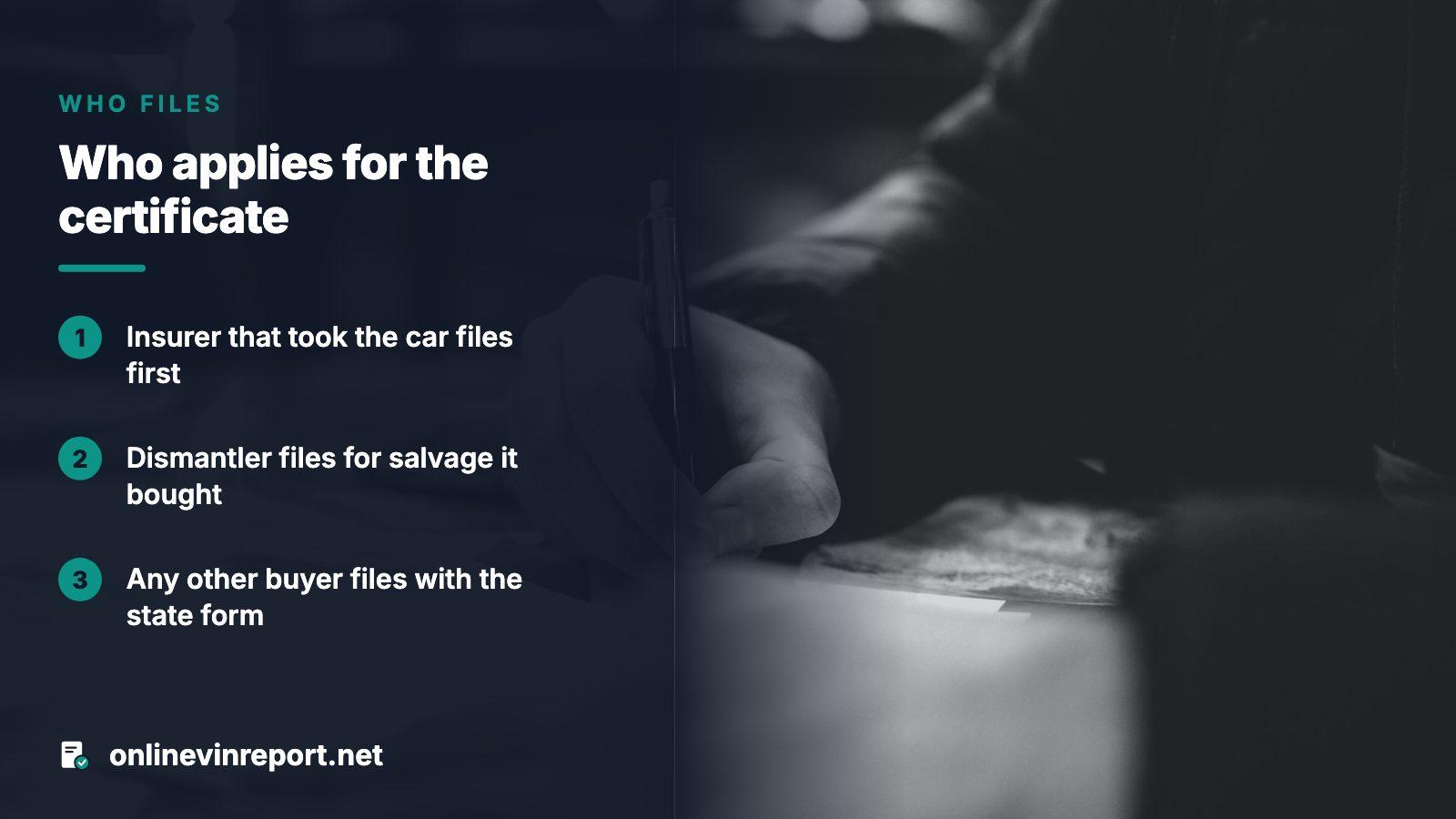
The certificate goes out under the applicant's name and doubles as proof of who owns the car while it has no regular title. Three kinds of applicant can ask for one.
- A Maryland-licensed insurer that took the car in a settlement, which must apply within 10 days of the settlement date.
- A dismantler or recycler that bought a salvage car from a source other than a Maryland-licensed insurer.
- Any other person who buys or keeps a salvage car, using the state's form and paying its fee.
The state keeps a record that the car moved as salvage, and it may not be titled or put on the road in Maryland except by way of the rebuilt-title process.
The notation on the certificate decides what comes next
When an insurer applies, it states one of five grounds, and the certificate carries a prominent notation for it. That notation controls whether the car can ever be titled again.
| Insurer's statement | Later title outcome |
|---|---|
| Repairable, repair cost above 75% of value | Title marked rebuilt salvage after repair and inspection |
| Cannot be rebuilt, kept for parts, no new title | No title can be issued |
| Stolen | Certificate waits until the car is recovered |
| Flood damage | Title marked Flood Damaged |
| Settled, but repair cost 75% or less of value | Title marked X-Salvage |
The X-Salvage wording also appears on titles for cars that came through a dismantler's certificate.
Keeping the wrecked car yourself
Plenty of owners take a payout and hold on to the car. In that case the insurer promptly notifies the state, with the paper title, a fee for a corrected title, and details on who owns the car and what it is. The state then logs the salvage declaration.
Registration clock
For a repairable car, the owner gets a notice. Registration is suspended unless proof of a safety inspection under the state's Title 23 reaches the state inside 90 days from the date on the notice. For a car marked not rebuildable, the state issues a salvage certificate, suspends registration and tells the owner to return the plates immediately.
Once a repairable car passes that inspection, the state issues the owner a new title.
From salvage certificate to rebuilt title
The owner applies on the state's required form and attaches three things: the salvage certificate itself, a police inspection certificate (county police or the State Police), and the separate safety certificate that Title 23 requires. The state may charge a fee for the police-side inspection, and that money goes to the State Police's safety enforcement division. Current amounts are on the Motor Vehicle Administration's site, which refused our automated request, so check the figure there.
The new title is issued in the applicant's name with the wording from the table above. If another state's document already says a car is in a condition substantially similar to Maryland's rebuilt salvage, Maryland's title must carry a similar notation. A brand earned elsewhere does not disappear at the border.
What a buyer should do with the brand
A rebuilt salvage title need not end the deal by itself, yet it changes what you ask. Ask for the inspection paperwork. Ask what was damaged and who repaired it. Have an independent mechanic look at structure, airbags and wiring, and compare the price against comparable clean-title cars rather than the seller's story.
A brand-new owner can find the opposite problem. Some sellers do not volunteer the wording, and a title copy can be old. That is where the VIN comes in.
How an online title check helps before you pay
The federal title database, which gathers records reported by motor vehicle agencies, auto recyclers, junk yards and insurance carriers, says that once a state brands a car, the brand stays part of its record. A VIN-based title check reads those brand records, plus insurer write-off calls and sales into salvage yards, and it can catch a brand a seller left out.
A preview comes first at no charge. The full report afterward is a single purchase, not a subscription, and its cost sits on the pricing page. The check pairs well with the salvage VIN check guide, which shows what each brand line looks like.
Be realistic about limits. That federal system is intentionally short, carries no repair history, and cannot report what no reporter submitted. An empty result is encouraging, not a guarantee, so keep the inspection.
Where this information comes from
- Maryland TR 11-152: definition of salvage — the three tests and the owner-keeps-the-car carve-out
- Maryland TR 13-506: salvage certificate rules — who applies, the five insurer statements, what repair math excludes
- Maryland TR 13-506.1: salvage kept by the owner — the 90-day inspection notice and plate return
- Maryland TR 13-507: titling a repaired salvage car — inspection documents and title wording
- NMVTIS for consumers (vehiclehistory.bja.ojp.gov) — what that national title record contains and why brands persist
Sources and photos: Facts checked against the sources above in November 2026. Photos by Leo_Visions, Owen Michael Grech and Iain on Unsplash; diagrams by OnlineVINReport.
Keep reading
- Salvage title VIN check: run it online before you paySee what a VIN check shows for a salvage brand.
- Maryland title check: search a car's title history by VINThe wider Maryland title check, beyond salvage.
- What is a rebuilt title? What it means and what a VIN title check showsHow rebuilt titles work across states.
- Rebuilt title inspection: what the state checks and what a VIN title check addsWhat a rebuilt-title inspection looks at.
Frequently asked questions
What is a salvage title in Maryland?
Maryland issues a salvage certificate that acts as the ownership document for a car that is salvage under state law. That covers cars with repair costs above 75% of pre-damage value, cars an insurer acquired in a settlement, and cars taken by a dismantler for rebuilding or parts.
Can I get a rebuilt title in Maryland after repairs?
Usually, yes, if the certificate's notation allows it. You apply on the state's form with the salvage certificate, a county or State Police inspection certificate and the Title 23 safety certificate. A car certified as not rebuildable cannot be titled at all.
Does the repair estimate include towing and a rental car?
No. Maryland's statute excludes towing, storage, vehicle rental and cosmetic repairs from the cost used for the 75% comparison. Only the cost of making the car legal for highway operation counts, which is why two cars with similar bills can fall on different sides.
What if I keep my car after the insurer pays?
The insurer notifies the state, and the car is recorded as salvage. For a repairable car you get a notice, and registration is suspended unless you prove a safety inspection within 90 days of that notice date. Not-rebuildable cars lose registration right away.
Will a VIN check show a Maryland salvage brand?
It can. Brands that a titling agency applies stay on the car's national record, and total-loss determinations by insurers are reported too. Coverage depends on what was submitted, so a clean result is not a guarantee. Look at the preview first, then decide whether the full report is worth buying.
Now check the car itself
The guide explains what to look for. The report shows what this VIN has on record.