THE SHORT ANSWER
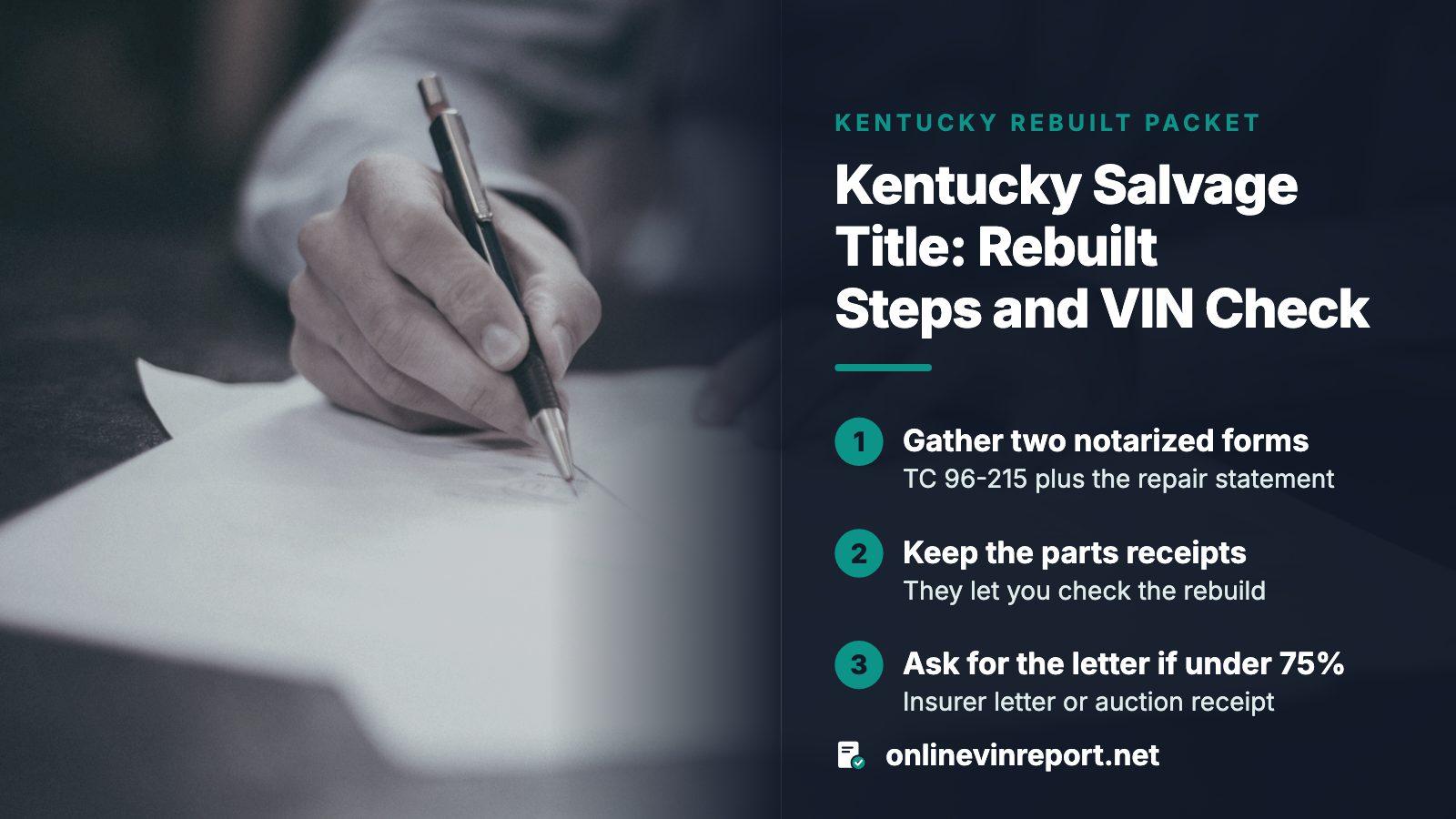
In Kentucky a car holding a salvage title returns to legal use only after the owner files for a rebuilt title with the Transportation Cabinet. The packet holds the original salvage title, two notarized forms, a repair statement and the original parts receipts. A brand history search by VIN tells you which stage a given car is at.
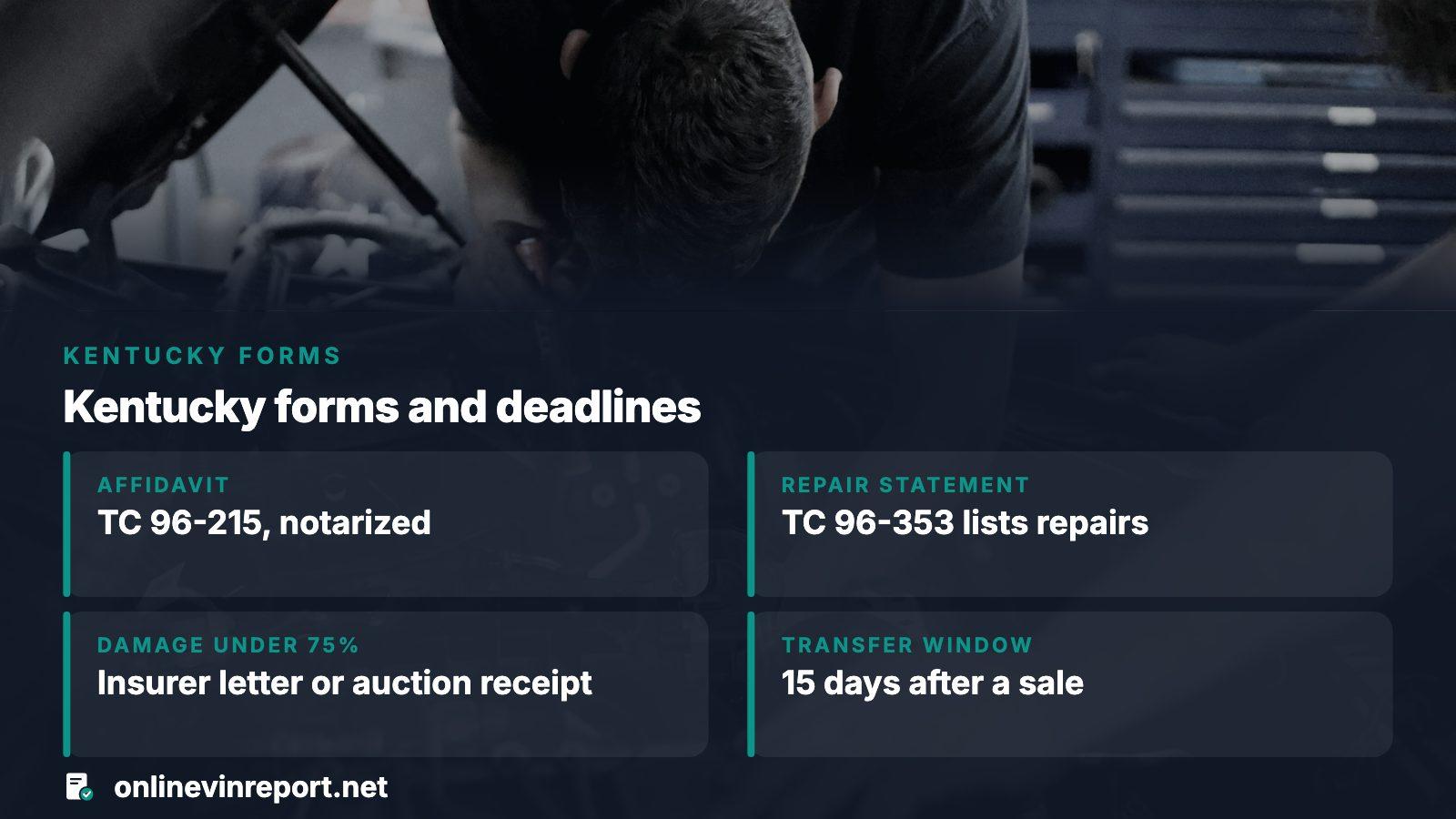
- Affidavit form
- TC 96-215, notarized
- Repair statement
- TC 96-353, listing the repairs
- Damage under 75%
- Insurer letter or auction receipt needed
- Title transfer window
- 15 days after a sale
Salvage first, rebuilt second: two stages of one car
Searches for a salvage title in Kentucky and a rebuilt title in Kentucky describe the same car at different points in its life. The salvage title comes first and marks serious damage. The rebuilt title comes later, only after the owner has repaired the vehicle and the state's rebuilt section has accepted the paperwork. A listing that says rebuilt therefore tells you a salvage record existed, even if the seller never uses the word.
Brands are labels that state titling agencies attach to a vehicle record, and the federal title database keeps the history of brands applied by any state. That matters for Kentucky buyers, because a car can be wrecked, branded and sold across a state line, then titled again somewhere else. The brand history is the part of the record that follows the VIN, so it is the part worth reading before you visit the seller.
What Kentucky asks an owner to file for a rebuilt title
The Transportation Cabinet's DRIVE site lays out the procedure and grounds it in two statute sections of chapter 186A (numbers 520 and 530) plus an administrative regulation, 601 KAR 9:200. It is a paper process, and photocopies of the key documents get refused. That is useful to you as a buyer, because a properly rebuilt car leaves a stack of paper behind it.
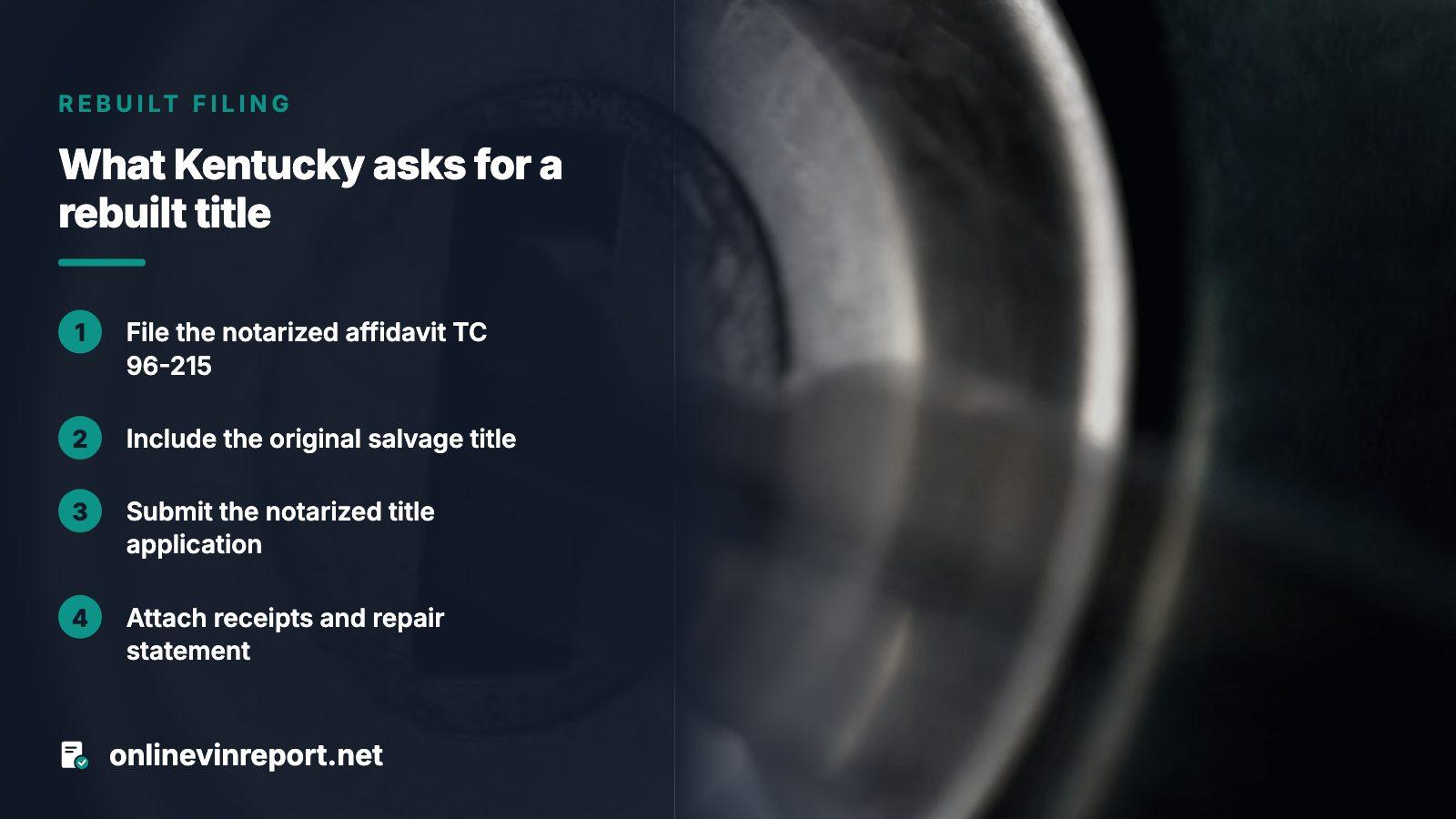
- Form TC 96-215, a notarized affidavit about a vehicle put together from wrecked or salvaged ones.
- The original salvage title; if the car came from a state that issues registrations only, that original registration stands in.
- Form TC 96-182, the standard title and registration application, also notarized.
- Original receipts for every part bought, marked to show which parts went on this car.
- Form TC 96-353, which lists the repairs carried out.
If the car still wears a license plate, the plate goes back to the County Clerk, and a lien on the title needs a lienholder's termination statement filed there too.
The parts receipts are where a rebuild can be checked
Kentucky is stricter about parts than many owners expect. When a part came from a private individual and not a business, the seller has to write down a name, full address and phone number, say what was sold, and give the VIN of the car it was taken from. If that seller cannot supply a VIN, the applicant files a notarized statement explaining why.
The rebuilt section initials the parts it accepts and sends the original invoices back to the applicant. So a seller who rebuilt a car in Kentucky should be able to show you invoices with the section's initials on them. Missing receipts for major components such as airbags, a frame section or an engine are a reason to walk away or to get an independent inspection before you commit.
Ask for the paper trail
Request copies of the repair statement and the parts invoices before you test drive. If a seller stalls, that is your answer.
When the damage was under 75 percent of value
Not every rebuilt application involves a crushed car. The Cabinet says that when a vehicle was not damaged beyond 75 percent of its current value, the file must include a statement from the insurance company, on its letterhead, describing the damage. These letters are usually written for lighter losses such as fire, flood, a theft recovery or hail.
A car bought at an auction can skip the insurer letter if the original auction receipt itself states the damage. For a buyer, this is a reason to read the damage type attached to a brand and not only the brand. Hail damage and a bent frame make for two very different rebuilt cars, and the auction photos and damage notes in a history report help you tell them apart.
Odometer paperwork on newer vehicles
For vehicles under 10 years old, the state asks for a separate Federal Odometer Disclosure Statement when the reading is missing from the TC 96-182 application, or when it does not appear on a properly completed title. A recently built car that went through a rebuild should therefore have a mileage figure on record at the point it was re-titled.
| Situation at rebuilt filing | What the state wants |
|---|---|
| Vehicle under 10 years old, no reading on the application | Separate federal odometer statement |
| Damage under 75% of value | Insurer letter, or an auction receipt stating the damage |
| Parts bought from a private seller | Seller's name, address, phone and donor VIN |
| Motorcycle | Pencil tracings of frame and motor numbers |
Reading a Kentucky brand by VIN
The federal title database tracks five things: where the title stands, brands, mileage, total loss and salvage events. Federal law makes insurers and yards that handle wrecks send it data, and state titling agencies feed it as well. A title brand search by VIN draws on that kind of data, then adds whatever else a provider holds, such as auction photos.
- A brand with no later rebuilt entry suggests the car has not been re-titled, or that the next title was issued somewhere the data has not reached.
- A rebuilt brand with an earlier salvage entry is the normal pattern, so ask what the damage was.
- A clean result is a good sign, but the federal source itself calls its report intentionally short, and it does not hold repair or maintenance records.
Our preview costs nothing and shows whether a brand appears. After that, a report is bought once, with no recurring charge; see the pricing page for the choices.
If you buy a Kentucky car: the title steps
After a sale, Kentucky expects the title to be put in the buyer's name inside 15 days. You apply at the County Clerk in your county of residence, or the county where the car is mainly driven. Bring proof of Kentucky insurance, identification, and the signed-over title with notarized signatures.
A car arriving from another state also needs a passed Sheriff's Inspection and proof of insurance issued within 45 days. If the title has not reached you within 45 days of applying, contact the County Clerk. Never fix a mistake on a title with white-out or a cross-out; the state asks for a notarized affidavit with the corrected information.
Pull the title history if something is off
Residents of the state, and businesses registered with the Secretary of State, can ask for a vehicle history record on form TC96-16A. The Cabinet says it can show salvage details, transfer dates and odometer discrepancies, and quotes a turnaround of 3 to 5 business days.
What this page does not confirm
The Kentucky statutes themselves did not open when this page was researched, so it does not restate how the law defines a salvage vehicle, the percent of value that triggers a salvage title, or the fees charged. Those details belong in a call to your County Clerk or the Cabinet's rebuilt support section before you act on them.
The page rests on the Cabinet's own pages on rebuilt filings and titling, plus the federal title database's explanation of brands. Confirm each step with the state before you spend money on a branded car.
Where this information comes from
- Kentucky DRIVE: Rebuilt-Salvaged Titles — forms, receipts, the 75 percent insurer-letter rule and odometer paperwork
- Kentucky DRIVE: Vehicle Titling — transfer deadline, County Clerk documents and out-of-state requirements
- Kentucky DRIVE: Title History Requests — who may request a history record and how long it takes
- US Department of Justice: Understanding an NMVTIS Vehicle History Report — what brands are and what the federal title database tracks
Sources and photos: Facts checked against the sources above in November 2026. Photos by Scott Graham, Derek Nelson and Mustafa Sheikhmouss on Unsplash; diagrams by OnlineVINReport.
Keep reading
- What is a rebuilt title? What it means and what a VIN title check showsWhat the rebuilt brand means for value, insurance and resale.
- Rebuilt title inspection: what the state checks and what a VIN title check addsWhat an inspection of a rebuilt car should cover.
- Salvage title VIN check: run it online before you payRun the VIN to see a salvage brand before you buy.
- Total loss threshold by state and what it means for a VIN title checkHow states decide when damage makes a car a total loss.
Frequently asked questions
How do I get a rebuilt title in Kentucky?
Send the Cabinet's rebuilt section the original salvage title, a notarized TC 96-215 affidavit, a notarized TC 96-182 application, the original parts receipts and a TC 96-353 list of repairs. Copies are refused, and any plate still on the car goes back to the County Clerk.
Can I check a Kentucky salvage title by VIN?
Yes. A VIN title check searches brand history held in national title data, and it is a sensible step before you travel to see the car. A no-cost preview comes first, then a separate paid report. The state's own title history request is the slower route, handled by mail or drop-off.
Does a rebuilt title in Kentucky need an insurance letter?
Only for a vehicle whose damage stayed under 75 percent of its current value. Then the file needs a statement on the insurer's letterhead describing the damage. A car bought at auction can use the original receipt instead, as long as that receipt states what was wrong with the vehicle.
What if the seller cannot show parts receipts?
Treat it as a warning. Kentucky wants original receipts for parts, and for parts from private sellers it wants the donor car's VIN or a notarized explanation. A rebuilt car with no documents behind it is worth an independent inspection, or a pass, before you hand over money.
What is the deadline to retitle a car bought in Kentucky?
The Cabinet expects the buyer's name on the title inside 15 days of the sale. Apply at your County Clerk with insurance proof, ID and the signed title. A car from another state also needs a passed Sheriff's Inspection before the clerk can process it.
Now check the car itself
The guide explains what to look for. The report shows what this VIN has on record.