THE SHORT ANSWER
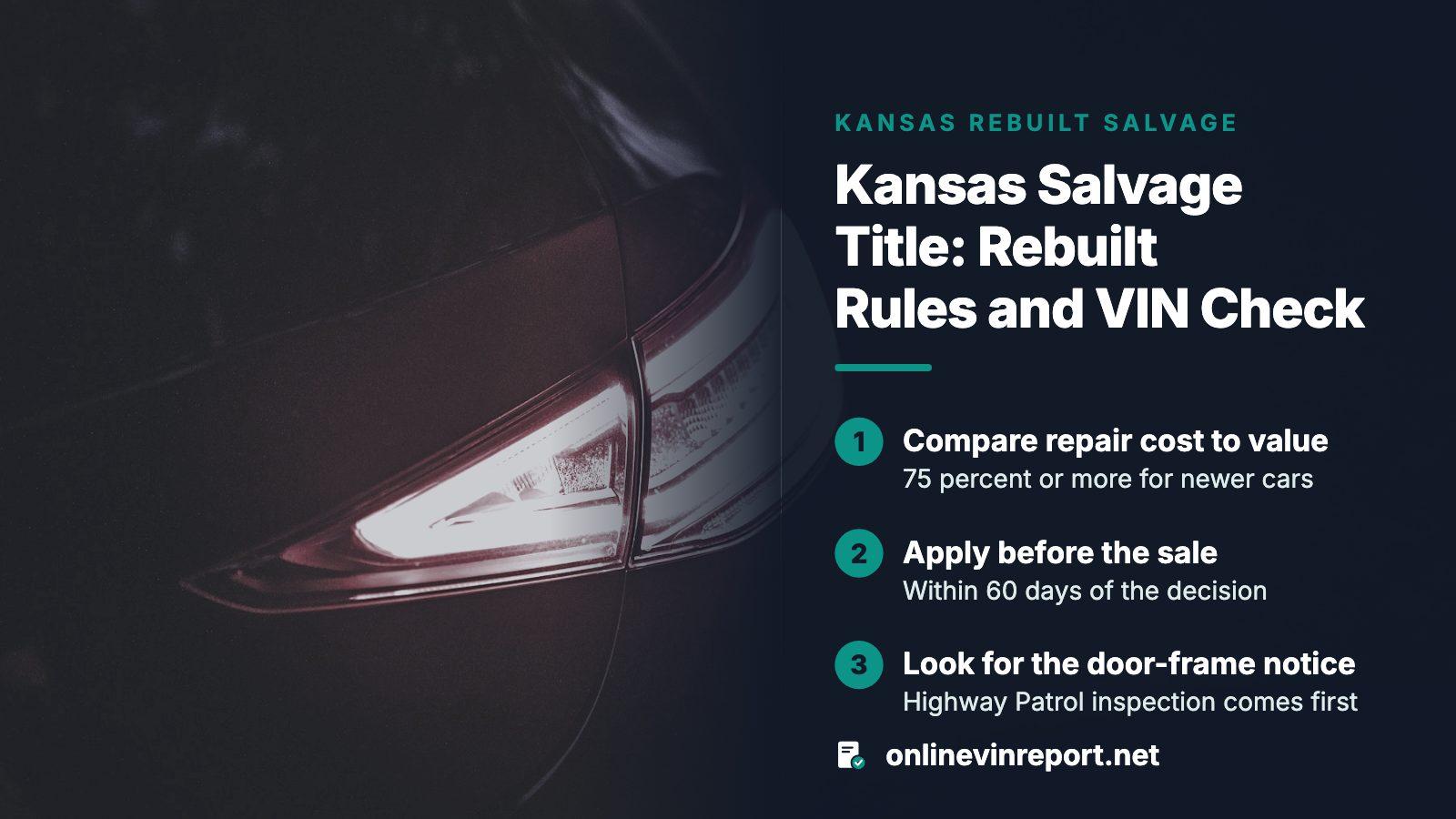
Kansas defines a salvage vehicle by repair cost against value (75 percent or more for a newer car), by an insurer write-off, or by damage that leaves an older vehicle unfit to register. After repair, the title becomes rebuilt salvage, but only once the Kansas Highway Patrol has inspected the car and attached a notice. Run the VIN to see whether a brand exists before you trust the seller.
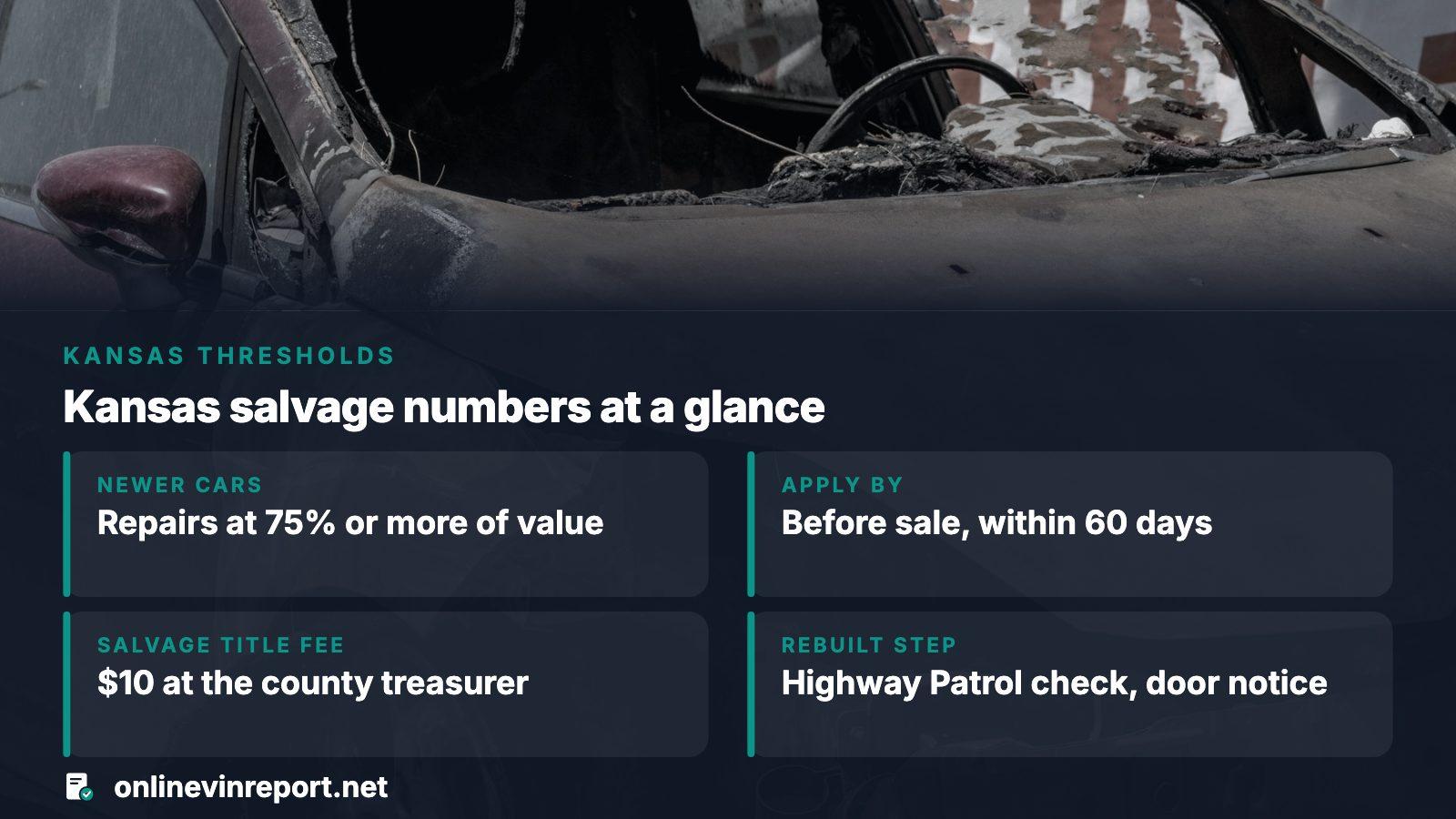
- Newer-car threshold
- Repairs at 75% or more of pre-damage value
- Deadline to apply
- Before sale, and within 60 days of the determination
- Salvage title application
- $10 at the county treasurer, $2 more if late
- Rebuilt step
- Highway Patrol check plus a door-frame notice
How Kansas decides a car is salvage
Kansas statute K.S.A. 8-197 offers three routes into the salvage category. A newer car qualifies once the estimate to fix it hits three quarters of its pre-wreck value (the statute says 75% or more). Dents from hail or wind that stay on the surface are carved out of that test. Then there is the insurer route: if the carrier writes the car off and takes ownership, it is salvage at any percentage.
Older cars follow a different rule. They land in the category when a wreck leaves legally required equipment absent or faulty, or the car unsafe or unable to run, and a big repair is needed before a county will register it. Which rule applies turns on model year: newer means the year of the damage or up to six years earlier.
| Situation | Salvage? |
|---|---|
| Newer car, repair estimate at 75% of value or above | Yes |
| Newer car, only surface hail or wind dents | Not on that ground |
| Carrier writes it off and takes ownership | Yes |
| Older car that cannot be registered without major repair | Yes |
What counts toward the repair figure
The estimate is retail parts plus labor at a normal local rate, and collision manuals or estimating software may supply the numbers. Tires, stereo equipment and parts sales tax stay out of the sum. Value comes from a recognized valuation guide or from comparable listings.
Those inputs leave room for judgment near the line, since two shops can price the same wreck differently. When a seller insists a car was never totaled, skip the debate and ask whether an insurer or the state ever recorded it as salvage. A title record answers that.
Who has to apply for the salvage title, and by when
An owner whose car reaches that level files for the salvage title before selling it, with a hard stop at 60 days after the determination. The clock differs by who holds the car:
- An insurer that settles and takes the car files within 60 days of receiving the signed title, liens cleared.
- An insurer that pays but leaves the car with the owner must send a notice, and the owner then has 60 days.
- A lessee informs the lessor within 30 days, and the lessor files within 60 days of that notice.
- A buyer of a salvage-level car that never got the brand files before reselling, and within 60 days of taking ownership.
Not filing is a class C nonperson misdemeanor. A buyer files with the treasurer of the home county, for $10 plus a $2 late charge. The document itself has to state plainly that the vehicle is salvage.
Selling a salvage car: the paperwork a buyer should receive
A seller who passes on a salvage vehicle without an assigned salvage title commits a class C misdemeanor under K.S.A. 8-199. Insurers face a similar bar on reselling until the brand is issued in their own name. Because that title can move only while the car remains salvage, a seller who has repaired the car still owes the buyer the salvage document, not a plain one.
A red flag at the table
A seller who offers a regular title for a wrecked-and-repaired car, or promises the paper later, is handing you a reason to pause. A plain title would bury what happened.
From salvage to rebuilt salvage
Repairing a car does not by itself change the title. The seller hands over the salvage title, the buyer applies for rebuilt salvage, and the state holds back until the Kansas Highway Patrol finishes its inspection. Patrol staff ask where the parts came from, may require a sworn statement, and must be satisfied nothing on the car is stolen.
During the inspection the Patrol fixes a label to the driver-side door frame (the statute says left) showing the VIN and rebuilt salvage status. Billing is $20 per hour or part of one, minimum $20, and the label adds $5. A repeat visit inside 60 days to swap salvage for rebuilt costs nothing. Skipping the rebuilt application is another class C nonperson misdemeanor.
Driving a repaired car before the rebuilt title
Salvage cars are exempt from registration, but the general ban on driving a car that needs registration stays in force. The bridge is a trip permit from the county treasurer: an insured owner may take the most direct route to a named destination, such as the inspection, and return. It rides in the car, displays toward the rear, and costs $1.
For a buyer, a car cruising around with no plate and a story about an inspection coming up is not a finished rebuild.
What a VIN title check shows on a Kansas car
A national title check does not rely on the seller's account. The federal NMVTIS report lists the latest title state and date, brands from any state, odometer, total loss and salvage history. Insurers, recyclers and yards must report into it. A clean result is a good sign, though the report is deliberately brief.
At OnlineVINReport you type the VIN and see a free preview, and the report behind it is one purchase with no recurring plan. On a Kansas car, read the title brands, any salvage or auction entry with photos, odometer readings and insurer loss records first. The pricing page lists current options. Compare dates with the seller's story, and look for a Kansas salvage entry that a later out-of-state title seems to have erased.
- Take the VIN off the vehicle in person; a listing can be wrong.
- Open the preview, and buy the report only for cars you still want.
- Read the brand entries, then the damage and auction history.
- Line up mileage entries by date and watch for any that drop.

Before you pay for a rebuilt car
A rebuilt Kansas title says the car passed a state check for stolen parts and a genuine VIN. It says nothing about repair quality. Request the repair invoices and photos taken before the work, and hire a neutral mechanic to inspect the frame, airbags and wiring.
Call your insurer and lender too, since both may treat a rebuilt car differently. If the VIN report and the paperwork disagree anywhere, settle it first or walk away.
Where this information comes from
- Kansas Revisor of Statutes: K.S.A. 8-197 — salvage and late model definitions, repair cost counting
- Kansas Revisor of Statutes: K.S.A. 8-198 — who applies, deadlines, fees, rebuilt notice, trip permit
- Kansas Revisor of Statutes: K.S.A. 8-199 — what a seller must hand over and the penalty
- Kansas Revisor of Statutes: K.S.A. 8-116a — Highway Patrol check and its charge
- Justice Dept (BJA): Understanding an NMVTIS report — what the federal title record contains
Sources and photos: Facts checked against the sources above in November 2026. Photos by Maurice Sahl, Alejandro Escamilla and engin akyurt on Unsplash; diagrams by OnlineVINReport.
Keep reading
- Rebuilt title check by VIN: is the car clean or rebuilt?What to verify on any car sold as rebuilt.
- What is a rebuilt title? What it means and what a VIN title check showsThe rebuilt brand explained apart from Kansas.
- Total loss threshold by state and what it means for a VIN title checkHow other states set the point where a car becomes salvage.
- Salvage title VIN check: run it online before you payFinding a salvage brand by VIN in any state.
Frequently asked questions
What makes a car a salvage vehicle in Kansas?
A newer car is salvage once the repair bill would reach 75 percent of the car's value before the damage, and an insurer write-off that takes the title counts too. An older car qualifies when damage leaves it unfit to register without substantial repair. Purely cosmetic hail or wind damage does not count.
How long does an owner have to apply for a Kansas salvage title?
Before the car is sold, and never more than 60 days after it is determined to be salvage. Insurers that take the car get 60 days from the moment the title is signed over. A late filing adds a $2 fee, and failing to file can be a class C nonperson misdemeanor.
What is a rebuilt salvage title in Kansas?
It is the title issued for a vehicle that once held a salvage title and has since been repaired. The state issues it only after the Highway Patrol check, and the Patrol puts a notice on the left door frame stating the car is rebuilt salvage.
Can I drive a Kansas salvage car home after buying it?
Salvage cars are exempt from registration, but the ban on driving a car that needs registration still applies. A county treasurer can issue a $1 trip permit for the most direct route to a named place, and it requires liability insurance. Confirm the details with the treasurer.
Will a VIN check show a Kansas salvage brand?
If the brand reached the national title record, yes. A report built from those records lists brand history from any state, along with total loss and salvage entries. It cannot grade the repair work, so pair it with an independent inspection.
Now check the car itself
The guide explains what to look for. The report shows what this VIN has on record.