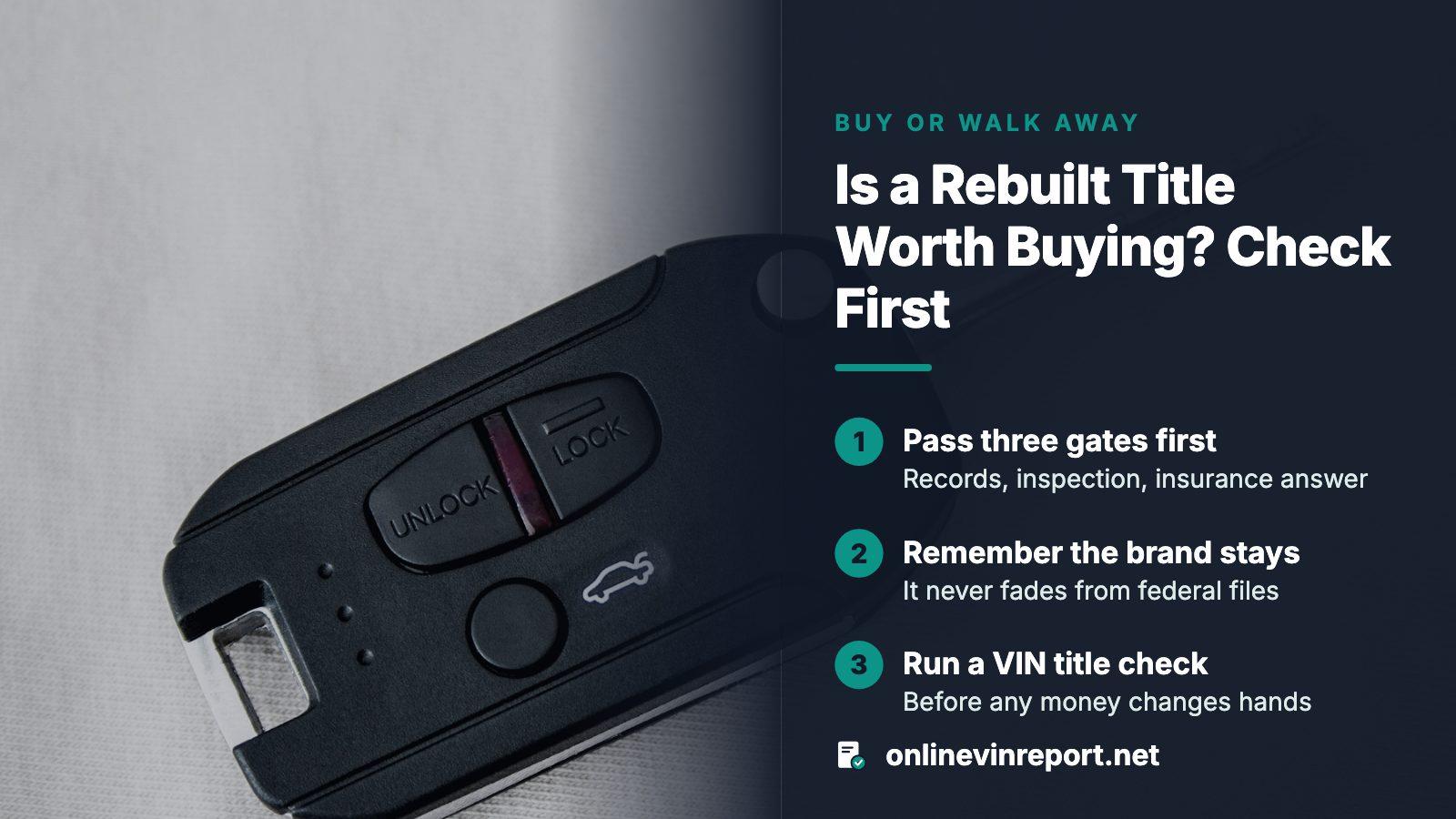
THE SHORT ANSWER
It can be, for a buyer who wants a cheap car, has the repair records, pays for an independent inspection and gets an insurance answer before handing over money. It is a poor bet when the seller has no paperwork, the frame was hit, or the price is close to a clean car. Run a VIN title check first to confirm the brand and its dates.
- What rebuilt means
- A salvage-branded car repaired and cleared for the road
- Does the brand fade
- No, it stays in the federal title record
- Biggest unknowns
- Repair quality, insurance, resale
- First step
- A VIN title check
When the discount actually pays off
Texas's motor vehicle agency says rebuilt cars are always valued well below clean look-alikes, since each once carried a salvage brand. That gap is the whole reason anyone considers one. The question is whether the gap is bigger than the risk you take on.
It tends to work for a person who keeps cars for years, drives modest miles, can read a repair file and is not counting on a quick resale. It tends to fail for someone stretching a budget, someone who needs a loan, or anyone who cannot afford a surprise bill. The same agency cautions that some repairs on these cars end up costing more than the vehicle's value.
What the rebuilt brand really tells you
Rebuilt is the later stage of a two-step story. First a state branded the car salvage after serious damage. Later the car was repaired, cleared the state's inspections for safety and theft, and got a fresh title. Terms differ across states; reconstructed and revived salvage are two labels for the same stage.
Passing that inspection says the car met a state standard on one day. It does not tell you how the frame was straightened, which parts went in, or whether airbag components were replaced properly. Those answers live in receipts, photos and a mechanic's eyes, not on the title.
Three gates to pass before you pay
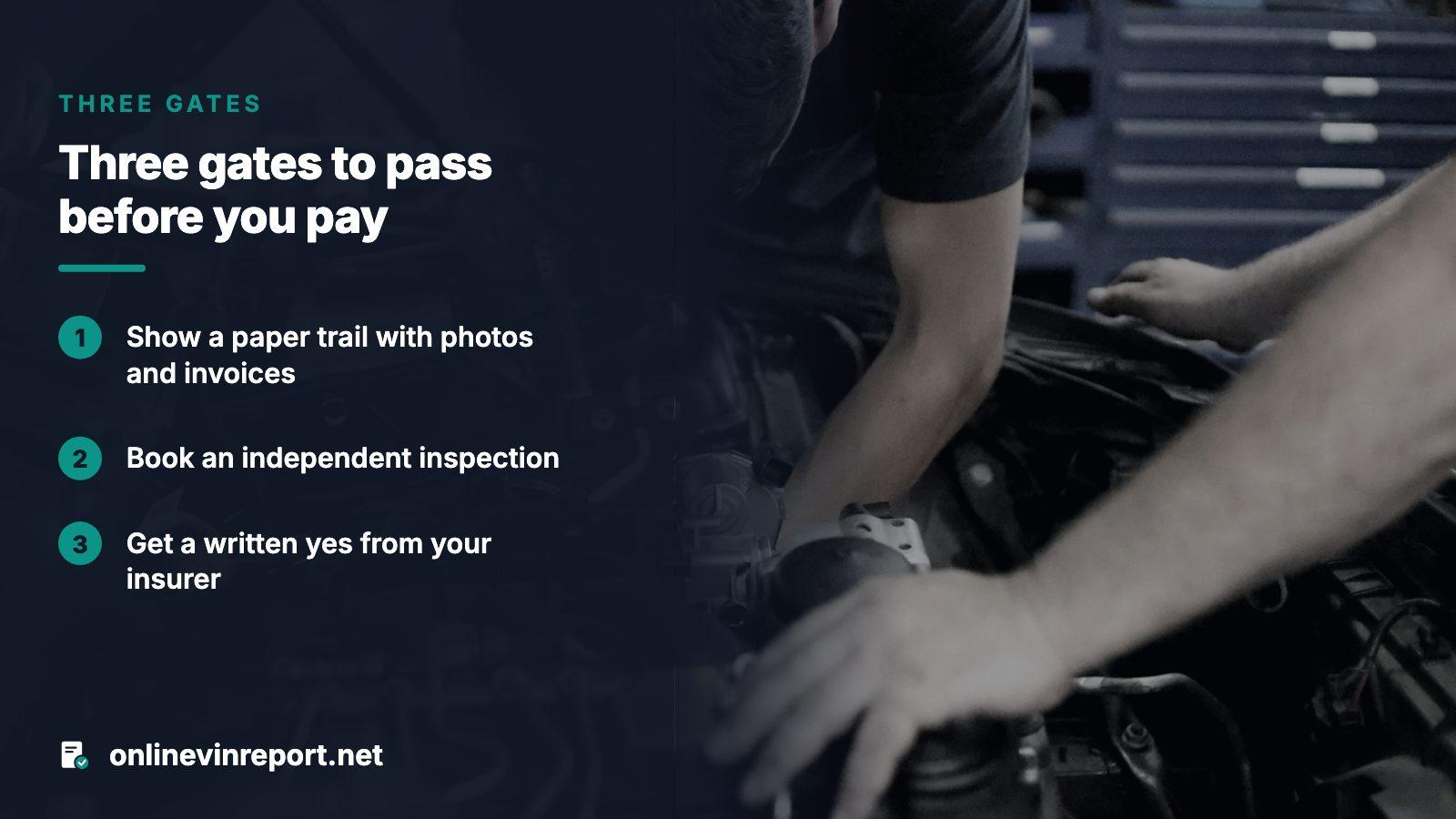
Think of the purchase as three gates. A car that fails any one is not a bargain at any price.
- Paper trail: before and after photos, repair invoices, and receipts showing where replacement parts came from.
- Independent inspection: a qualified mechanic you choose, who looks at frame alignment, welds, suspension wear and the restraint system, and gives you a written estimate.
- Insurance: a quote or a written yes from your own agent for this exact VIN, before any money moves.
Texas frames the same worries as questions for sellers: how bad was the hit, who did the repairs, was the frame aligned, can anyone insure it. Insurers often decline these cars, it says.
What a VIN title check adds to the decision
Washington's national title database stores every brand any state has applied. A brand, once entered, stays on that vehicle's record. The search also returns the newest mileage on file, whether an insurer ever declared the car a write-off, and if it was sold on to a scrapper or auction yard. That is the backbone of a fair negotiation.
| What you learn | Why it matters for price |
|---|---|
| Whether the car was branded salvage, and when | Confirms the seller's story and the age of the repair |
| Insurer total-loss entries | Shows the damage was bad enough that a company wrote the car off |
| Salvage-yard transfers | Points to where the car sat before it was rebuilt |
| Odometer history | Catches a reading that does not fit the timeline |
OnlineVINReport gives a free preview on the VIN, so you can see whether title and salvage records exist before you pay for the full record.
The recall problem owners report
One cost shows up repeatedly in owner complaints to NHTSA: a manufacturer or dealer declining recall work on a rebuilt car. These are owner accounts, not findings, but they are first-hand.
From an NHTSA owner complaint
The owner of a 2012 Kia Optima with the 2.4 liter GDI engine wrote in 2025 that a Kia dealer refused a recall repair solely because the car had a rebuilt title, and that Kia's consumer affairs line repeated the refusal for branded cars. The owner argues the engine flaw is a design problem unrelated to the car's past, and asked NHTSA to look into the practice.
For a buyer, the lesson is practical. Before you buy, look up open recalls for the VIN, then ask the maker's dealer in writing whether it will perform recall work on a car with this brand. Do not assume the answer.
A second owner, a different denial
From an NHTSA owner complaint
An owner of a 2012 Hyundai Sonata said the engine seized, and that after finding a recall by entering the VIN, the car was towed to a dealer where the claim was denied. The owner says the reason shifted from the rebuilt title to an earlier inspection to the branded title, and says a recall is a recall.
NHTSA's record for that campaign shows the engine problem was real: Hyundai offered free inspection and engine replacement where needed, plus a stretched short-block warranty covering both first and later owners. Whether a rebuilt title changed what this particular owner received is the owner's claim alone. Treat it as a reason to ask before buying, not as a rule.
Signs you should walk away
California's DMV says a few revived salvage cars were poorly repaired or never properly tested, and a few contain stolen parts. It also names physical clues to hidden damage.
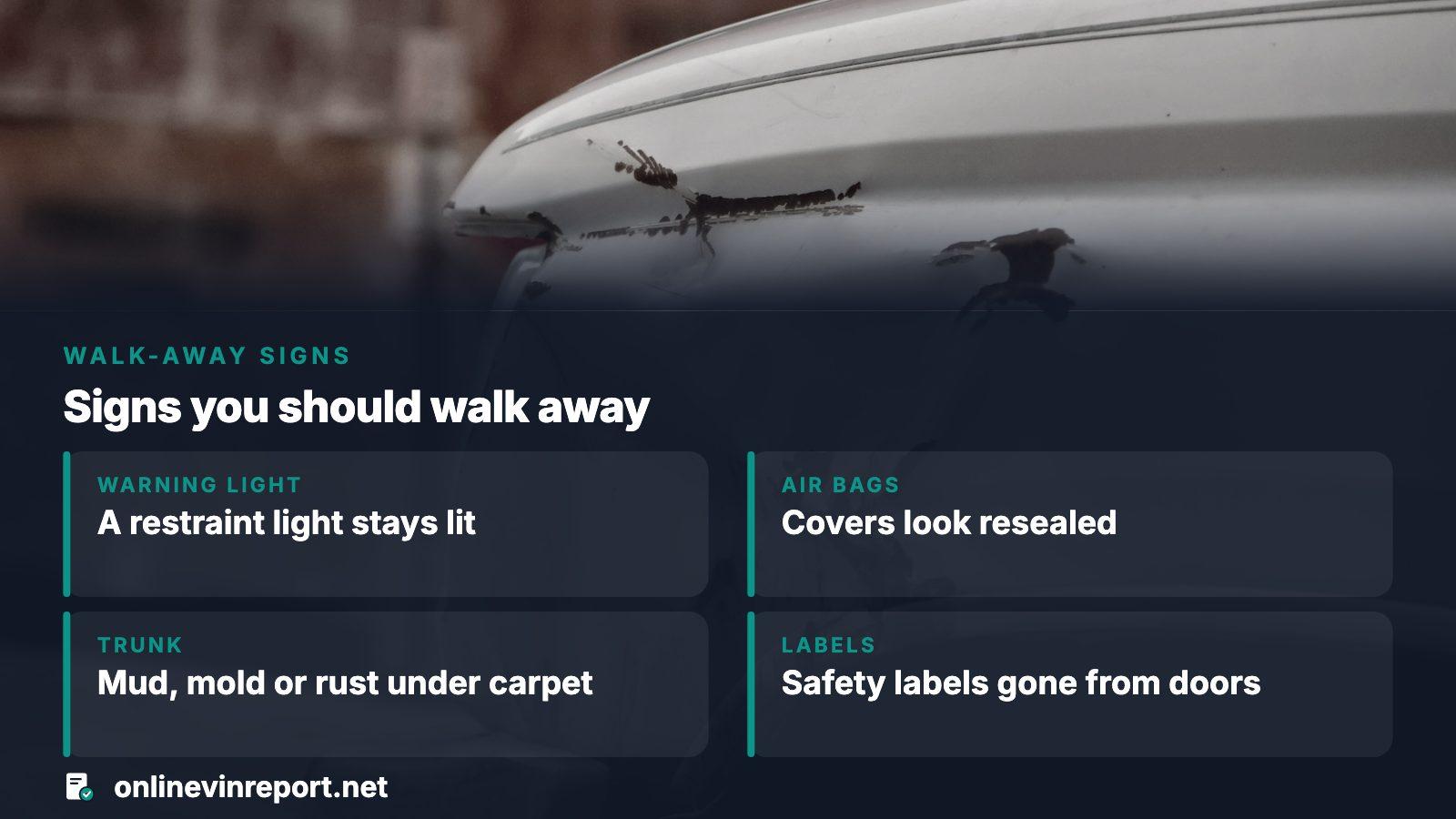
- A safety restraint light that stays lit
- Airbag covers that look resealed or fit badly
- Mud, mold or rust beneath the trunk carpet
- A VIN plate fixed on without rivets
- Safety labels gone from the doors, hood or hatch
- Visible repair marks inside the fender structure
Add your own: a seller who cannot produce receipts, a price barely under a clean example, or a refusal to allow an outside inspection. Any one of those is enough reason to leave.
What to do before you commit
Start with the VIN. A title check can also expose a brand the paper title leaves off, which matters because a brand can vanish if the next state to issue a title skips the originating state's records. Sellers must disclose salvage history in California, though the DMV there admits enforcement is difficult for cars from elsewhere.
If the brand and dates match the story, buy the inspection, get the insurance answer in writing and price the car off the estimate. If the numbers still work, the car may be worth it. If not, you have lost an hour rather than a car payment.
Where this information comes from
- TxDMV: Rebuilt vehicles — State agency view of rebuilt cars, value, insurance and the questions a buyer should ask.
- Justice Department NMVTIS: for consumers — What a federal title search shows and why brands persist in the record.
- California DMV: Branded titles — Risks of revived salvage cars, disclosure duty and physical warning signs.
- NHTSA recall 15V568000 — Official record of the Hyundai Sonata engine recall and its remedy.
- NHTSA owner complaint 11658894 — owner experience, paraphrased
- NHTSA owner complaint 11052232 — owner experience, paraphrased
Sources and photos: Facts checked against the sources above in November 2026. Photos by Shadow Photography, Mustafa Sheikhmouss and Everett Pachmann on Unsplash; diagrams by OnlineVINReport.
Keep reading
- What is a rebuilt title? What it means and what a VIN title check showsHow the brand arises and what it does to value, insurance and loans.
- Rebuilt title inspection: what the state checks and what a VIN title check addsWhat the state and your own mechanic look at on a rebuilt car.
- Can you finance a rebuilt title car? What lenders look atWhether a lender will fund the car and what that does to the total cost.
- Rebuilt title check by VIN: is the car clean or rebuilt?How to run the VIN search and read each brand it returns.
Frequently asked questions
Is a rebuilt title a bad sign?
It is a warning, not a verdict. The car was once damaged enough to be branded salvage, then repaired and cleared. Many are sound, but the title cannot prove how well the work was done, so the inspection and records matter more than the label.
Will I be able to insure a rebuilt car?
Not always. Texas's agency notes insurers often decline rebuilt cars, and terms differ by company. Ask your agent for a quote or written confirmation for the exact VIN before you pay the seller.
Can a dealer refuse recall repairs on a rebuilt car?
Some owners tell NHTSA that it happened to them. Those are owner reports, not rulings. Check open recalls for the VIN and ask the brand's dealer before buying whether it will do the work.
How much cheaper should a rebuilt car be?
Texas says only that such a car is worth far less than a clean equivalent and publishes no percentage. Base your offer on the mechanic's written estimate and the repair records, not on a rule of thumb.
Does the rebuilt brand ever go away?
Not in the national title record, where a brand is permanent. A paper title from another state can still leave it off. That is why a VIN check is worth running.
Now check the car itself
The guide explains what to look for. The report shows what this VIN has on record.