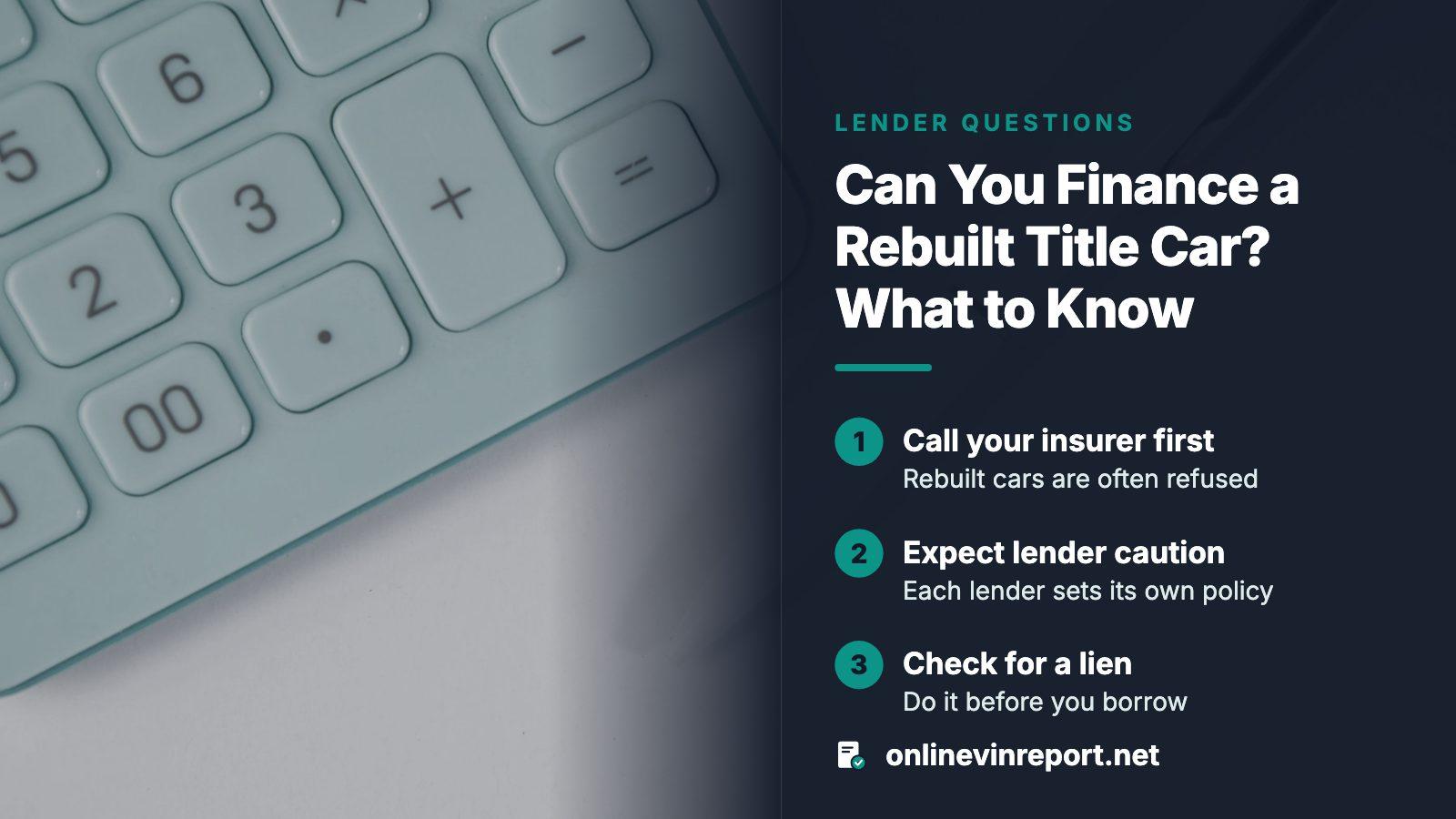
THE SHORT ANSWER
You can sometimes finance a rebuilt title car, but approval is the lender's call. No official source we read sets a rule for or against it. Expect questions about the car's value, its repair record and whether it can be insured. Run a VIN title check first so you know the brand history before you apply.
- Who decides
- Each lender, under its own policy
- Insurance
- Rebuilt cars are often denied cover, per TxDMV
- Value
- Always substantially below a clean-title car
- Brand
- Stays in the national title record once applied
Why a rebuilt brand makes lenders cautious
A car loan is secured by the car. If the borrower stops paying, the lender repossesses the vehicle and sells it, so the lender cares what that vehicle would fetch. A rebuilt brand muddies that number. Texas states the point bluntly on its own rebuilt-vehicle page: these cars are always worth substantially less than the clean version because they were once salvage.
Nothing we found from a government source tells lenders to refuse a rebuilt car or to accept one. That gap is why you hear both answers. One bank declines at the first mention of the brand, while a credit union down the road may look at the paperwork and quote a rate. Treat any flat claim that rebuilt cars cannot be financed as a generalization, and ask lenders directly.
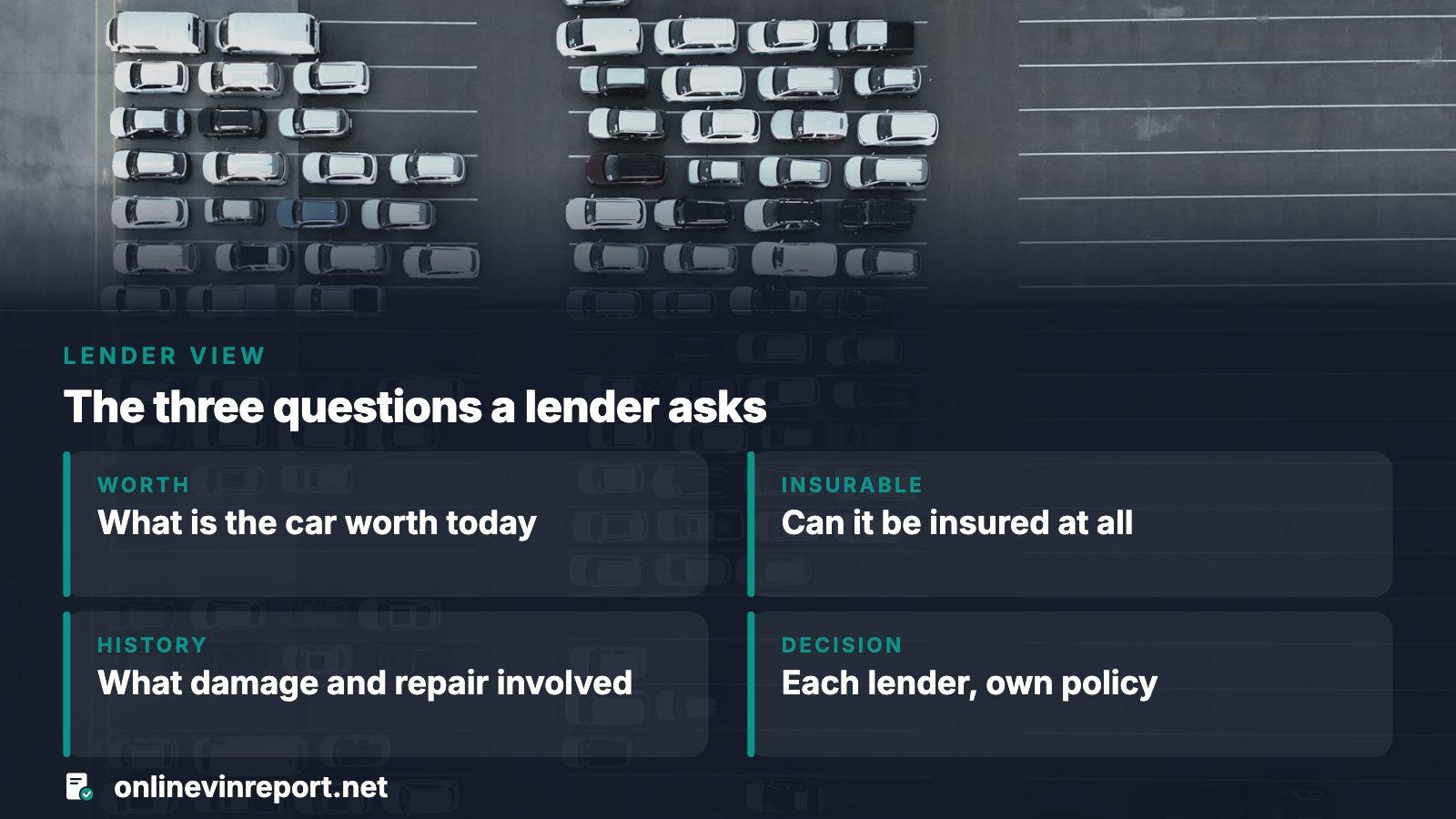
The three questions a lender is really asking
Lender wording differs, but the underwriting concerns usually fall into three buckets. Knowing them lets you gather answers before you apply instead of after a rejection.
- What is the car worth today? A rebuilt car has no clean comparison, so the appraised figure can come in low and cap the loan amount.
- Can it be insured? Texas warns that rebuilt vehicles are often denied insurance, and a lender will want cover on the collateral before it releases funds.
- What did the damage and the repair involve? Texas lists frame alignment, who did the work and whether an independent mechanic certified it as the points a buyer should press on.
A lender that sees good answers to all three has less reason to say no. A lender that sees blanks tends to say no and move on.
Call your insurance agent before the lender
Lending and insurance travel together. Even a willing lender will normally expect proof of coverage, so a car you cannot insure is a car you will struggle to finance. TxDMV tells buyers to check with an insurance agent before buying the vehicle, and that order is worth following: agent first, lender second, seller last.
Get it in writing
Give the agent the VIN and say plainly that the title is rebuilt. Ask whether they will write full coverage, whether they want their own inspection or photographs first, and how a total loss would be valued. A verbal yes from a seller about insurance describes the seller's policy, not yours.
Where to apply, and how to shop without hurting your credit
The federal consumer finance agency suggests lining up a preapproval from your bank or a credit union so you hold a rate to compare against dealer offers. With a rebuilt car that advice carries extra weight, because a dealer's finance desk may route your application to several lenders at once and many of them will simply decline it.
Shopping around has a credit cost, but a limited one. The CFPB says that if lender pulls land inside a window of 14 to 45 days, the scoring counts them together as a single inquiry. It also notes a dealer may send your data to roughly five lenders, so keep the process tight.
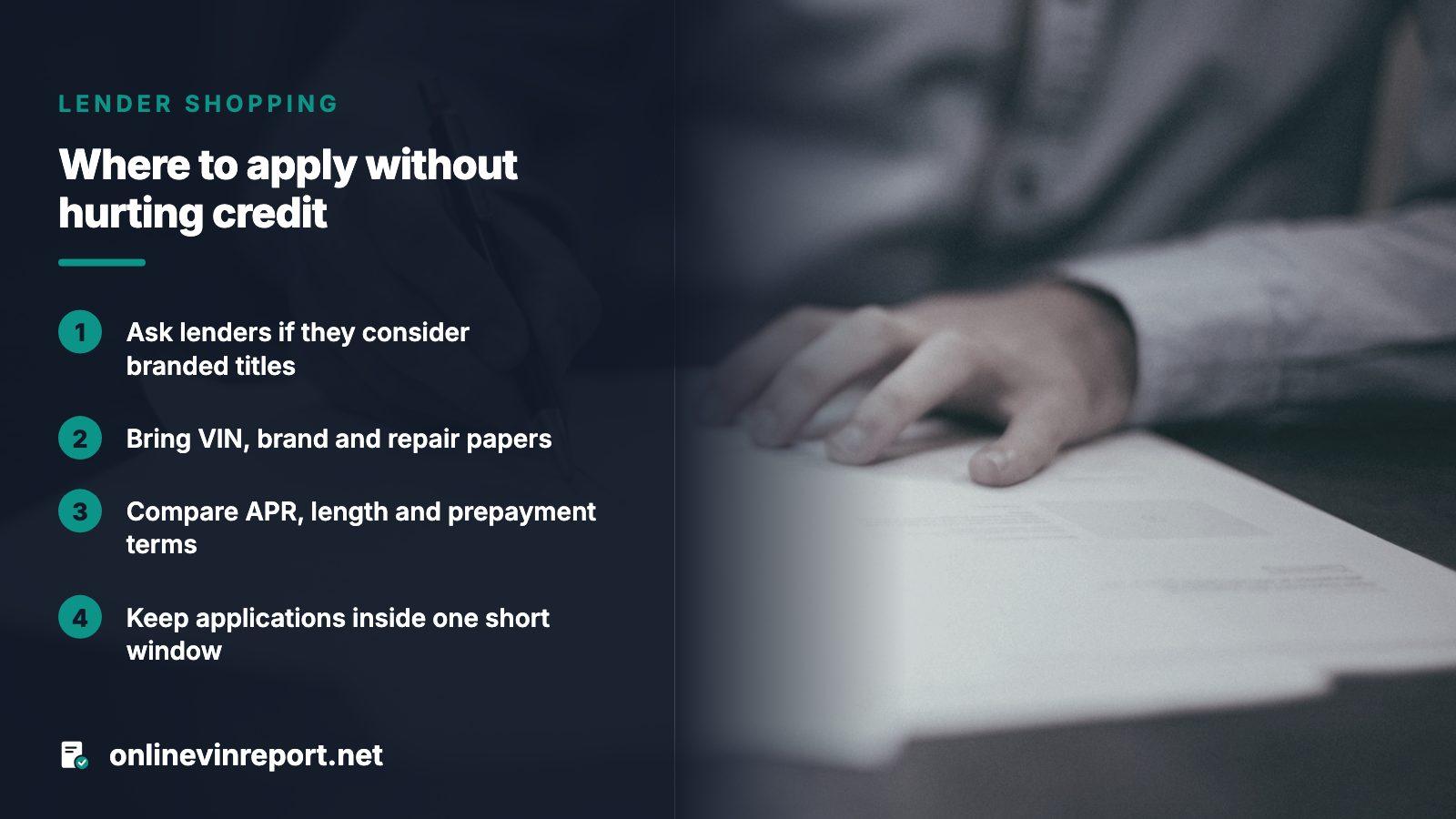
- Ask each lender before applying whether it considers branded titles at all.
- Bring the VIN, the brand name and the repair documents to the first conversation.
- Compare APR, loan length and any prepayment penalty, not only the monthly payment.
- Keep applications inside one short window.
What a VIN title check adds to your application
The brand is the first thing a lender will ask about, so confirm it before anyone else does. The national title system holds each brand that a state has ever put on a VIN, and once a brand is on a car it stays in that record. A title check on OnlineVINReport reads the brand history for the VIN you enter, and the free preview shows what turned up before you pay for the full report.
This matters for two reasons. A seller may call a car rebuilt when the record shows a different brand, or may skip the brand entirely. And a lender that finds a brand you did not mention will treat the omission as a red flag. The federal title system also warns that a search can come back clean when not every reporter feeds it, so pair the report with your state's own title record where one exists.
| Question | Where the answer comes from |
|---|---|
| What brand does the car carry? | VIN title check and the printed title |
| Is there a lien on it today? | State title or lien lookup, where offered |
| Could it be insured? | Your own insurance agent |
| Is the repair sound? | Independent mechanic, on a lift |
Check for an existing lien before you borrow
If the seller still owes money on the car, a new lender will not be first in line. Some states let you look up a title for liens by VIN. New York's lookup, for example, reports how many liens exist plus who holds them and where, and reveals nothing about the owner. Search your own state's DMV site for an equivalent.
A rebuilt car with an open lien and a seller who cannot produce the title is a stalled deal. Settle the lien question in writing before you sign, and make sure the payoff goes to the lienholder rather than to the seller.
When no lender says yes
Plenty of rebuilt cars are bought without a car loan. If you cannot get approved, the sensible choices are a bigger down payment on a cheaper vehicle, a smaller loan from a source you already deal with, or a clean-title car instead. The CFPB notes that a larger down payment and a less expensive vehicle both lower borrowing costs.
Watch the loan length as well. A long loan lowers the payment, but it keeps you owing more than the car is worth for longer, and on a car whose resale value is already limited, that is an uncomfortable place to sit. Keep in mind too that Texas cautions rebuilt vehicles can cost more to repair than they are worth.
A short checklist before you sign anything
- Run the VIN title check and compare the brand to what the seller said.
- Get written answers from an insurance agent on coverage.
- Collect the repair file and book an independent inspection.
- Ask lenders about branded titles before submitting applications.
- Compare total loan cost, and confirm no prepayment penalty.
If the title check shows a brand more severe than rebuilt, or one you were never told about, stop and renegotiate before spending time on loan paperwork.
Where this information comes from
- CFPB: preparing before you shop for a car loan — credit checks, co-signers and loan cost factors
- CFPB: negotiable terms on a car loan — preapproval, loan length and prepayment penalties
- TxDMV: Rebuilt Vehicles — buyer questions on repair, insurance and value
- NMVTIS: for consumers — how brands persist and where a search can miss
- NY DMV: Check a Title or Lien Status — what a state lien lookup returns
Sources and photos: Facts checked against the sources above in November 2026. Photos by Sasun Bughdaryan, Scott Graham and Iain on Unsplash; diagrams by OnlineVINReport.
Keep reading
- Rebuilt title check by VIN: is the car clean or rebuilt?Run the brand check on the exact VIN before you apply anywhere.
- What is a rebuilt title? What it means and what a VIN title check showsHow a car earns the brand and what the state inspection covers.
- Rebuilt title inspection: what the state checks and what a VIN title check addsWhat an independent inspection should look at on a rebuilt car.
- Do you have to disclose a rebuilt title when you sell a car?What a seller must tell you about the brand before the sale.
Frequently asked questions
Can you finance a rebuilt title car?
Sometimes. No official source we read forbids it or requires it, so the decision belongs to each lender. Some decline branded titles outright and others review the car case by case. Ask before you apply, and arrive with the title history, repair records and an insurance answer in hand.
Will a rebuilt title car get insured?
Often it is harder. TxDMV says rebuilt vehicles are often denied insurance and tells buyers to ask their agent before buying. Some carriers decline, some want their own inspection. Get the VIN to your agent early and ask for the answer in writing.
Does applying with several lenders hurt my credit?
Less than people fear. The CFPB says lender pulls that fall inside a 14 to 45 day window are scored as a single inquiry. Keep your applications inside one short window, and remember a dealer may pass your data to roughly five lenders on its own.
How do I know the car is really rebuilt and not something worse?
Check the brand history by VIN. The national title system holds each brand a state has put on a VIN, so a title check shows whether the car is rebuilt or carries another brand. Because a search can miss data, also look at your state's own title record.
What if I cannot get a loan for the car?
Look at a larger down payment, a cheaper vehicle or a clean-title alternative. The CFPB notes both a bigger down payment and a less expensive car reduce borrowing costs. Avoid stretching the term just to get a payment you can afford, since that prolongs the time you owe more than the car is worth.
Now check the car itself
The guide explains what to look for. The report shows what this VIN has on record.