THE SHORT ANSWER
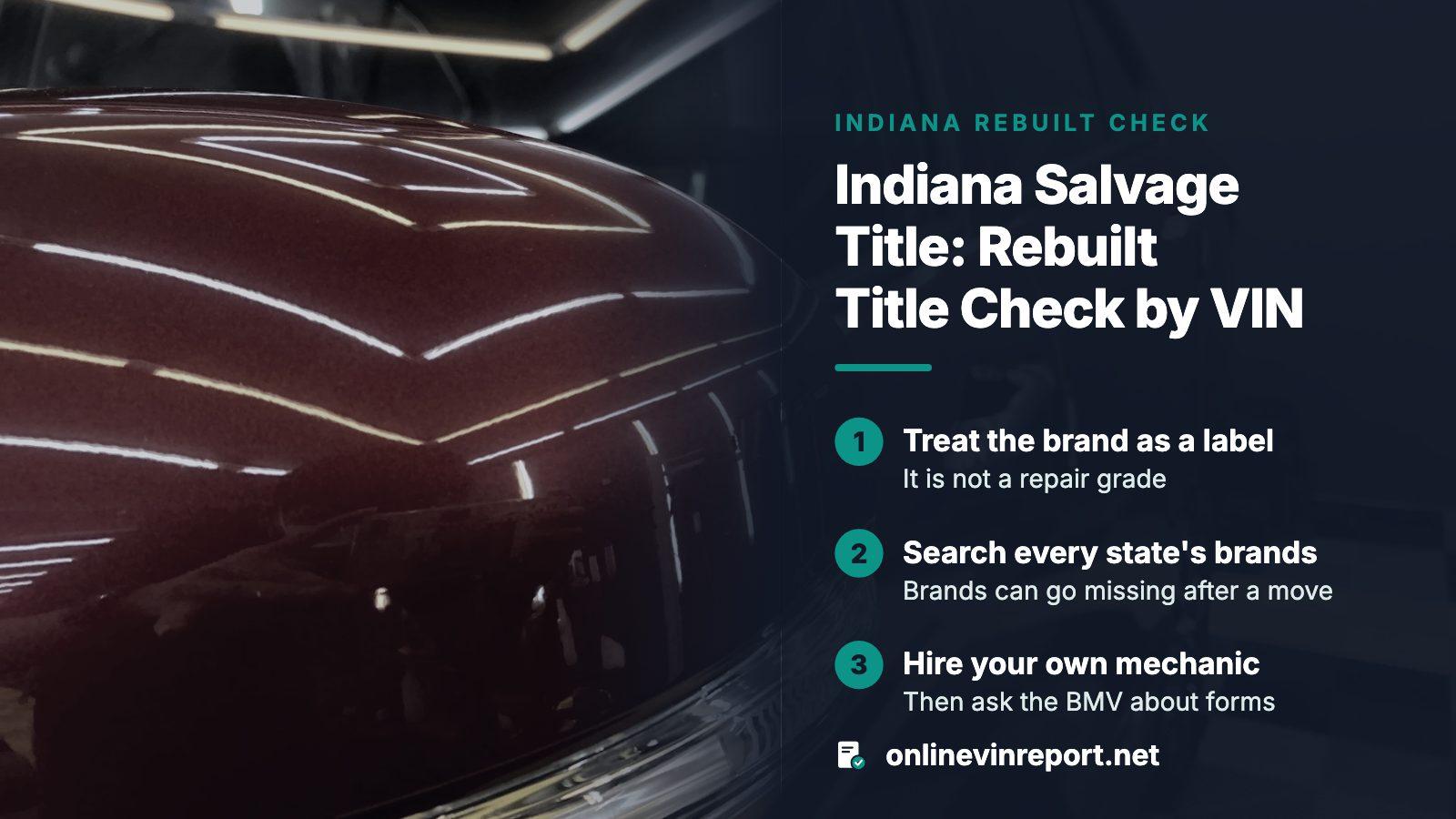
Both a salvage title and a rebuilt title in Indiana are brands that stay attached to the car's record. Run the VIN through a title check to see brands from every state, then ask for repair paperwork and hire your own mechanic. We could not open the Indiana BMV pages, so confirm fees, forms and inspection steps with the BMV directly.
- What the brand is
- A label on the title record, not a repair grade
- Where to read it
- A VIN title check shows brands from any state
- What it cannot show
- How well the repair was done
- Indiana rules
- Confirm with the Indiana BMV; we could not open its pages
A brand is a label, and the repair is a separate question
People searching for an Indiana salvage title usually hold a listing with a suspiciously low price. The brand explains the price: someone decided the car was hurt badly enough that its record needed a permanent warning. What it does not explain is the car itself.
A salvage brand can sit on a hail-dented sedan with a sound frame or on a flood victim with green corrosion behind the dash. The title carries the same word for both. That is why a rebuilt title in Indiana is better read as the start of an inspection than as a verdict.
Salvage and rebuilt as two chapters of one car
Think of the two words as a sequence. A car is first branded salvage. If someone repairs it and the state accepts it back onto the road, the record moves to a rebuilt status. The earlier entry does not disappear, so a title check on a rebuilt car still surfaces the salvage chapter.
| What you see | What it usually tells you |
|---|---|
| Salvage brand | A loss was recorded and the car has not been cleared for ordinary use |
| Rebuilt brand | The car was repaired and re-titled; the damage history is still on file |
| No brand shown | Nothing was reported for this VIN, which is not proof of no damage |
The Indiana BMV pages that spell out how a car moves from one stage to the next refused our connection, so this page does not quote Indiana forms, fees or deadlines. Open the BMV's title pages yourself and compare them to what the seller tells you.
What an online VIN title check shows for an Indiana car
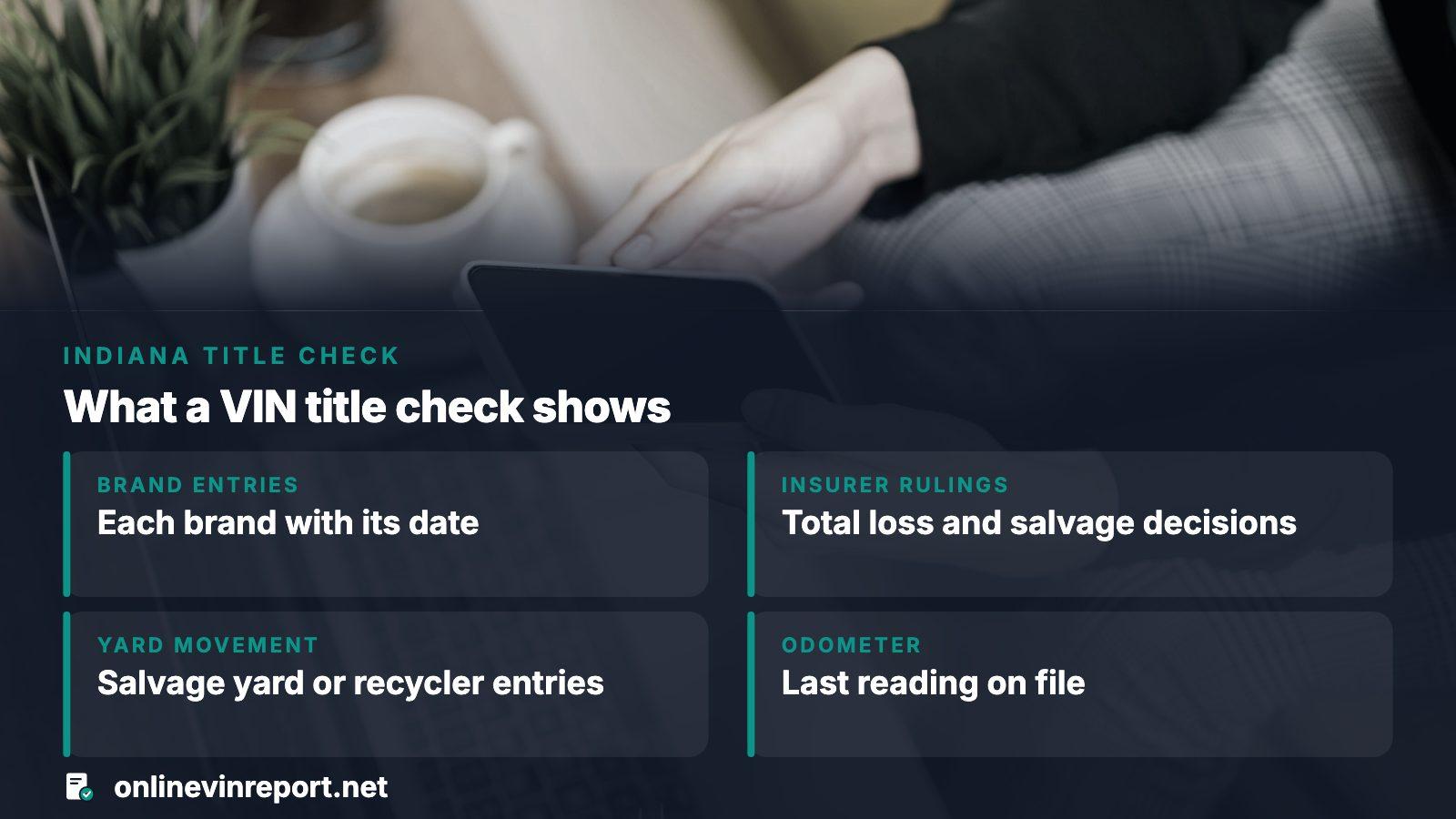
The federal title database behind consumer reports returns brand history, the newest odometer reading, any insurer ruling that a car is salvage or a total loss, and reports that the car went to a recycler or salvage yard. In some cases it adds historic theft data.
Each brand is kept with the date it was applied, which lets you line up the loss against the title date and the mileage. An Indiana title speaks only for Indiana, so a car that lived in another state first can show that state's brand here too.
- Brand entries and the date each one was applied
- Total loss and salvage rulings from insurers
- Movement into a salvage yard or recycler
- The last odometer reading on file
When a brand goes missing after a move
Once a state applies a brand, it is meant to stay in the national record. The weak point is a later title issued by a state that never checks where the car came from. The Justice Department page behind these reports points to Experian data from early 2008: over 185,000 cars were titled again in a second state and came out with a clean title, after a first state had branded them.
That is old data, and the page uses it as an illustration rather than a current rate. The takeaway for a buyer is practical: when a car has changed states, ask the seller where each title was issued, and treat a clean result on a well-traveled car with a little extra suspicion.
Where a title check runs out
Federal figures put roughly 87 percent of American vehicles in the national system, while just over half of states send it records. So a report can come back empty because the data is thin, not because the car is spotless.
Two limits worth remembering
Sitting in a wrecking yard does not guarantee a car ever got the brand. And a total loss label can attach to something undamaged: stolen cars that stay missing past 30 days can get it, and keep it after recovery.
The definition of salvage also differs from state to state, and repair history is not part of the data at all. That gap is the reason the next section exists.
Inspection and paperwork before you pay
The FTC treats a mechanic's inspection and a history report as two separate jobs. Pick an independent mechanic yourself rather than one the seller recommends, and get the inspection results written down along with cost estimates. If a dealer refuses an outside inspection, the FTC suggests trying another dealer.
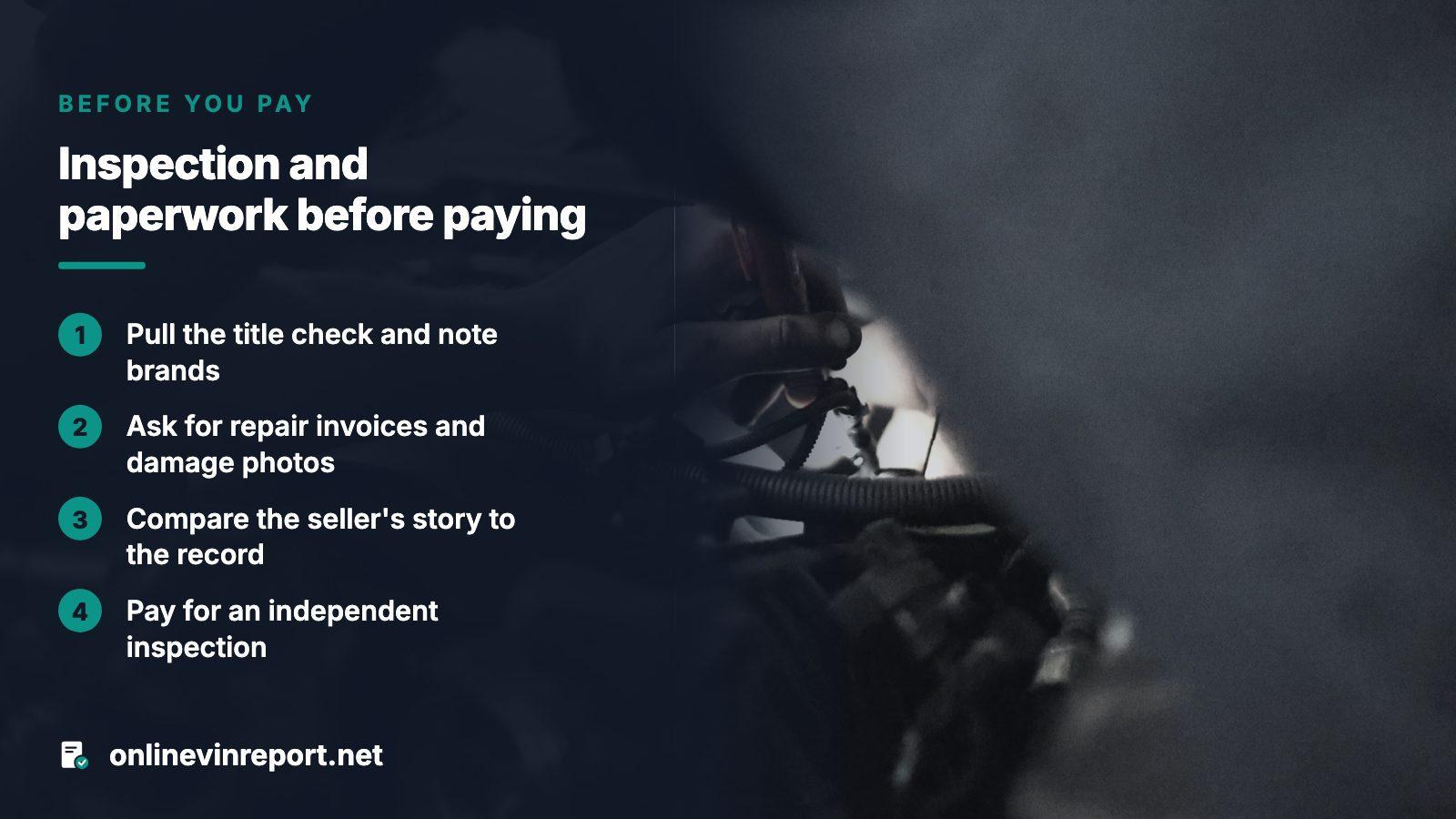
- Pull the VIN title check and note every brand and date.
- Ask the seller for the repair invoices and photos of the damage.
- Compare the seller's story to the record you pulled.
- Pay for an independent inspection with a written estimate.
- Check the current Indiana BMV rules for registering a branded car.
At a dealer, the Buyers Guide on the window says if you get a warranty or buy the car as is. Buying as is leaves later repair bills with you, so write down any promise the salesperson makes.
Matching the seller's story to the record
Listings use loose words. A salvage title in Indiana, an out-of-state rebuild and a car repaired after a fender-bender are three different histories with three different sets of papers. Ask which state issued the brand and who did the work.
If the record shows a brand nobody mentioned, or shows none when the seller volunteers a rebuild story, one of the two is wrong. Settle that before you negotiate price, because the price you are discussing may rest on the wrong history.
Running the check on this site
Before checking an Indiana car, put its VIN into the box for a no-cost preview of the records on file. The complete report is paid for once, and the pricing page lists the choices. Its contents: title brands, total loss records, odometer readings, plus salvage and auction entries that carry photos when available.
Use it as the first filter, then take what it shows to the Indiana BMV and to your mechanic. A brand you already know about before the test drive is cheaper to deal with than one you find at registration.
Where this information comes from
- Justice Dept (BJA): NMVTIS information for consumers — what a title search returns, brand washing, coverage limits
- Justice Dept (BJA): NMVTIS frequently asked questions — report contents, data freshness, salvage definitions differ by state
- FTC: Buying a used car from a dealer — independent inspection, Buyers Guide, as-is sales
Sources and photos: Facts checked against the sources above in November 2026. Photos by Clarence Tioh, Mustafa Sheikhmouss and Jakub Żerdzicki on Unsplash; diagrams by OnlineVINReport.
Keep reading
- Salvage title VIN check: run it online before you payHow to find a salvage brand by VIN in any state.
- Rebuilt title check by VIN: is the car clean or rebuilt?What to verify on a car sold as rebuilt.
- What is a rebuilt title? What it means and what a VIN title check showsThe rebuilt brand explained apart from any one state.
- Title washing: how a brand vanishes and what a VIN title check can showWhy a brand sometimes vanishes after a move to another state.
Frequently asked questions
What does a salvage title mean in Indiana?
It is a brand on the title record showing the car was recorded as too damaged for ordinary use. The exact legal test and the steps to put such a car back on the road are on the Indiana BMV site, which we could not open, so confirm them there before you buy.
Can I get a rebuilt title in Indiana for a salvage car?
A rebuilt status exists as the stage after salvage once a car is repaired and re-titled. We could not read the BMV's current forms, fees or inspection steps, so ask the BMV what it requires before you spend money on repairs or on a branded car.
Will a VIN check show an Indiana salvage brand?
It shows brands reported into the national title system, with dates, along with insurer total loss rulings and salvage yard entries. Coverage is not complete, so an empty result is not a guarantee. Pair it with an inspection and the seller's repair records.
Is a car with a rebuilt title in Indiana a bad buy?
Not automatically, and not safely either. The brand tells you damage happened, not how well it was fixed. Judge the car on the repair paperwork, an independent inspection and a price that reflects the history.
Does the brand disappear if the car moves to another state?
It is meant to stay in the national record once a state applies it. A brand can still drop off if the next state issuing a title skips the check of earlier titles, which is why a title check across all states matters.
Now check the car itself
The guide explains what to look for. The report shows what this VIN has on record.