THE SHORT ANSWER
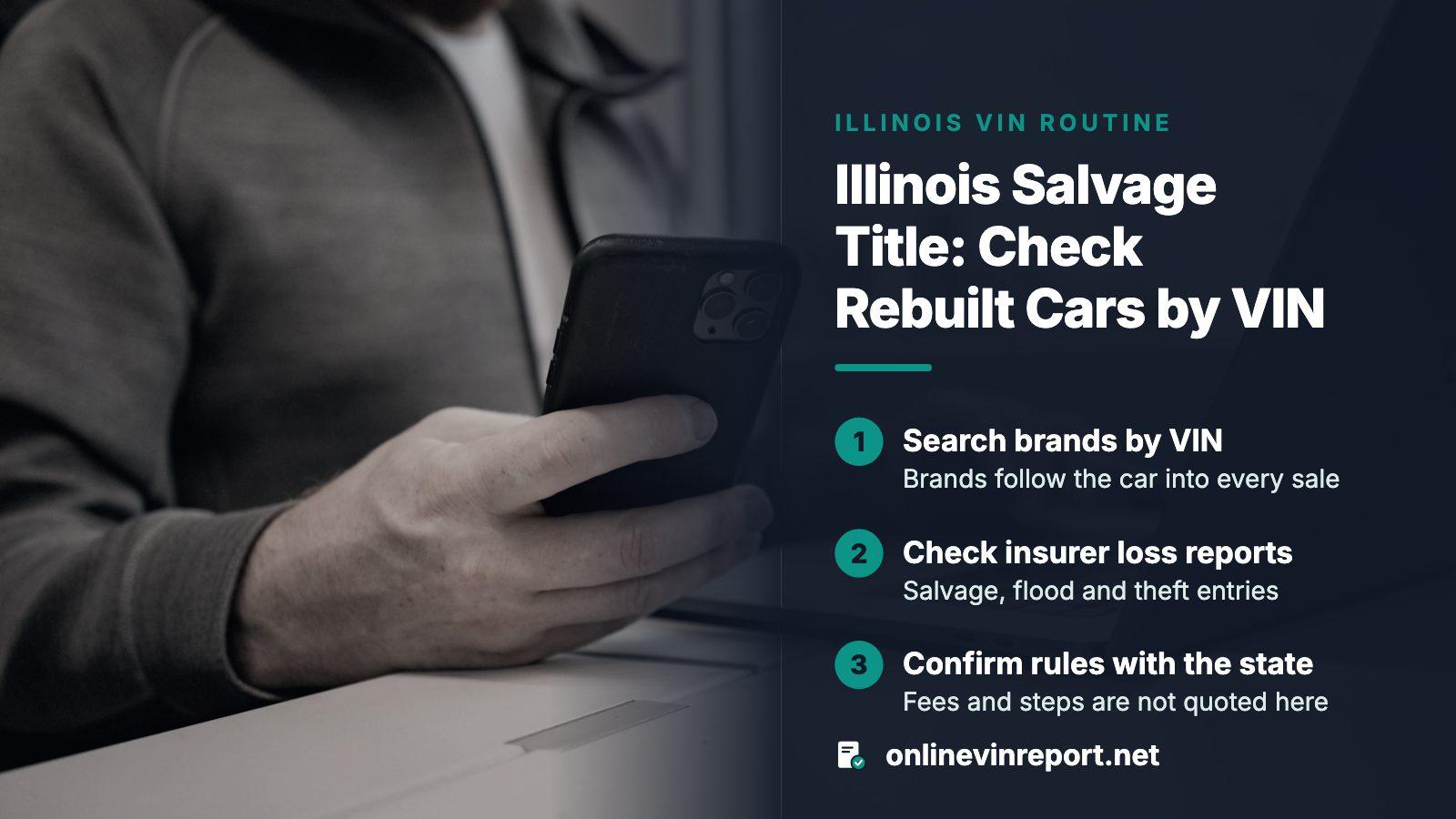
A salvage or rebuilt title is a brand a state attaches to a vehicle's record, and it follows the VIN into every later sale. Check the VIN for brands, total loss and salvage entries, then read the Illinois Secretary of State's current rules for retitling and inspection. We could not open the Secretary of State's pages ourselves, so we do not quote its fees or steps here.
- What the brand is
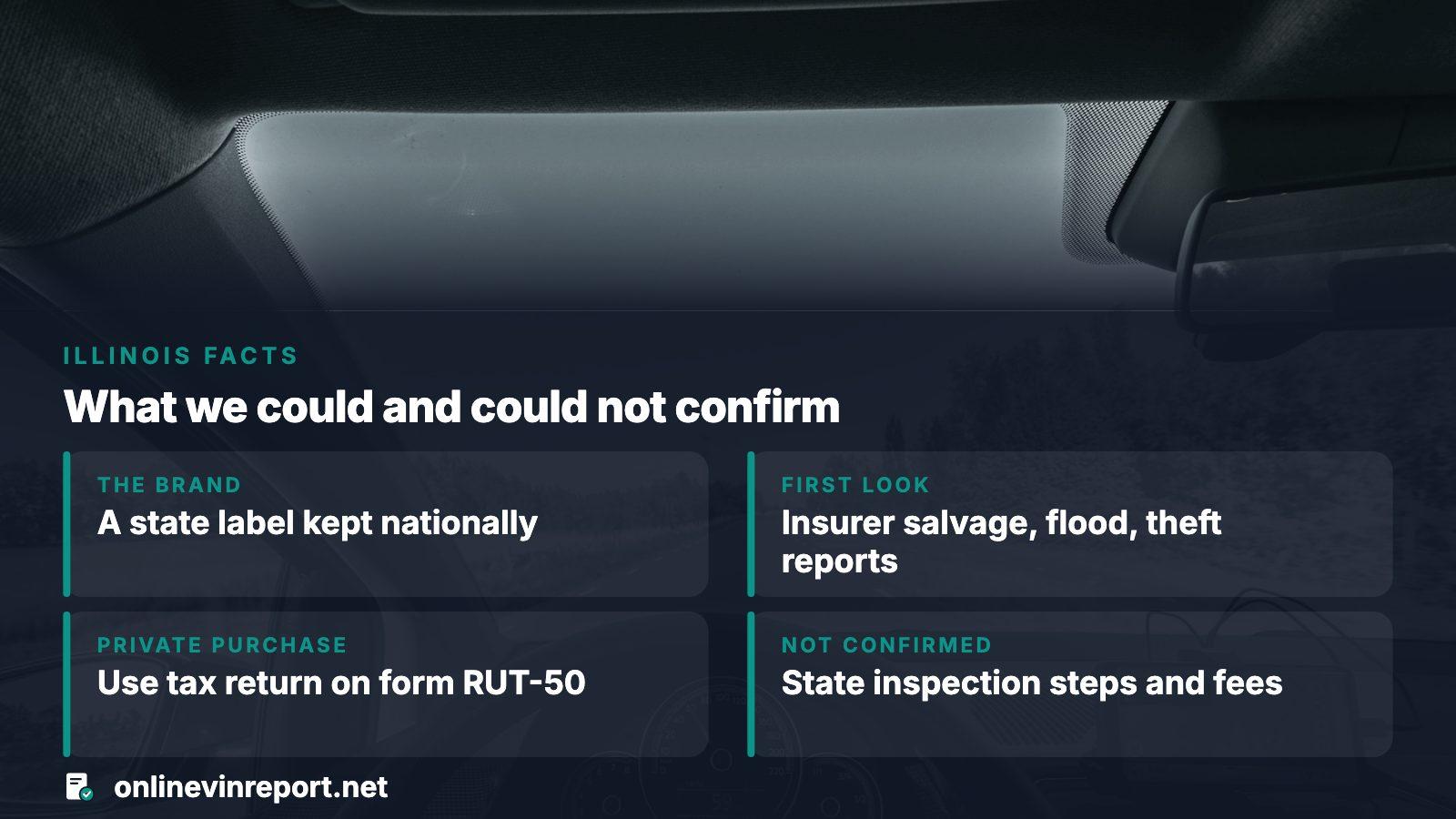
- A label set by a state titling agency, kept in national title data
- Free first look
- NICB VINCheck covers insurer salvage, flood and theft reports
- Private purchase
- Illinois expects a use tax return on form RUT-50
- Not confirmed here
- Secretary of State inspection steps, licensing and fees
Salvage versus rebuilt: two points in one story
Search results use the phrases salvage title Illinois and rebuilt title Illinois as if they were one thing. They describe different stages. Salvage is the car after the loss decision, usually before anyone has repaired it. Rebuilt is the same car after repair and the state's sign-off, still branded, now allowed to go back toward registration.
Federal rules supply the core idea. A car counts as salvage when the repair bill needed for lawful road use, added to what the wreck would fetch as scrap, comes out above its pre-damage market worth. Cars an insurer or state writes off as a total loss land here as well. Junk is harsher: the car is beyond driving on public streets and is worth only what its parts or metal bring, and both tests must be met.
| Term | Plain meaning | Where it comes from |
|---|---|---|
| Salvage | Repair plus scrap value beats pre-damage worth, or a total loss was declared | Federal definition, 28 CFR 25.52 |
| Junk | Beyond driving, worth only its parts or metal | Same federal definition |
| Rebuilt | A salvage car the state later cleared for retitling | State procedure, confirm with Illinois |
| Flood | A brand some state has applied after water damage | State titling agency, kept in national data |
What we could and could not confirm about Illinois
We tried to read the Illinois Secretary of State's pages on salvage vehicles and the state statute behind them. Both refused our requests, in plain fetches and in a browser. So this page does not say who may repair a branded car, how many inspections exist, what they cost or how long they take. Guessing at a state's rules is a fast way to own a car you cannot register.
Ask the Secretary of State these before you pay
Who is allowed to apply for the rebuilt title on this car, and does the seller or a licensed party do it? Which inspections apply to this model year? What paperwork proves where replacement parts came from? Can the car be driven to an inspection, and under what permit? Ask for the answers in writing where possible.
The answers decide whether a cheap salvage car is a bargain or a stalled project.
Run the VIN before you drive out there
A seller's word about a car's past is a claim. The national title system is a record. It exists so that a brand applied in one state shows up when the car lands in another, and every state must run a verification before it issues a new title to a vehicle arriving from elsewhere. The check covers title validity, junk or salvage history, odometer consistency and lien status.
Reporting reaches beyond titles. State titling agencies, junk yards, salvage yards, recyclers and insurers all owe federal reports. A car that sat in another state's salvage pool can surface even when the Illinois paper looks tidy. Copy the VIN from the car yourself, since a seller's photo proves little.
- Current state of title and the date it last changed
- Brand history from any state that has applied one
- Odometer reading, to compare against what the seller says
- Total loss history
- Salvage history
The free first look and where it stops
The National Insurance Crime Bureau offers VINCheck, a free lookup that asks whether member insurers flagged a VIN as an unrecovered theft, a salvage vehicle or a flood loss. It needs a correct 17-digit VIN, and you get five lookups per IP address in any single day. Participating insurers cover 92.49% of earned premium nationwide, by NICB's count.
NICB is candid about the limits. Results come only from insurance records, and only from companies that participate; police records are not searched. A clean answer proves nothing, and NICB says outright that this lookup is not a complete history. A salvage hit tells you a participating insurer totaled the car and settled the claim; such a car can still be rebuilt and retitled under state rules.
A title-focused report fills part of that gap. Our preview costs nothing and hints at any record tied to the VIN. Unlocking the rest is one purchase, no subscription, and the pricing page lays out single reports and packs.
What a clean title check does and does not mean
The federal title system treats a clean result as good news, and its reports are brief on purpose. If nothing appears under brand, total loss or salvage, no reporting source has flagged the car. That is not proof of a crash-free life, because unreported damage leaves no trace, and the record says nothing about brakes, tires or an oil leak.
The reverse holds too. A brand does not tell you the severity of the damage or the quality of the fix. A hail-dented sedan and a car that sat in floodwater can carry the same label. Add an independent inspection by a mechanic you chose, and ask for repair invoices, before-and-after photos and receipts for major parts.
A mismatch is the finding
If the seller calls the title clean and the VIN shows a brand from another state, stop and ask for an explanation in writing. The title system exists to catch exactly that gap, and the receiving state's own law decides how the car is branded on arrival.
If you buy from a private seller in Illinois
Buying privately adds a tax step. The Illinois Department of Revenue uses form RUT-50 to collect the use tax on private-party vehicle sales. It asks for purchase price, odometer reading and VIN, plus both parties' names and addresses. Paper filers mail it with their registration application to the Secretary of State in Springfield. Anyone filing online through MyTax Illinois prints the finished return and hands a copy to the Secretary of State.
For a price or fair market value below $15,000, the amount depends on the vehicle's age: take the model year away from the year of the title application. The age table starts at $465 for a car one year old or less and falls to $100 at eleven years or more. From $15,000 up, price brackets apply instead. Family transfers pay $15, and late filing or payment brings penalties.
A branded car sold cheaply may still be taxed on fair market value, so read the form's own guidance and ask the Department of Revenue how it treats a price far under book. The form says nothing about the salvage brand itself.
A sensible order of operations
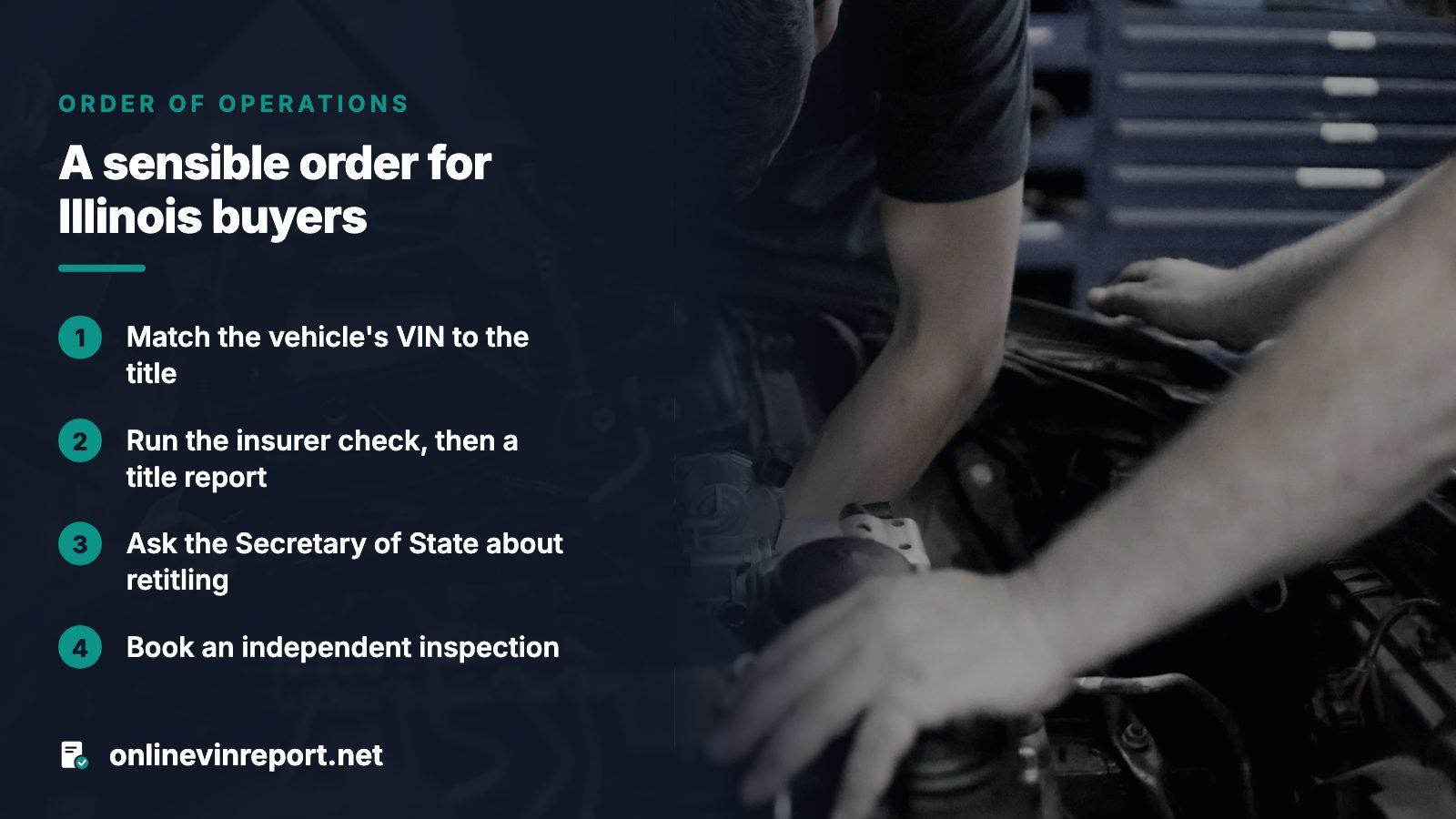
- Read the VIN off the vehicle and match it against the title paperwork.
- Run the free insurer check, then a title report for brand and total loss entries.
- Call or write the Illinois Secretary of State about retitling and inspection for this specific car.
- Book an independent inspection and collect the repair records.
- Work out purchase price, tax and repair cost together before you agree to anything.
Begin with the VIN preview on this site, which hints at any brand or salvage entry before you spend anything.
Where this information comes from
- NMVTIS: Understanding a vehicle history report — Supports the five indicators, brand meaning and who reports.
- NMVTIS: Information for states — Supports the state title verification before issuing a title.
- eCFR: 28 CFR 25.52 definitions — Source for the federal salvage and junk definitions.
- NICB VINCheck — Supports what the free insurer check covers and its limits.
- Illinois Department of Revenue: RUT-50 instructions — Supports the private party use tax steps and tables.
Sources and photos: Facts checked against the sources above in November 2026. Photos by Anastasiia Nelen, Mustafa Sheikhmouss and Sander Jeurissen on Unsplash; diagrams by OnlineVINReport.
Keep reading
- Salvage title VIN check: run it online before you payHow a VIN search surfaces a salvage brand in the first place.
- What is a rebuilt title? What it means and what a VIN title check showsWhat changes for value and insurance once a car is rebuilt.
- Rebuilt title inspection: what the state checks and what a VIN title check addsWhat an inspection after repair is and is not meant to show.
- Title washing: how a brand vanishes and what a VIN title check can showWhy brands sometimes go missing when a car changes states.
Frequently asked questions
What is a salvage title in Illinois?
It is a brand on a vehicle's title record showing the car was treated as a loss, usually after serious damage. Federal rules describe salvage as damage where repair cost plus scrap value tops the pre-damage worth. The Illinois procedures themselves are set by the Secretary of State, so confirm them there.
Is a rebuilt title in Illinois the same as a clean title?
No. Rebuilt means the car was salvage and later went back through the state's process, but the brand stays in the record and shows in national title data. A buyer should treat it as a car with history and ask for repair records and an independent inspection.
Can I find out if a VIN has a salvage brand for free?
Partly. NICB's VINCheck is free and shows insurer-reported salvage, flood and theft records from participating companies, capped at five searches per IP address each 24 hours. Police records are not searched, so a clean result is not proof. A title report adds brand history from state records.
Do I owe tax when I buy a salvage car from a private seller?
Illinois expects form RUT-50 for private party vehicle purchases. Below $15,000 the tax follows vehicle age; at $15,000 or more it follows price brackets. Some family transfers pay $15. Read the current instructions on the Department of Revenue site before filing.
Why can't this page tell me the Illinois inspection steps?
The Secretary of State's pages refused our automated and browser requests, so we left out anything we could not read. Rather than guess at fees, forms or licensing, we list questions to put to the Vehicle Services Department directly. Their answer for your car and model year is the one that counts.
Now check the car itself
The guide explains what to look for. The report shows what this VIN has on record.