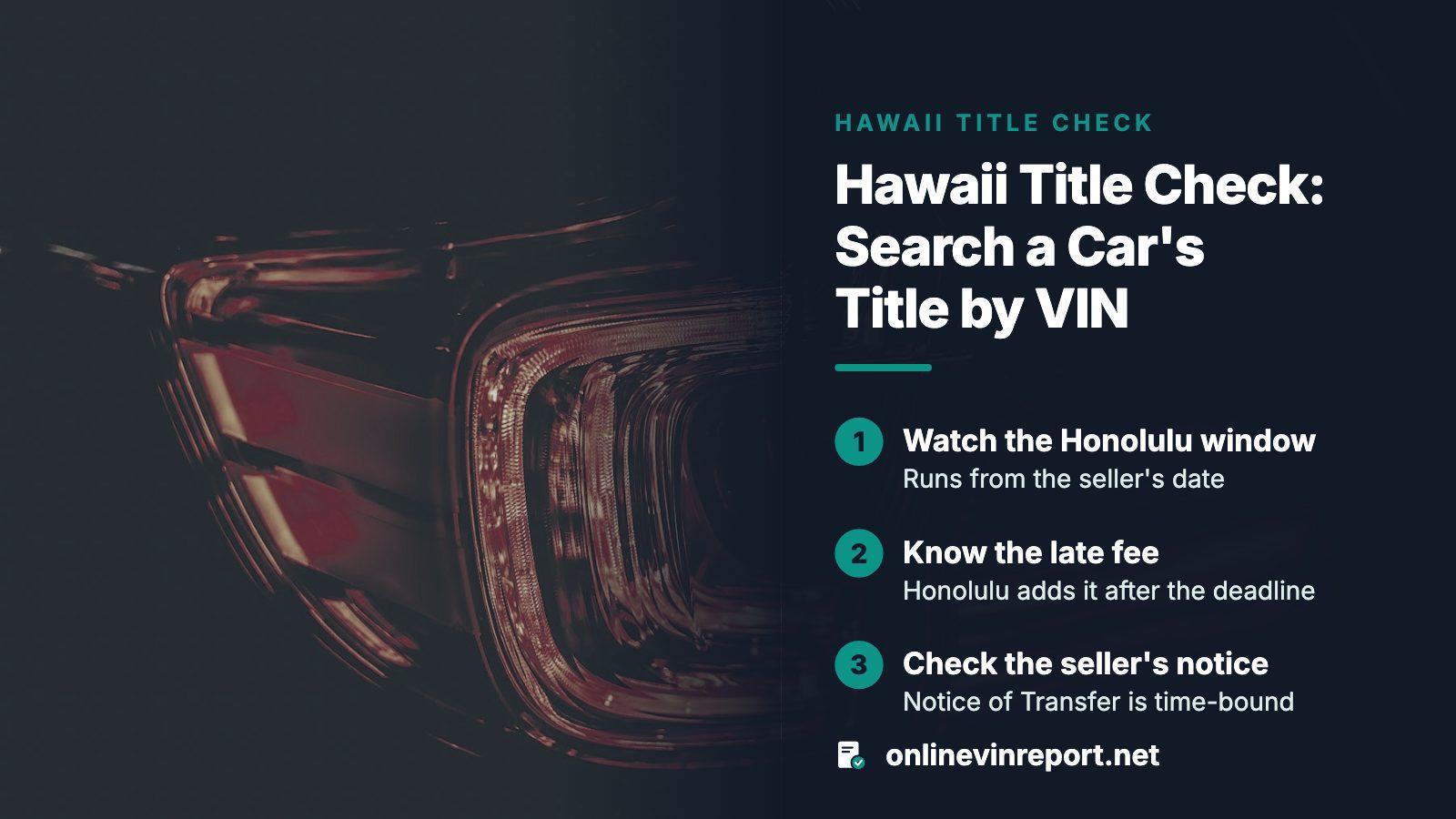
THE SHORT ANSWER
To check a Hawaii car's title, copy its VIN, run an online title check for brand history, total-loss and salvage entries, odometer readings and the latest title state, then lay the result beside the paper title and the county's transfer rules. A clean result is a good sign but says nothing about repairs, so finish with the lender's release and an independent inspection.
- Honolulu transfer window
- 30 days from the seller's date
- Honolulu title fee
- $10, plus $50 if late
- Seller's Notice of Transfer
- Within 10 days
- Preview
- Free, no card needed
What a Hawaii title check covers, and where each piece lives
No single office shows everything about a Hawaii car's title. The counties register vehicles and record title transfers, the state runs the annual safety check, and a federal database (NMVTIS) pools reports from state titling agencies, salvage yards, recyclers and insurers. Each answers a different question.
| Where you look | What it answers | What it misses |
|---|---|---|
| Paper title and county transfer desk | Owner, lender's release, odometer line, endorsements | Anything that happened in another state |
| Honolulu's online inquiry | Fee estimate for an Oahu-registered car, from the plate and last four VIN digits | Brands, liens, damage |
| Online title check by VIN | Brand history, total-loss and salvage entries, odometer readings, latest title state and date | Repairs; any yard or state that has not reported |
| NICB VINCheck | Flood damage, theft never recovered, salvage declarations | Anything beyond those flags |
| Independent inspection | Hidden damage, true condition | Paperwork, brands |
Why an island car's title story can start on another coast
Registration here is a county job, and a car that arrives by ship brings a title written elsewhere. For an out-of-state title, Honolulu asks for that state's endorsed title and a bill of lading, or a shipping receipt, that proves when the car reached Oahu, unless the car holds a Honolulu out-of-state permit. The receipt fixes an arrival date, nothing more.
Brand history is where the earlier life shows. A brand a state applies stays in the federal record for good, while a car retitled somewhere that never consults earlier records can end up looking clean on paper. An online title check reads the federal record, so it can catch what the paper hides.
Records divide by island too. Honolulu has its own path for a car on Oahu that was previously registered in Kauai, Maui or Hawaii County, so ask the seller which county handled it.
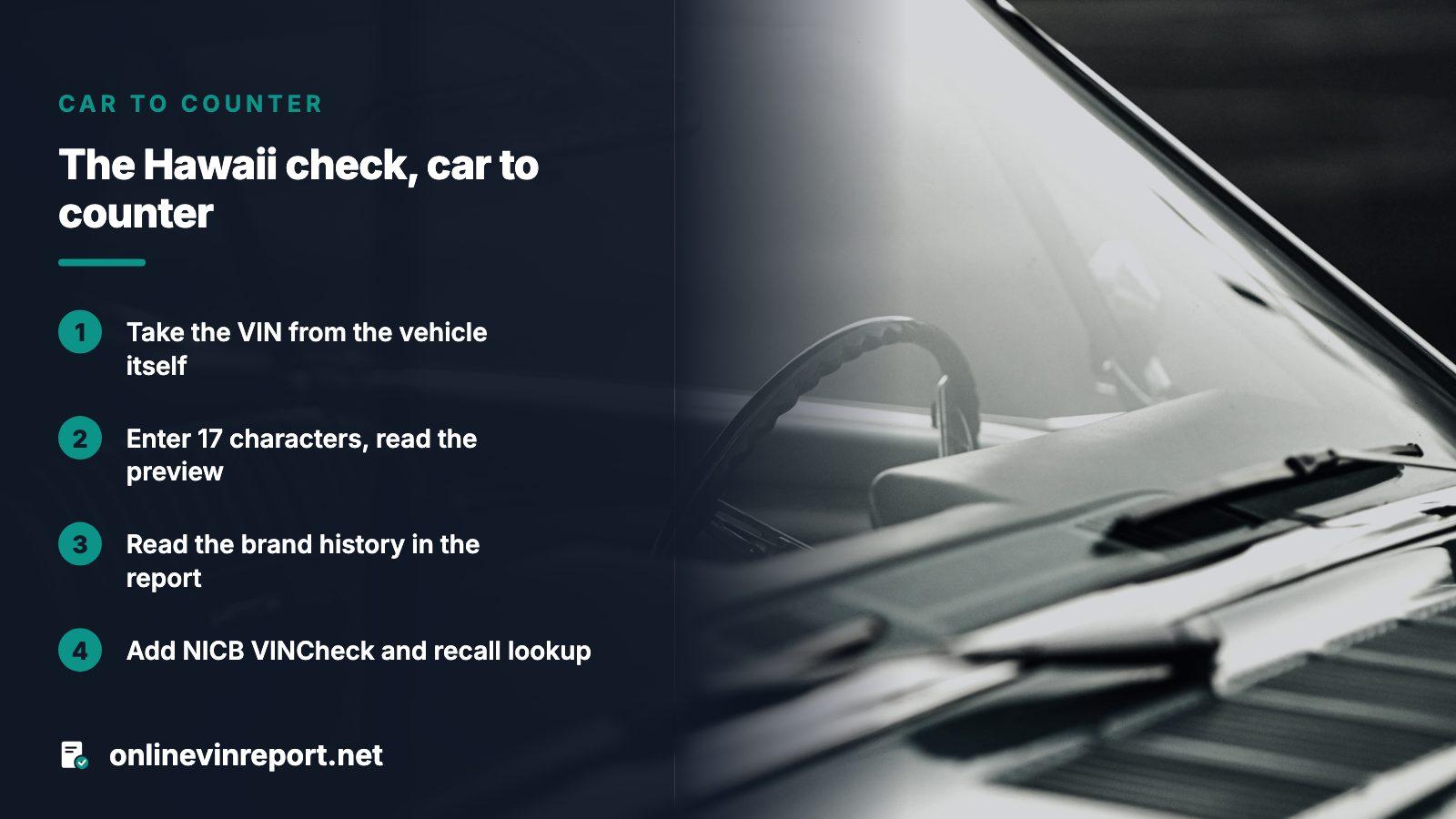
The check in six steps, from the car to the county counter
- Take the number off the vehicle itself and hold it up against the paper title. Any mismatch stops the deal until explained.
- Enter all 17 characters in the form on this page and read the preview before paying.
- Still keen on it? Get the report and read the brand history first, then the total-loss and salvage lines.
- Ask which county last registered the car and ask to see its current safety certificate; Honolulu wants one from the buyer at transfer.
- Hold the paper title beside the screen. Names, VIN, issuing state, lender's release and odometer line must agree.
- Add NICB's VINCheck and the federal recall lookup, then hire a mechanic. Settle open questions before money moves.
Reading brand lines on a car that was shipped in
Each state sets its own brand words and damage thresholds, so one wreck can be branded salvage in one state and carry no brand in the next. The federal record keeps every brand reported, which makes the online result a better guide to an out-of-state past than the paper title.
| What the report shows | How to read it | Your next move |
|---|---|---|
| Salvage, junk or flood brand from another state | The state's label stays on record whatever the paper title says | Price the car as branded; ask for repair papers |
| A total-loss entry but no brand | The insurer wrote it off, yet a state may never have branded it; an unrecovered theft can also cause the entry | Ask for the story; book an inspection |
| A reconstructed or rebuilt history | Honolulu says reconstructed-vehicle requirements are met at the yearly inspection | Ask for the station's inspection record |
| A new title state on an older car | The car may have relocated, or the move may have shed a brand | Ask why; request the earlier title |
| No entries at all | A good sign, though not every state and yard reports yet | Inspect anyway |
Checklist for the handover: the paper title
Honolulu advises buyer and seller to attend the transfer appointment together. Bring this list.
- Seller's name matches the owner on the title; joint owners are present to sign.
- The VIN on the title matches the car and the report.
- The lender's release on the back is complete; if blank, ask for a lien satisfaction letter.
- The odometer line holds a reading. Honolulu exempts model year 2010 and older, so a blank line on a newer car is a question.
- The title is undamaged. A defaced or mutilated one needs a duplicate application from the owner on record.
- A notarized seller signature is optional on Oahu, yet it prevents a rejection when signatures are compared with the file.
- Agree that the seller files the Notice of Transfer, due in 10 days.
Lenders and releases: who holds a Hawaii title
On Oahu a lender holds the paper title for as long as money is owed on the car. Once the debt is cleared, or if there never was one, the registered owner holds it. A seller handing you a title is therefore saying the loan is gone, and the lender's release section on the back should agree.
Honolulu spells out the fallback for a car arriving from another county or state. If the lender never signed the release, the buyer needs a lender's lien satisfaction letter or the old contract marked PAID IN FULL and canceled, plus a notarized bill of sale when the owner of record has not signed the title over.
Get the release in writing
A lien or a missing release is for the seller to clear with the lender. Hold your payment until the paperwork is complete.
After you buy: Honolulu's deadlines and fees
These are Honolulu's rules for a car registered on Oahu. Maui, Hawaii and Kauai counties run their own offices, so confirm the steps with the county that will register the car.
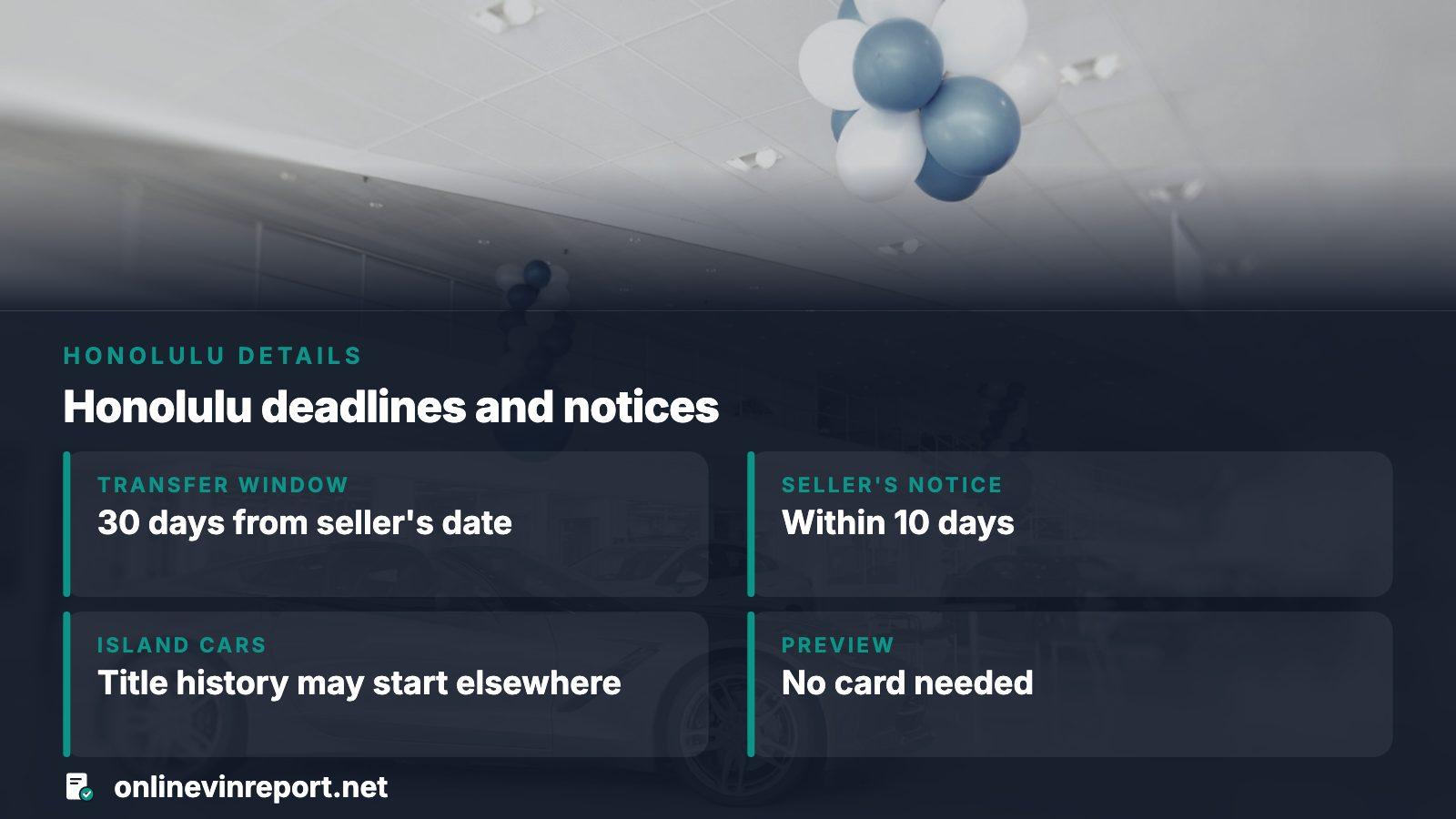
- Buyer: take the signed title to a satellite city hall inside 30 days of the date the seller signed it over, on an AlohaQ appointment. Transfers do not go through the express window.
- Fee: $10 on time, plus a $50 penalty when late.
- Seller: file the Notice of Transfer within 10 days. A skipped notice risks a fine as high as $100.
- Bring: the endorsed title, the last registration and a current safety certificate.
- Lapsed registration: renewal is due at the same visit if it has ended or ends within 45 days, and a delinquent car hands its unpaid back taxes to the new owner.
Run the title check before these clocks start; whatever it finds after you sign is yours to fix.
What the check costs and what to run next to it
Looking costs nothing, since the preview is free. A report is one payment, or a multi-car pack if you are comparing, and nothing renews. Current options are on the pricing page.
- Run NICB's VINCheck for salvage declarations, flooding and thefts never recovered.
- Put the VIN through the federal recall lookup too.
- Book a mechanic of your choosing; per the FTC, a history report cannot stand in for that inspection.
- Walk away or renegotiate if a brand, lien or odometer gap stays unexplained.
Where this information comes from
- Honolulu: motor vehicle ownership transfer — Title, lender release, out-of-state and out-of-county transfers, deadlines and fees on Oahu.
- Honolulu: motor vehicle services — Where reconstructed-vehicle requirements are met on Oahu.
- Hawaii DOT: Motor Vehicle Safety Office — The state safety inspection program and the four county registration offices.
- NMVTIS: consumer information — What brands are, where the federal data comes from and why a clean search can still miss something.
- NMVTIS: understanding a vehicle history report — The indicators a federal title report covers and what it leaves out.
- FTC: used cars — Why a history report never replaces an independent inspection, and what NICB's check screens for.
Sources and photos: Facts checked against the sources above in November 2026. Photos by A n v e s h, Dylan Michaud and Richard R on Unsplash; diagrams by OnlineVINReport.
Keep reading
- Title washing: how a brand vanishes and what a VIN title check can showHow a brand disappears from a paper title when a car changes states.
- Check title and lien by VIN: brands first, then who holds a claimMaking sure the loan is truly closed before the signature changes hands.
- Rebuilt title inspection: what the state checks and what a VIN title check addsWhat a rebuilt-title inspection looks at, and what it leaves unchecked.
- PricingReport options, pack sizes and the single payment, with no subscription.
Frequently asked questions
Is there a free Hawaii title check by VIN?
In part. A free preview comes first on this page, and the full brand history is one paid report. Honolulu's online inquiry estimates registration fees from a plate and the last four VIN digits, so it is no brand search. NICB's VINCheck screens salvage declarations, flooding and unrecovered thefts.
Who keeps title records for Hawaii cars?
Registration runs through four county offices, and the state transportation department links to Honolulu, Maui, Hawaii and Kauai for it. On Oahu the city's motor vehicle division also handles title transfers. A federal database adds brands from other states. Ask the county of last registration about its file and use a VIN report for the rest.
How long do I have to transfer a title on Oahu?
Honolulu allows 30 days from the date the seller signed, with a $10 fee and a $50 penalty added if you are late. The seller's Notice of Transfer is due in 10 days. Other counties set their own steps.
Can a title check show a lien on a Hawaii car?
A report can flag a lender's claim, but the paperwork settles it. Since the lender holds the title during a loan, a seller with the title in hand should show the lender's release or a lien satisfaction letter. For a car from another county or state, Honolulu also takes a canceled contract marked PAID IN FULL.
Does a clean result mean the car was never wrecked?
No. Federal title data covers brands, total-loss and salvage entries, odometer readings and the title, but not every state and yard reports, and a repair with no insurer write-off may leave no trace. Treat it as a good sign, then book an independent inspection before paying.
Now check the car itself
The guide explains what to look for. The report shows what this VIN has on record.