THE SHORT ANSWER
No state turns a salvage title back into an unmarked clean title. The usual route is a salvage title, repairs, an inspection, then a new title that carries a rebuilt brand. That title lets the car be registered and driven, yet the history stays visible. Anyone selling a car described as clean after salvage should be checked against the VIN record before money changes hands.
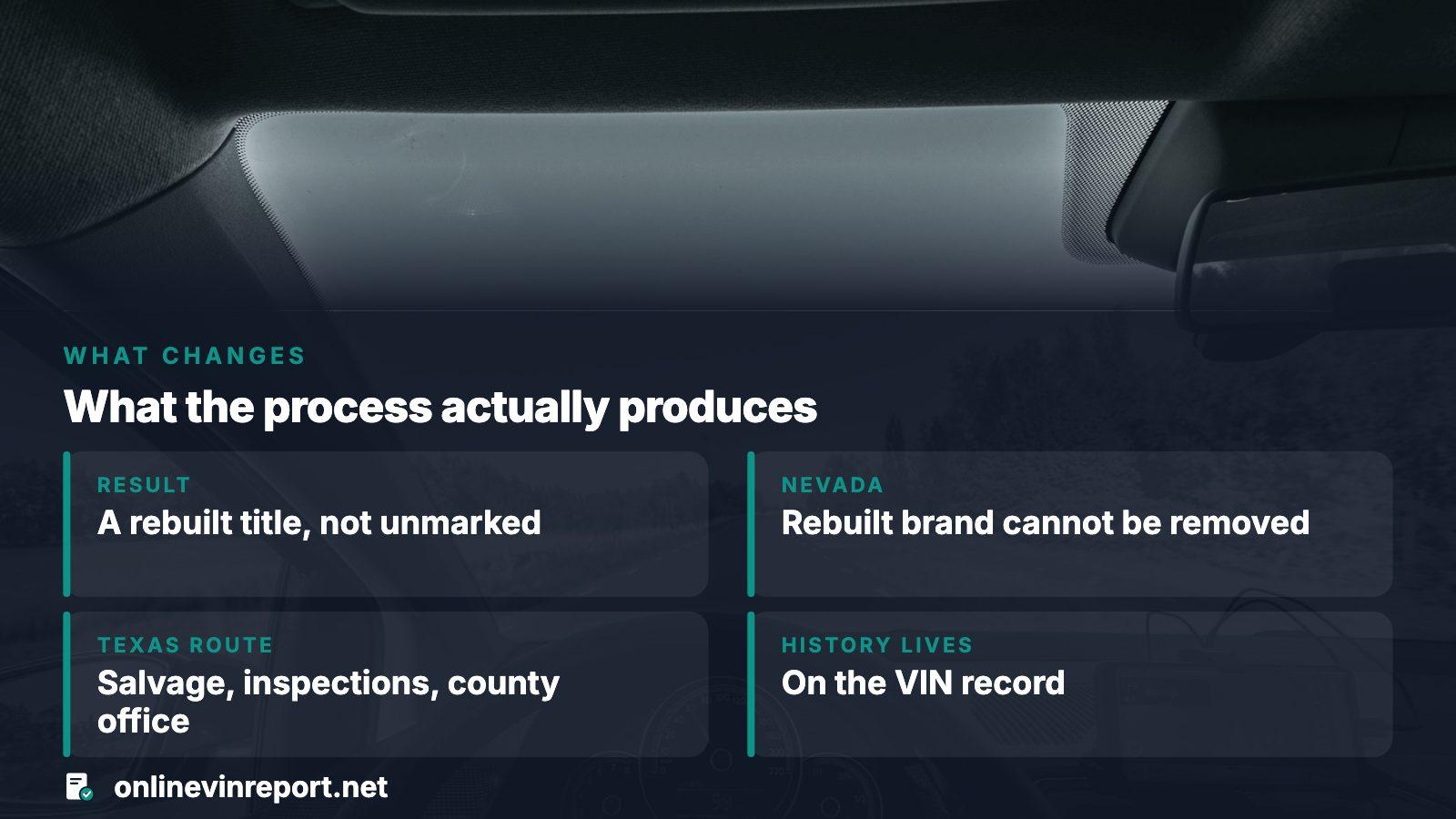
- What the process produces
- A rebuilt title, not an unmarked one
- Nevada's position
- The rebuilt brand cannot be removed
- Texas route
- Salvage title, inspections, then the county tax office
- Where the history lives
- On the VIN record, beyond the paper
Clean is a word sellers stretch
Searchers who ask whether a salvage title can become clean usually have one of two cars in mind. One is a wreck they own and want back on the road. The other is a car for sale whose seller says the title was cleaned up. The answer differs for each, and both end at the same point: a state can replace a salvage title, but it does not erase the fact that the car was once salvage.
Nevada's DMV defines a salvage vehicle broadly. Its definition reaches any car once ruled a total loss, a flood victim or beyond repair, and any car whose title ever bore the word salvage or something like it. So in the state's eyes the label sticks to the car, even after the repairs are done.
The usual route from salvage to a drivable car
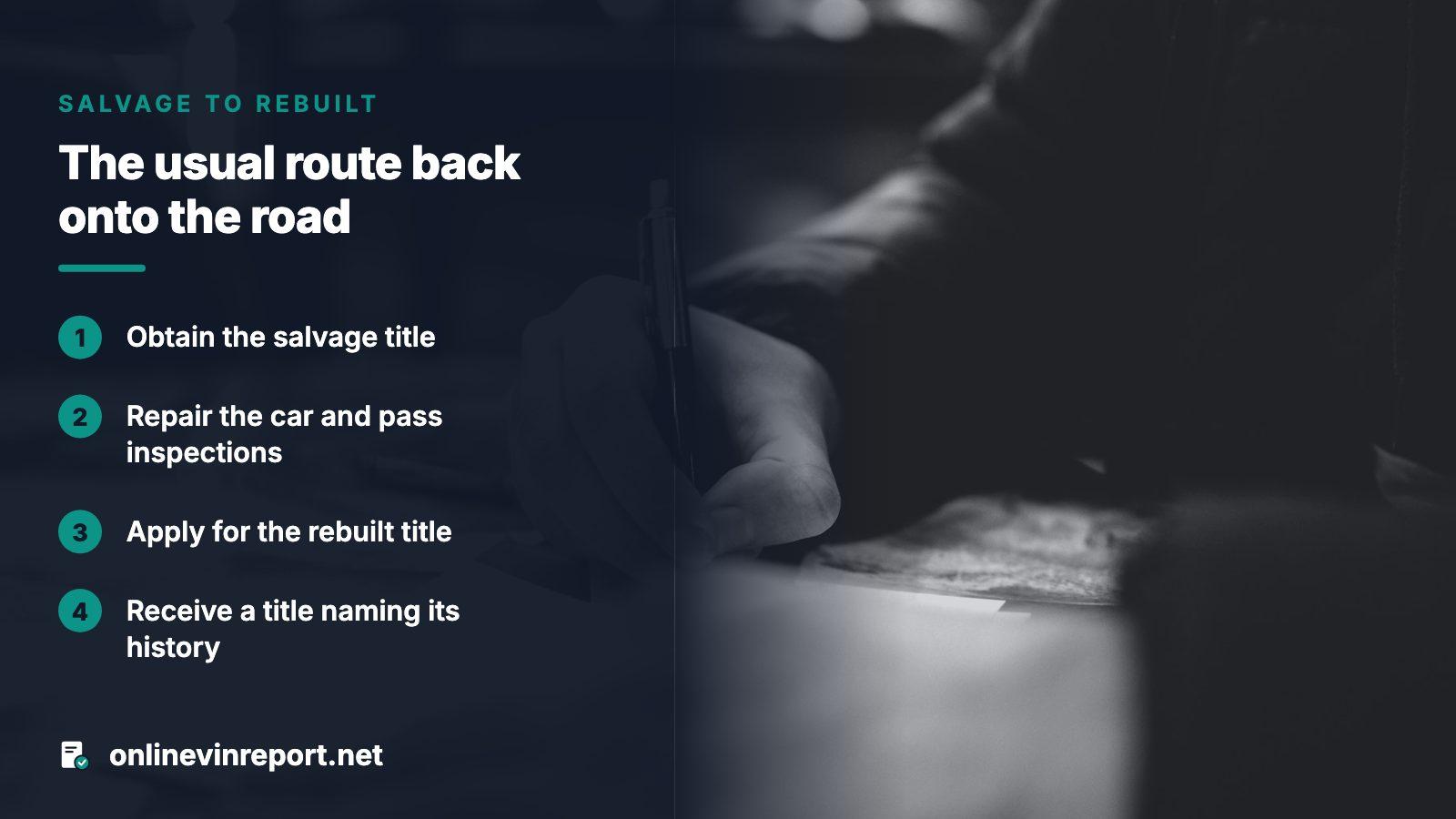
Forms and fees change from state to state, yet the order holds. The owner first holds a salvage title, then repairs the car, then proves the work passes inspection, then applies for a new title and registration. Texas lays this out as three ordered steps on its DMV FAQ, and Nevada's page follows a similar chain.
- Obtain the salvage title. In Texas this is done by mail with an application, the existing title, lien payoff proof if there was a loan, photo ID and a small fee.
- Repair the car and pass the required inspections. Texas asks for safety and or emissions inspections, depending on where the car will be registered.
- Apply for the rebuilt title and registration. In Texas that means the county tax office, with a Rebuilt Vehicle Statement and proof of insurance.
- Receive a title that names the car's history through a rebuilt brand.
Nevada adds a step for newer cars. If the vehicle is 5 model years old or newer, it goes to a DMV inspection station for authorization before repairs begin.
What the new title says about the car
The document that follows a rebuild is a normal certificate of title, with one difference. In Nevada it is branded rebuilt or another suitable term, and the DMV adds that the brand cannot be removed. Other states use their own words, such as reconstructed, but the idea is the same: the title now tells the next buyer that the car went through salvage.
Rebuilt is the finish line
Treat a rebuilt title as the cleanest outcome a salvage car can reach. It restores the right to register and drive the car. It does not restore the history, and a careful buyer will price that in.
Some repairs trigger the brand even without a total loss. Nevada adds that swapping out even one listed major part forces the rebuilt brand, with the cowl assembly, the panel between the engine and the windshield, as one example.
Fees and waiting time you can plan for
Official fees are small compared with repair bills, and they vary by state. Texas lists $8.00 for a salvage title application by check or money order, and $10 total if the title is lost. Nevada lists a $10 salvage title fee, with no fee for a non-repairable certificate. New Jersey lists a $60 title fee for a salvage title request.
| State | What the official page says | Timing noted |
|---|---|---|
| Texas | Salvage title by mail, then inspections, then county tax office | Salvage title within 3 weeks |
| Nevada | Mail application to the central Salvage Unit | Usually 2 business days |
| New Jersey | Photos of each side before repairs, inspection after | Call the Special Title Unit |
The big cost is not on these pages. It is the repair itself, plus any inspection and insurance steps the county or state adds. Ask your DMV for current amounts before you budget.
Paperwork that trips people up
New Jersey tells owners to photograph every side of the car before repairs start. That single line saves arguments later, because an inspector wants to see what was damaged and what was replaced. Keep receipts for replacement parts as well; several states ask for them at inspection.
- New Jersey will not issue a salvage title while a lien still shows on the face of the old title.
- Texas wants proof a loan was paid off if the title shows one.
- Nevada's DMV advises against buying a car that still has the orange salvage title, and says a private sale is illegal until the rebuild and inspection are done.
- Nevada treats a non-repairable car as worth only its parts and scrap, so no rebuild route exists for it there.
That last point is the one to confirm early. Once a car is stamped non-repairable, no amount of work changes that status.
When a clean paper title meets the VIN record
The harder case is the buyer's. A seller hands over a title with no brand, but the car's record says something else. That can come from fraud, or from two states applying different definitions. Whatever the cause, the paper is only one document, and the VIN record is built from more than one source.
From an NHTSA owner complaint
An owner who bought a 2013 Nissan Altima in 2018 told NHTSA the car's title read clean, yet a recall letter arrived and, in the owner's account, the maker would not do the repair because the VIN showed salvage in two other states. The owner added that offices in both states told them a second title is off the table while they hold the first. No outcome was reported. Read it as one owner's account, and as a reminder that a clean-looking title did not settle the question.
Federal NMVTIS, described on VehicleHistory.gov, was built to guard consumers against fraud and unsafe cars and to deter title crime. A title check by VIN is how an ordinary buyer reads that kind of record.
Run the check while the car is still unpaid for
Read the VIN stamped on the vehicle itself, match it to the title, then check it. Here the preview is free and shows whether brand entries exist for that VIN. The full report is a single payment, with no subscription, and spells out the brands next to damage and odometer entries. Amounts are on the pricing page.
- Look for salvage, junk, flood or rebuilt entries and the dates attached to them.
- Compare the states on the record to the state on the paper title.
- Read any auction or damage photos that appear, and see whether they match the car in front of you.
- If the paper says clean and the record says otherwise, ask the seller for the earlier titles in writing.
What to do with each answer
If you own the salvage car, start with your DMV's salvage page, collect photos now and confirm whether the car is salvage or non-repairable. Plan on ending with a rebuilt brand, and tell any future buyer so.
If you are buying, treat a rebuilt brand as a fact about the car, not an insult. It may be fine, with fair pricing and an inspection by a mechanic you trust. A car whose seller promises a title that is clean after salvage is another matter, because no state process we read produces that. Walk away or ask for proof you can verify.
Where this information comes from
- Nevada DMV: Salvage vehicles — salvage definition, rebuilt brand that cannot be removed, steps, fees
- Texas DMV: Frequently asked questions — three-step route from salvage title to rebuilt registration
- New Jersey MVC: Salvage titles — photos before repairs, lien rule, title fee
- VehicleHistory.gov: NMVTIS — federal title system and its purpose
- NHTSA owner complaint 11342126 — owner experience, paraphrased
Sources and photos: Facts checked against the sources above in November 2026. Photos by Martin Fennema, Owen Michael Grech and Sander Jeurissen on Unsplash; diagrams by OnlineVINReport.
Keep reading
- What is a rebuilt title? What it means and what a VIN title check showsWhat the rebuilt brand means for insurance and resale
- Rebuilt title inspection: what the state checks and what a VIN title check addsWhat inspectors look at before the brand is issued
- Title washing: how a brand vanishes and what a VIN title check can showHow brands go missing between states
- Salvage title VIN check: run it online before you payCheck a salvage record by VIN before buying
Frequently asked questions
Can a salvage title ever be removed completely?
The official pages we read describe replacement, not removal. Nevada says the rebuilt brand cannot be removed, and its definition of salvage includes any car that ever carried the word on a title. Ask your own DMV, since each state sets its own rules and wording.
Does a rebuilt title count as a clean title?
No. A rebuilt title lets the car be registered and driven, but it is branded, so the next buyer sees that the car was once salvage. A clean title carries no brand at all. Sellers sometimes blur the two, which is why the VIN record matters.
How long until a rebuilt title arrives?
It depends mostly on repairs and inspection scheduling. Texas says the salvage title should arrive within 3 weeks, and Nevada usually issues its salvage title in 2 business days. The rebuilt title follows after inspection, so confirm current timing with your DMV.
Can a non-repairable car be rebuilt?
Not in Nevada, whose DMV says such a car cannot be put back into operating condition and is worth only parts and scrap. Other states have their own categories, so confirm which label your car holds before spending money on repairs.
What if a seller says the title was cleaned?
Treat it as a warning and verify. Run the VIN through a title check, compare states and dates against the paper, and ask for the earlier titles. A real rebuild leaves a rebuilt brand. A plain clean title after salvage needs an explanation you can confirm.
Now check the car itself
The guide explains what to look for. The report shows what this VIN has on record.