THE SHORT ANSWER
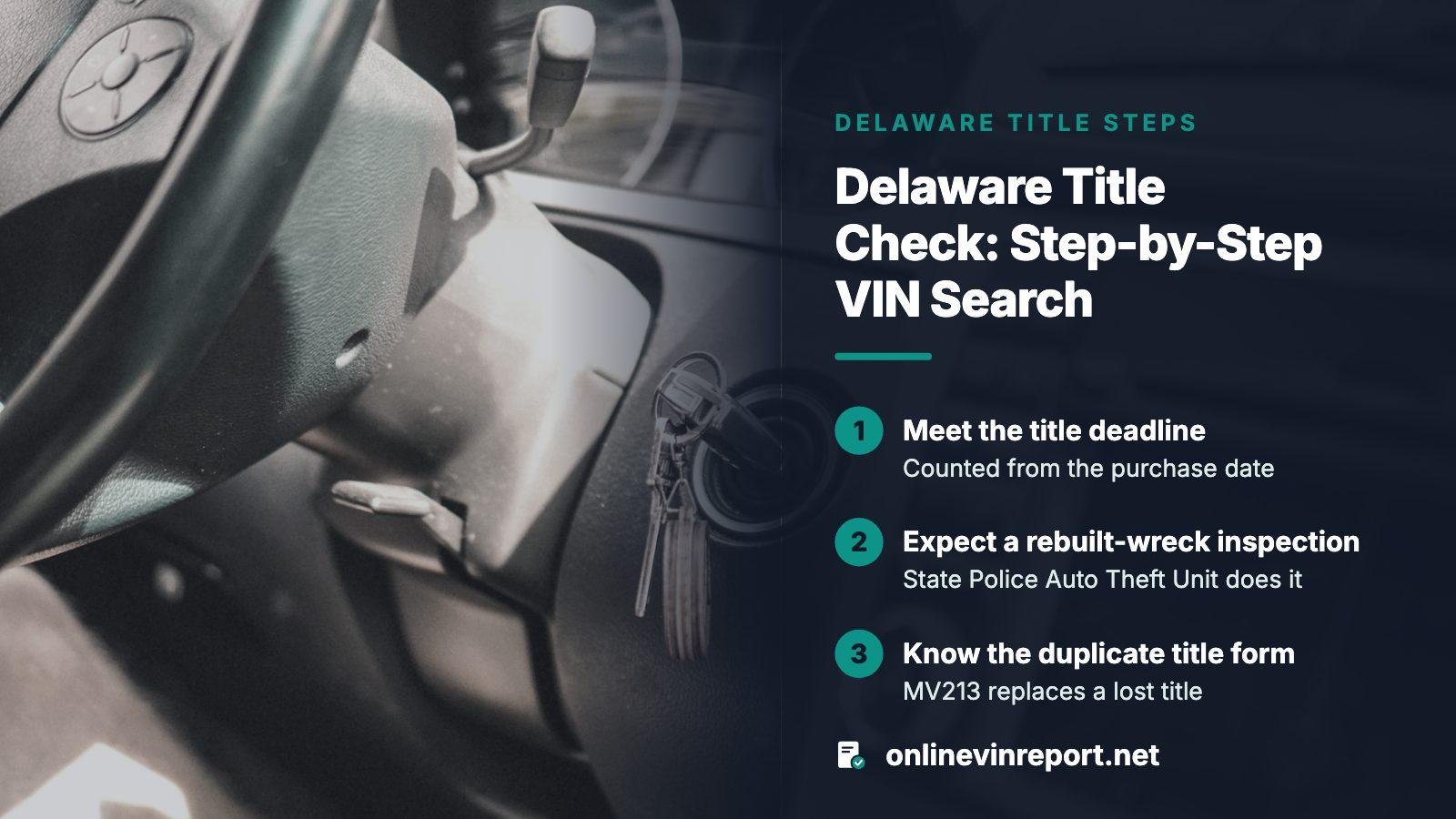
To check a Delaware car's title, search its VIN online for brand history from any state, then set the paper title beside the results. Match the VIN, the owner names, the lienholder box, any brand word and both mileage entries. A flood, salvage, rebuilt or reconstructed mark, or a lien without a notarized release, means the seller must explain before you pay. Finish with an independent inspection.
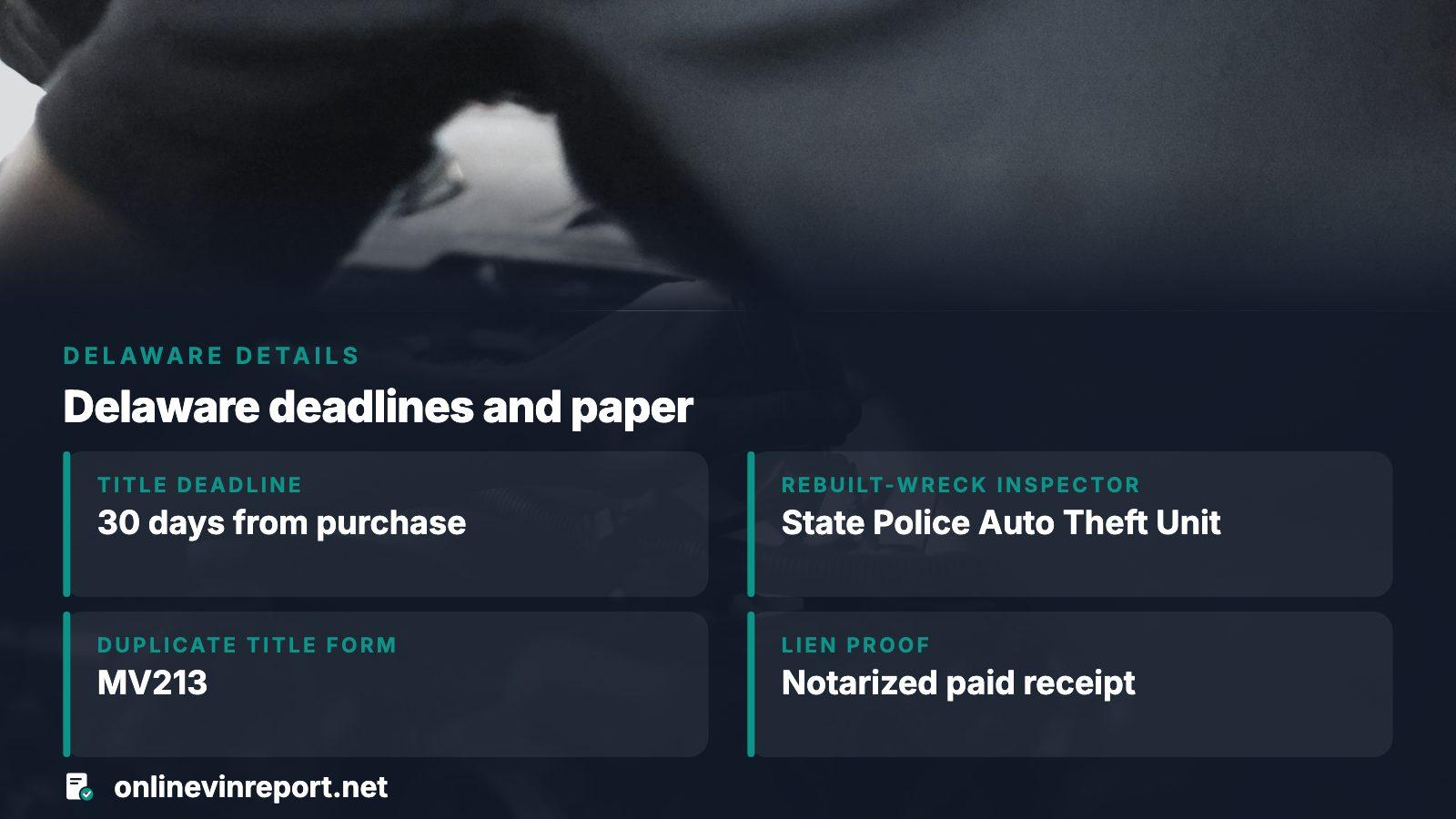
- Title deadline
- 30 days from the purchase
- Rebuilt-wreck inspector
- State Police Auto Theft Unit
- Duplicate title form
- MV213, $50
- Preview
- Free
Four ways to run a Delaware title search, and what each one misses
Delaware has no single lookup that answers every title question, so the check stacks sources. Each route sees something the others cannot.
| Route | What it gives you | What it leaves out |
|---|---|---|
| The paper title | VIN, owner names, lienholder box, any printed brand, mileage entries | Anything not printed on that one document |
| An online VIN title search | Brand history from any state, last title state and date, odometer reading, total-loss and salvage entries | Repair history, which the federal title system leaves to private providers |
| A DMV vehicle record request | A record released only for a listed use, at $25 per record for non-government requesters | A general lookup for curious buyers |
| The seller's rebuild file | Photos, receipts and a State Police Auto Theft Unit sign-off for a rebuilt wreck | Cars that never went through the salvage process |
The check in order, from the driveway to the counter
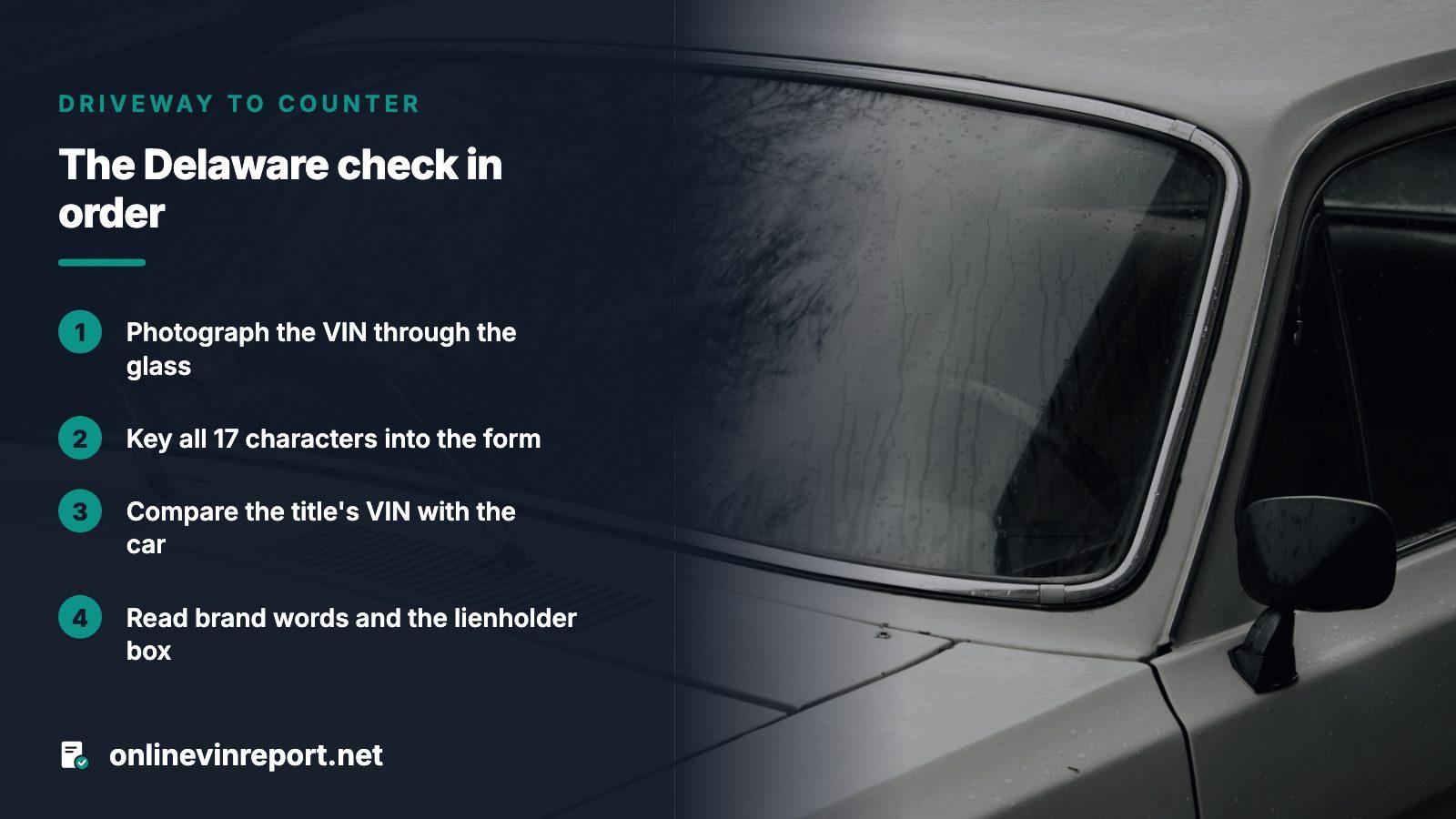
- Photograph the VIN as it shows through the glass at the driver's corner of the dash, then compare it with the advert.
- Key the full 17-character number into the search form. A typo brings up the wrong vehicle or no record.
- Read the preview. If the car is still a contender, buy the report and open the brand history first, then the last title state and date, then the odometer lines.
- Ask to see the paper title and compare its VIN with the car, character by character. The DMV wants buyers to do this in person.
- Read the front of the title for brand words and the lienholder box, then the back for the seller's signature and the mileage entry.
- If a lien is printed, ask for a notarized paid receipt before any money moves.
- Book an inspection at a body shop, then agree the price.
Brand words the DMV tells buyers to look for
Delaware's buyer tips send you to the front of the title for brand wording, and they warn that some states print codes instead of words.
| On the title | What the DMV says | Your move |
|---|---|---|
| Flood, salvage, rebuilt, restored salvage | Signals possible rebuilding or damage | Treat it as a wreck history and pay a body shop to look |
| Reconstructed, specially constructed, homemade | A state-issued serial number must be on the car; if you cannot find it, expect trouble titling and registering | Find that number yourself before any money moves |
| Odometer discrepancy, or not the actual mileage | The true mileage is unknown | Price the car as unknown mileage, or walk away |
| A number or letter code | Some states print codes in place of words | Ask what the code stands for and compare it with the report's brand lines |
Reconstructed sits on both of the DMV's lists, so it earns both reactions. A brand printed here is only part of the picture: the federal record logs labels applied by any state, so a mark from a previous owner's state can surface in a report while the paper in front of you stays quiet.
A rebuilt wreck should arrive with its own paper trail
Delaware sets a path for an owner who keeps a car after an insurance total loss. The DMV bars it from the road until the owner has rebuilt it, had the State Police Auto Theft Unit inspect it, cleared a safety inspection and retitled it. A seller offering such a car should hold the evidence:
- Color photos taken before the repairs began, covering the car from every side.
- Parts receipts, with the donor vehicle's VIN written on any used-part invoice.
- The title, the receipts and the bill of sale or settlement letter, all in one name.
- The Application for Title, form MV214, which the Unit supplies after a passed inspection.
- The safety and emissions inspection report.
A half-finished rescue
The DMV says the Unit no longer approves vehicles repaired by a previous salvage owner. If a seller says an earlier owner did the repairs, ask how the car will pass that inspection before you pay anything near a rebuilt price.
Why a car with out-of-state roots needs the national record
A car titled for the first time in Delaware arrives with paperwork from elsewhere: the original title or a certificate of origin carrying an odometer disclosure. The DMV then checks the number on the car, through a VIN verification at a recheck lane for the newest seven model years or a full inspection for older ones. Neither is described as a search for past brands.
That gap is where an online search earns its fee. The federal title system draws on state titling agencies, junk and salvage yards, auto recyclers and insurers, all required to report regularly. Its report covers five indicators, from the current title state and date to salvage and total-loss history.
Liens, signatures and mileage: the paper checks that cost nothing
- Lienholder box. Any lender named on the front has to sign off. Ask for a notarized paid receipt that describes the car, names the seller and gives the date and amount of the loan.
- Owner names. AND between two names means both owners sign; AND/OR means either one can.
- Seller's signature. It should match the owner on the front. If it is already filled in and someone else is selling to you, you may be dealing with a middleman, which the DMV calls illegal in Delaware.
- Mileage. The seller's entry on the back should normally show more miles than the front. The DMV rejects a lower one unless the mechanical-limits or not-actual-mileage box is ticked, so compare both sides, then compare both with the report's odometer lines.
A lost title is fixable but slow. The owner applies on form MV213 with a $50 fee, every owner signs, and if a lien remains the new title goes to the lender, not the seller. A fresh lien waits until the duplicate exists.
What Delaware asks of you once the check is clean
- Take the paperwork to a Division office inside 30 days of buying, or face a penalty.
- Bring the title itself. Neither a bill of sale nor a registration can substitute for it.
- Expect an inspection or a VIN verification before the first Delaware title issues.
- Budget the document fee. The out-of-state titling page prints 5.25% on whichever is higher, the sale price or the NADA average trade-in value. Confirm the current rate with the DMV before you quote it to a seller.
- If an out-of-state tag has expired, the DMV can issue a 5-day temporary tag for the drive to Delaware.
What the report costs and what to pair it with
Start with the preview, which costs nothing. Buy the report once if the car survives it; packs exist for shortlisting several cars, and nothing renews. Current options are on the pricing page.
- Enter the VIN at NICB's VINCheck; the FTC says it shows whether a VIN links to flood damage, theft that was never recovered, or a salvage declaration.
- Check the VIN for open recalls through the federal lookup.
- Pay a mechanic to inspect it, because the FTC says a report cannot replace an independent inspection.
- Hold the deal if any brand, lien or mileage gap stays unexplained.
Where this information comes from
- Delaware DMV: buying and titling a used vehicle — Buyer tips on brands, the lienholder box, signatures, mileage and the 30-day deadline.
- Delaware DMV: owner-retained salvage vehicles — The salvage certificate, Auto Theft Unit inspection and retitling steps for a wreck an owner keeps.
- Delaware DMV: vehicles purchased from out of state — VIN verification or inspection, the documents and the document fee for a car titled from another state.
- Delaware DMV: duplicate title — Form MV213, its fee and what happens when a lien remains.
- Delaware DMV: odometer disclosure — How the mileage boxes on the title work and why a lower back entry is rejected.
- NMVTIS: understanding a vehicle history report — The five indicators in the federal title record, its data sources and what it leaves out.
- FTC: used cars — Why to buy a history report, why it never replaces an inspection, and the NICB screen.
Sources and photos: Facts checked against the sources above in November 2026. Photos by tim, Tigran Shishmanyan and Mustafa Sheikhmouss on Unsplash; diagrams by OnlineVINReport.
Keep reading
- Salvage title VIN check: run it online before you payThe same VIN lookup for any state, with a closer look at salvage entries.
- Rebuilt title inspection: what the state checks and what a VIN title check addsHow a rebuilt-title inspection works, if the search turns up a rebuilt car.
- Check title and lien by VIN: brands first, then who holds a claimConfirm that a lender has no claim before the title changes hands.
- PricingReport options, pack sizes and the one-time payment, with no subscription.
Frequently asked questions
Can you search a Delaware car's title for free by VIN?
Partly. Running the preview here costs nothing, and the FTC points buyers to NICB's VINCheck for flood, theft and salvage flags. The DMV's titling pages list no public VIN search, and a full title record is a paid one from a provider. Pair either with the paper title.
What does a Delaware salvage certificate mean for a buyer?
It is the paper an owner receives after keeping a totaled car. The car stays off the road until it is rebuilt, passes the State Police Auto Theft Unit and a safety inspection, and is retitled. Ask for the photos, parts receipts and form MV214 that prove those steps.
What is the deadline for titling a used car in Delaware?
A new owner has 30 days from the purchase to apply at a Division office before a penalty applies. Run the VIN check before you pay, because a brand or lien discovered afterward lands on you.
Can a title check show a lien on a Delaware car?
A report's lien lines can flag a lender's claim, and the title's own lienholder box names the lender on paper. The DMV says that lender must release the lien, and it expects a notarized paid receipt from the seller. No receipt, no payment.
Does a clean title check mean the car was never wrecked?
No. Five indicators make up the federal title record, and accidents are not among them. Repair histories are left to private providers. A wreck repaired without a total-loss declaration can slip past, so add an inspection.
Now check the car itself
The guide explains what to look for. The report shows what this VIN has on record.