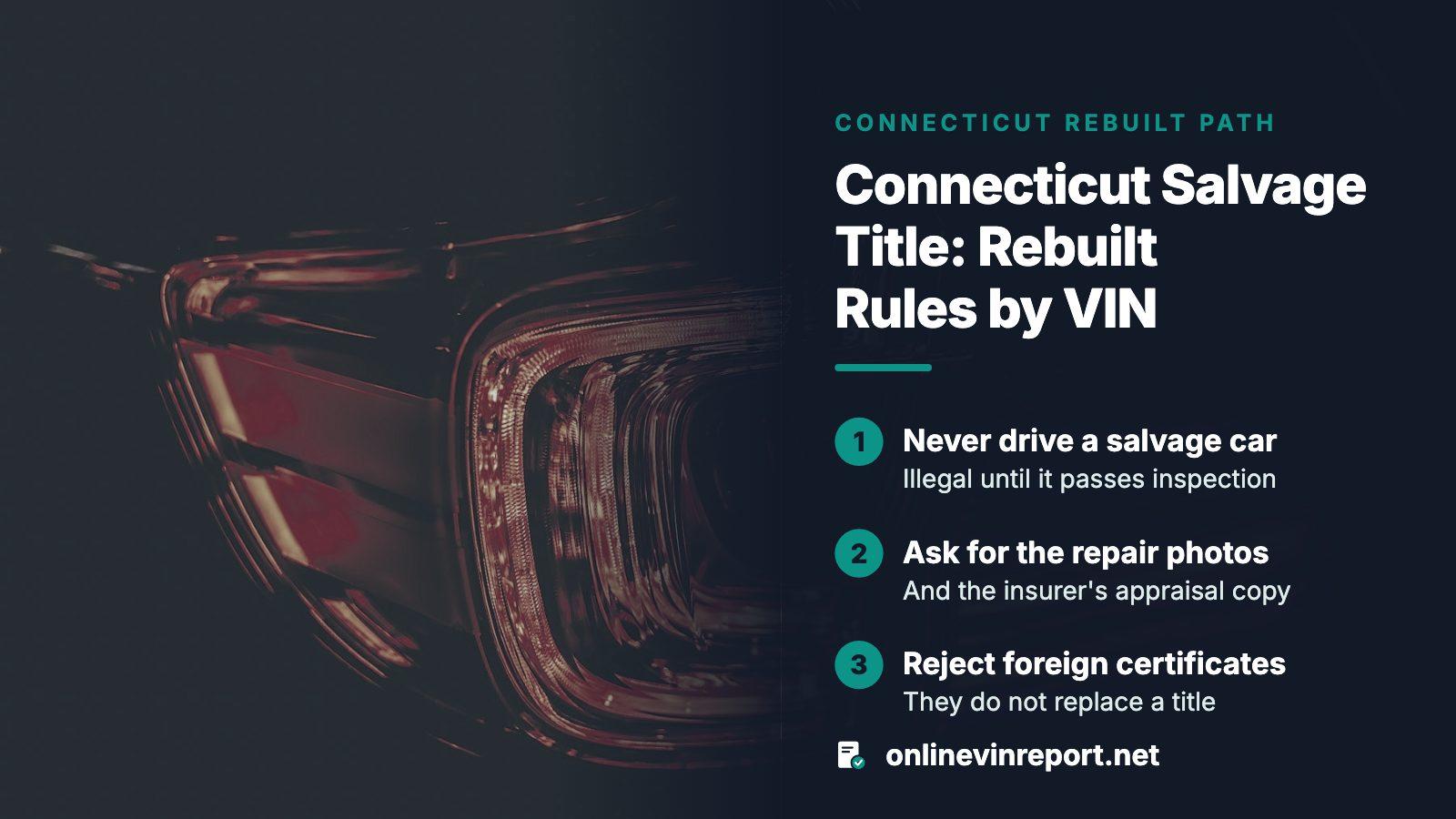
THE SHORT ANSWER
Connecticut treats a car as salvage when its insurer declares a total loss or the title bears the state's salvage stamp. Driving it is against the law until it is repaired, passes the DMV salvage inspection and gets a title reading Rebuilt. Three brands close that door for good. Enter the VIN to see which brand, if any, sits on the record.
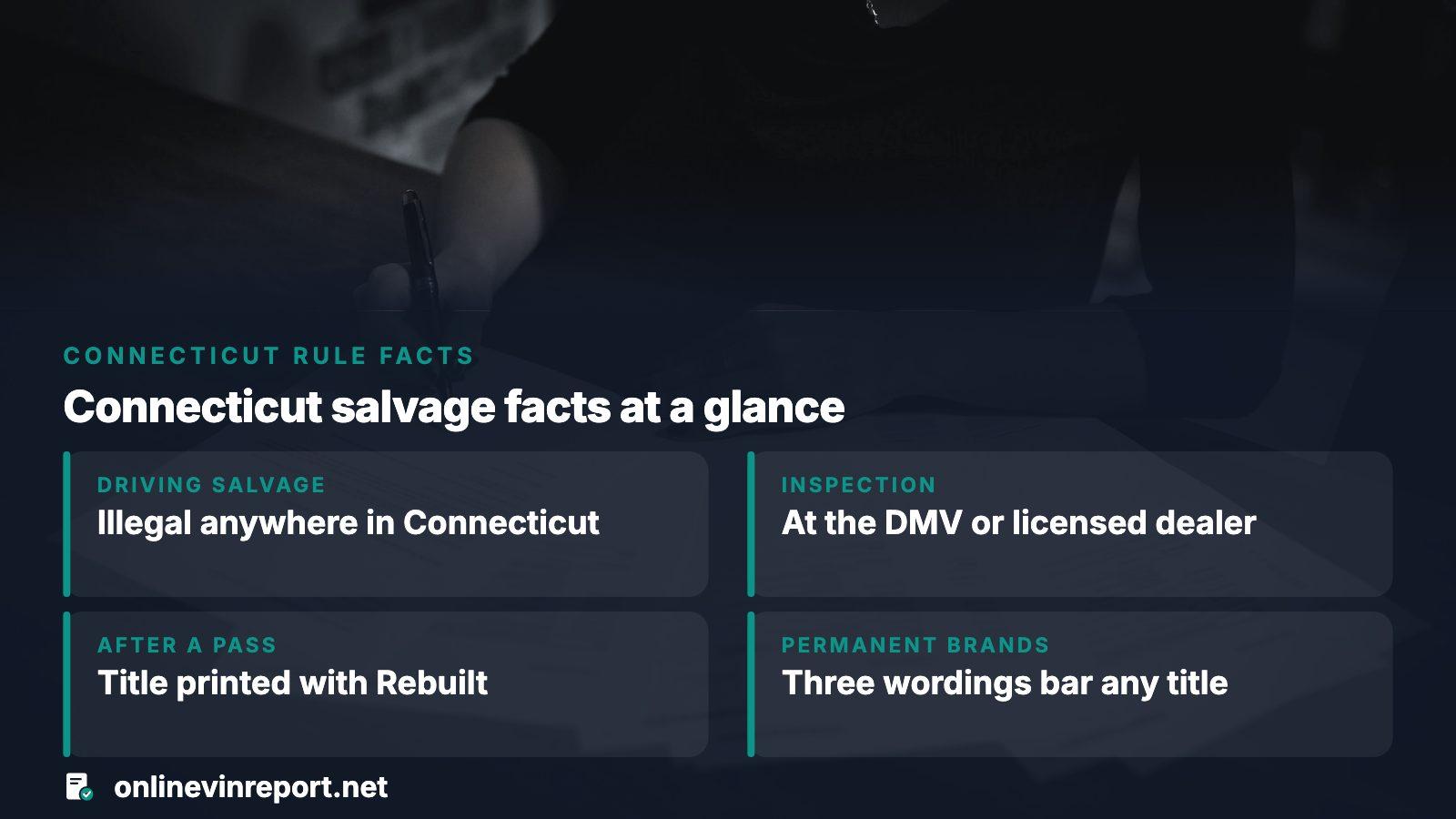
- Driving a salvage car
- Illegal anywhere in Connecticut
- Salvage inspection
- $88 at the DMV or a licensed dealer or repairer
- Result of a pass
- New title with the word Rebuilt printed on it
- Permanent brands
- Three wordings bar any future title
When a Connecticut car becomes salvage
The state's own wording gives two triggers. One is the insurer deciding the vehicle is a total loss. The other is a salvage stamp on the title. The agency is sent the stamped title, so the brand lands in the state record and then in the federal database that history reports read from.
From that point the car is off the road in practical terms. Driving it anywhere in Connecticut breaks the law, the registration is cancelled and the plates are removed. Keep that in mind when a seller says the car just needs paperwork and offers to drive it to you.
Write-off does not equal wreck
Federal guidance notes that an insurer's write-off label can linger in a car's record even if the vehicle was recovered in good shape afterward. The label records how a claim ended, and says little about how well any repair went.
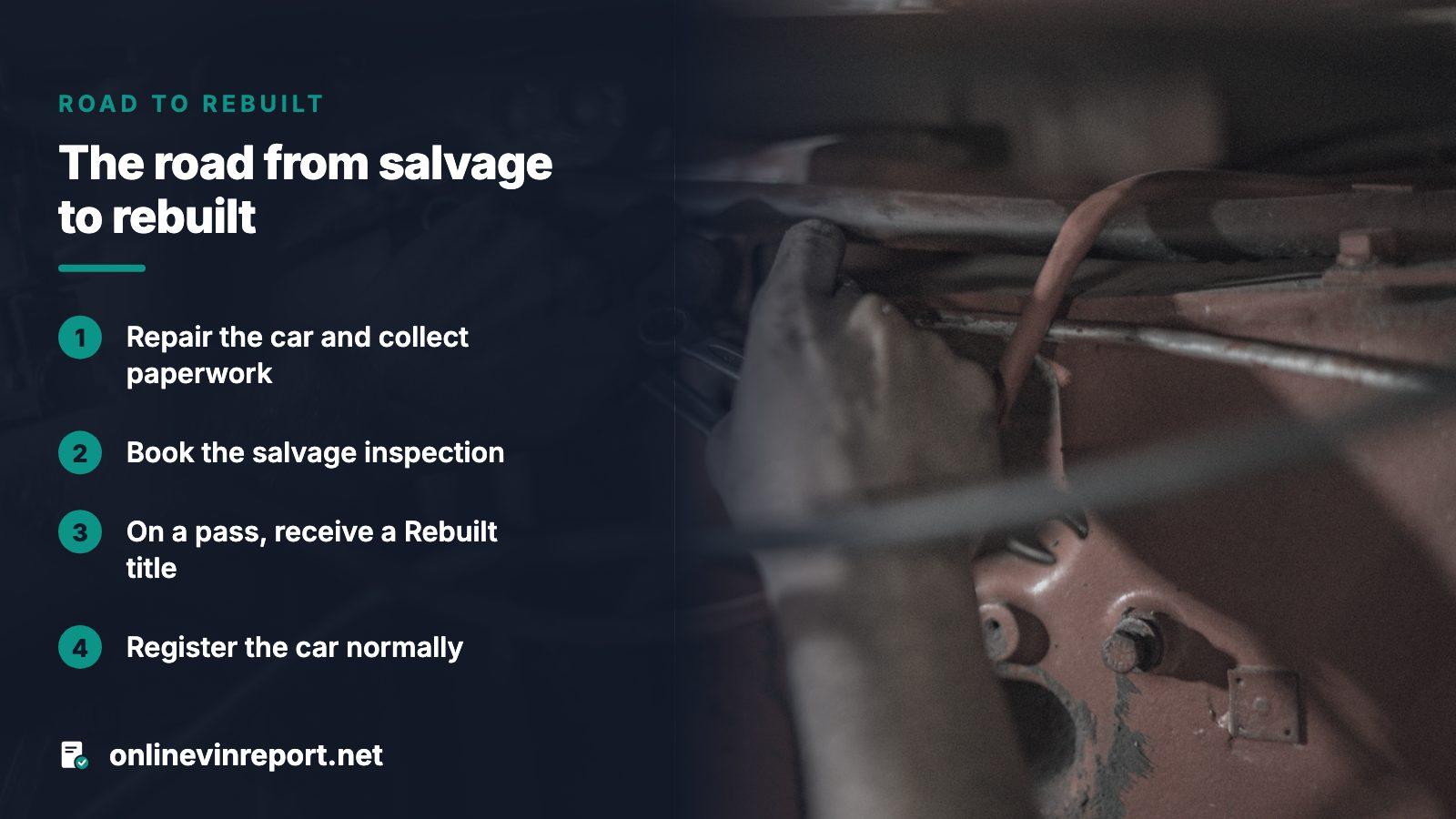
The road from salvage to rebuilt
A salvage car must be repaired and then inspected by the DMV before anyone can re-title it. It cannot be driven to the appointment, so it has to be delivered on a flatbed. After a pass, the DMV issues a replacement title with no salvage stamp. Instead the title shows Rebuilt, and that word follows the car through every later sale.
- Repair the car and collect the paperwork described below.
- Book the salvage inspection and bring the car in on a flatbed.
- Pay the inspection fee, which the DMV lists at $88.
- On a pass, receive a title that reads Rebuilt instead of Salvage.
- Register the car in the normal way.
Licensed dealers or repairers may carry out the inspection for the same $88, and their passing result is recorded on form B-270. Confirm the current fee and the booking method with the DMV before you plan around either number.
The paperwork behind a rebuilt title
This list is useful to a buyer, not only to a rebuilder. A genuine repair leaves a trail, and a seller who cannot produce it is telling you something. Ask to see copies, and compare them with the VIN on the car.
- Receipts for major component parts, with the donor car's VIN when used parts went in
- The insurer's original appraisal, in copy form
- Form K-186, the repair report, with photos
- Form B-303, the air bag statement
The air bag statement deserves a second look. Restraint systems are a common place to cut corners after a collision, and a missing or vague statement is a reason to book an independent inspection before any money moves.
Brands that end the road
Not every Connecticut salvage car can be rescued on paper. Three title wordings, salvage parts only, salvage unrebuildable and salvage unrepairable, mean the state will never register or re-title the vehicle. Those cars are destined for the parts bin, not the street.
| Brand on the record | Can it be re-titled? |
|---|---|
| Salvage | Yes, once repaired and through the DMV inspection |
| Rebuilt | Inspection already passed; Rebuilt wording on the title |
| Salvage parts only | No, ever |
| Salvage unrebuildable or unrepairable | No, ever |
If a listing or record shows either of the last two, any plan to register the car is a warning about the seller, whatever story comes with it.
Selling and buying a car that still has the salvage stamp
A salvage owner cannot sell using only form H-6B, the duplicate title application. The DMV first issues a duplicate title carrying the Salvage legend, and the owner then assigns its reverse side to the buyer. So a lawful private sale of a stamped car ends with Salvage in plain print on the title in the buyer's hands.
Be wary of paperwork that skips this. Another state's salvage certificate is not a substitute either: the DMV does not accept New York's MV907A, because it is not a title document. A buyer holding only a certificate has a car Connecticut will not title.
Connecticut titles are paper
The state issues no electronic titles, so a paper document is the evidence. Read the brand wording on the title you are handed, then match it against the VIN record.
Bringing a branded car in from out of state
A car from another state needs VIN verification rather than a safety inspection, done at a station listed on the ctemissions.com site. The exception is a salvage-titled car: its first Connecticut registration calls for a safety inspection. Personal vehicles otherwise generally skip that step.
Connecticut has fully implemented the federal title database, NMVTIS. When the results raise questions, the DMV holds off on titling until it has researched the car further. So a brand hidden in another state's paperwork is likely to surface at the counter, after you have paid.
The federal site adds that a brand, once applied by a state, remains in NMVTIS, so crossing a border should not erase it. It also warns that states use different damage thresholds, so a car branded salvage in one place may carry no brand in another.
What a VIN title check shows, and what it misses
A title check by VIN reads the brand history from the car's current title, the latest reported odometer figure, any insurer total loss or salvage determination, and any move to a junk or salvage yard. That is exactly the evidence for a Connecticut buyer deciding whether a car's story matches its record.
The federal consumer page is candid about limits. Some states have yet to report and some cars are missing, so a clean result is no guarantee. A yard visit does not automatically brand a car, and the report is short on purpose. Treat a clean search as one good sign, then look at the car and its paper title.
OnlineVINReport starts with a free preview of a VIN, which tells you whether brand records exist before you pay for the full report. The report is a single payment, with pricing on the pricing page.
Asking the DMV for the title record
Connecticut lets you request a title record by mail using form J-23T. The listed search fee is $20, and you need the VIN plus a photo ID. The request goes to the Copy Records unit in Wethersfield. Records for someone else's vehicle need a stated permitted purpose, so this route suits sellers checking their own car or buyers with a permitted reason.
Mail takes time, so use it when a deal is serious and the VIN check has left a question open. Do the quick online check first, then spend the time and the fee where the record is unclear.
Red flags before you hand over money
- A seller who offers to drive a car that the record shows as salvage
- A rebuilt car with no appraisal copy, repair photos or parts receipts
- A foreign salvage certificate offered in place of a title
- A price far below similar cars with no explanation of why
- A VIN on the paperwork that does not match the car
Any one of these is enough to pause. Run the VIN, ask the DMV questions you cannot answer yourself, and have an independent mechanic look at the frame and the restraint system.
Where this information comes from
- Connecticut DMV: salvaged and totaled vehicles — salvage definition, inspection, rebuilt title, dead-end brands
- Connecticut DMV: vehicle inspections — VIN verification and safety inspection for out-of-state cars
- Justice Dept (BJA): NMVTIS for consumers — what the federal title record holds and where it falls short
Sources and photos: Facts checked against the sources above in November 2026. Photos by A n v e s h, Nina Mercado and Dimitri Karastelev on Unsplash; diagrams by OnlineVINReport.
Keep reading
- Rebuilt title check by VIN: is the car clean or rebuilt?What to verify on any car sold as rebuilt.
- What is a rebuilt title? What it means and what a VIN title check showsThe rebuilt brand explained apart from Connecticut.
- Total loss threshold by state and what it means for a VIN title checkHow states decide when a car becomes salvage.
- Salvage title VIN check: run it online before you payFinding a salvage brand by VIN in any state.
Frequently asked questions
Can I drive a Connecticut salvage car home after buying it?
No. The DMV says operating a salvaged vehicle anywhere in Connecticut is illegal, and the registration is cancelled with the plates removed. Plan on a flatbed, which is also how a car has to arrive for its salvage inspection if you intend to rebuild it.
Does a rebuilt title in Connecticut ever go back to clean?
The DMV describes the new title as one with the word Rebuilt printed on it, not a clean title. That wording stays on the car's paper record, so expect later buyers and insurers to see it. Ask your insurer how it treats rebuilt cars before buying.
Which Connecticut brands can never be registered?
Three wordings: salvage parts only, salvage unrebuildable and salvage unrepairable. Connecticut will not register or re-title a vehicle carrying any of them. If a listing or VIN record shows one, treat the car as a donor for parts, whatever the seller says about making it legal.
Will a VIN check catch a salvage brand from another state?
Usually, because a brand stays on the federal NMVTIS record when a car crosses a state line. The catch is coverage: some states do not report yet, so a clean search can still be wrong. Pair it with the paper title and an independent inspection.
Who can do the Connecticut salvage inspection?
The DMV performs it, and licensed dealers or repairers may do it as well. The fee listed is $88 in both cases, and a dealer's passing result is recorded on form B-270. Confirm the current fee and booking steps with the DMV before you start.
Now check the car itself
The guide explains what to look for. The report shows what this VIN has on record.