THE SHORT ANSWER
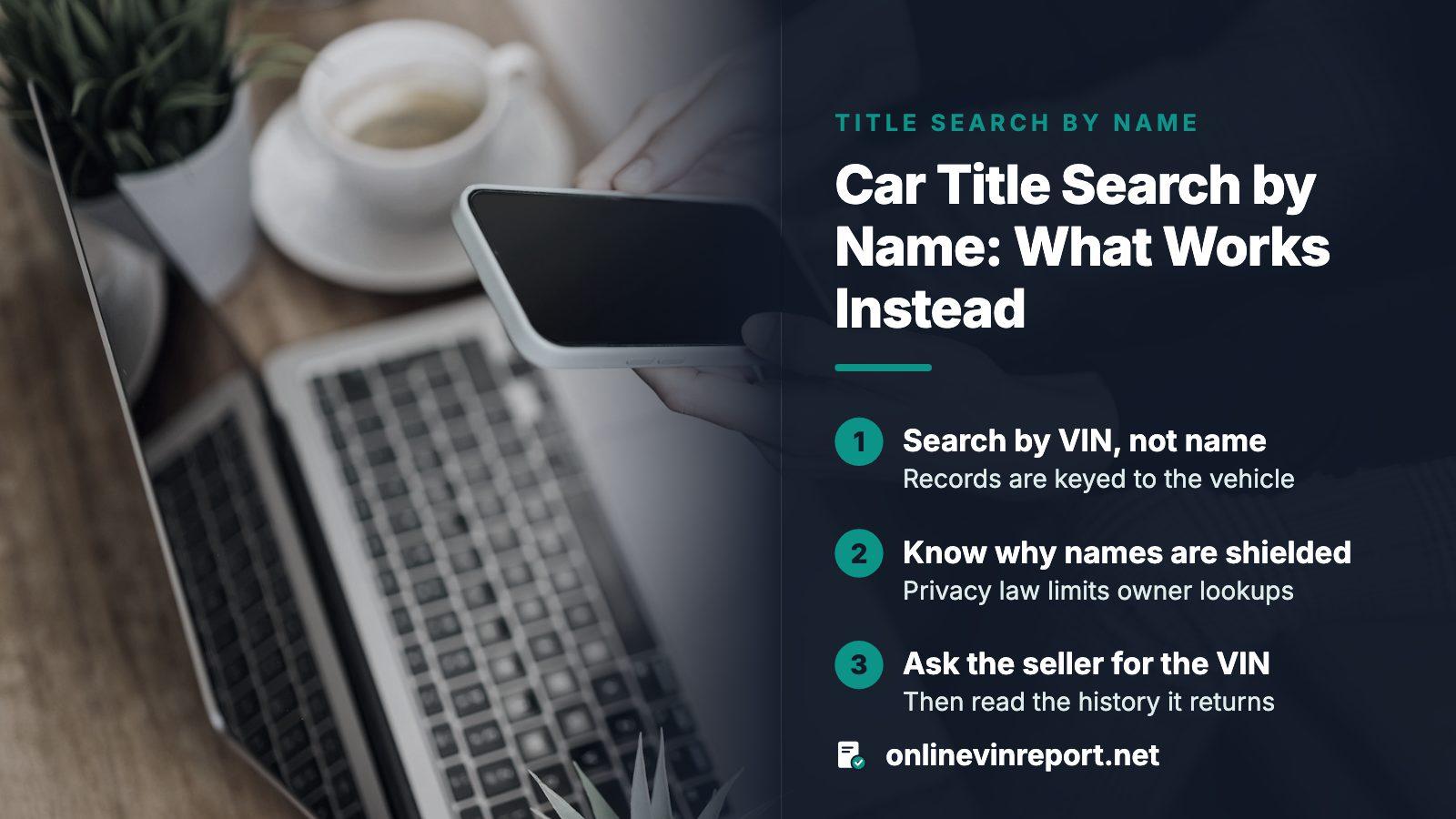
No public tool turns a name into a title. States file titles by VIN, and the Driver's Privacy Protection Act limits the release of owner names to a list of permitted uses. Three routes do work: ask your state for your own record with ID, run the VIN for brand and salvage history, or apply to the state under a permitted use. The owner's identity stays with the state, while the car's history does not.
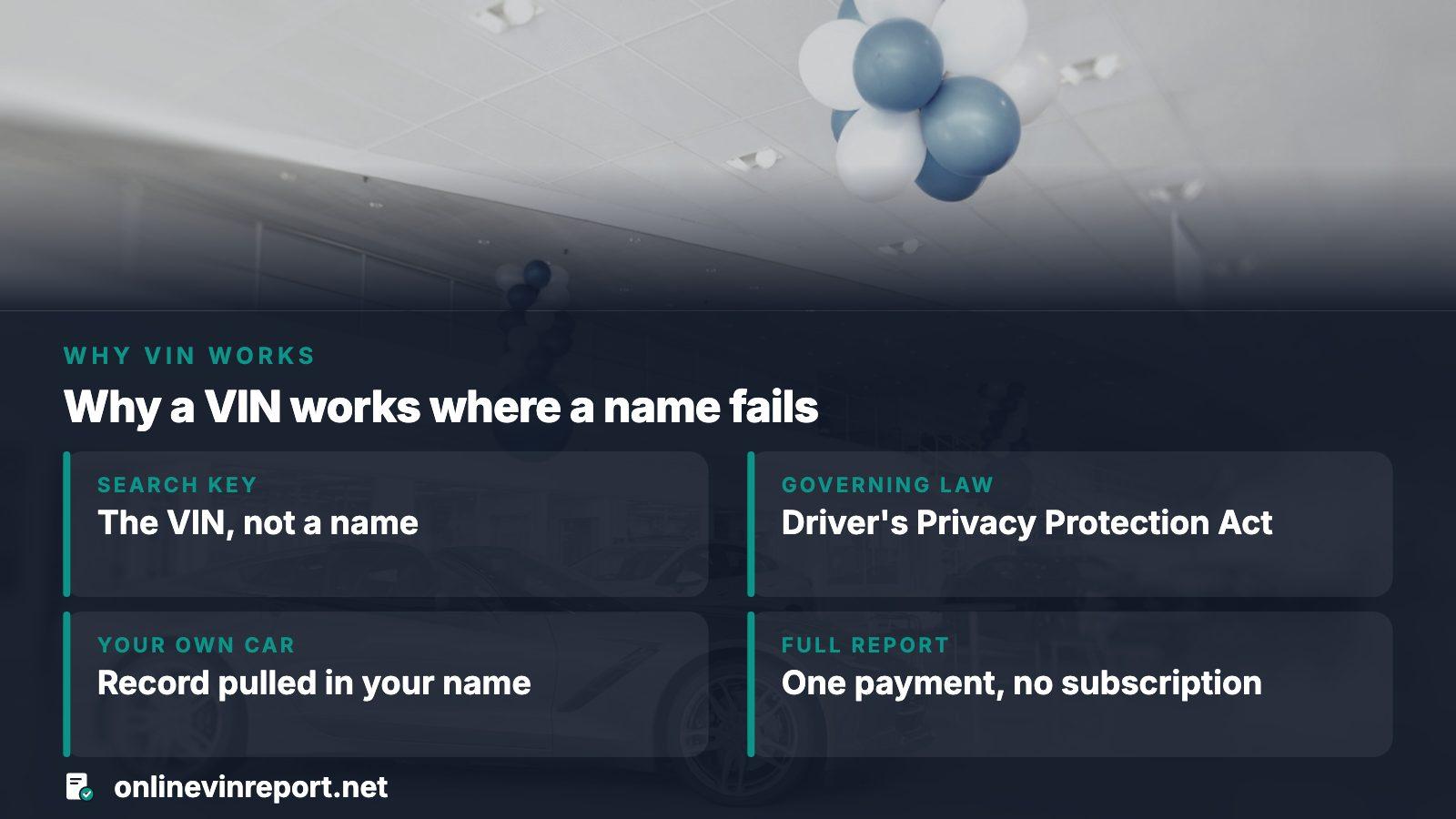
- Search key
- The VIN, not a name
- Governing law
- Driver's Privacy Protection Act
- Preview
- Free
- Full report
- One payment, no subscription
Why a name will not pull up a title
Agencies index each title by its vehicle identification number. The owner's name sits inside the record as one field, and it is not a door into the record. Federal law, in section 2721 of Title 18, keeps state motor vehicle offices and their contractors from handing out personal details held in vehicle records unless the request fits a short list of permitted purposes.
New York's DMV explains what that does to lookups. It names three the law restricts, and the first is the one most people are attempting.
| Lookup attempt | Where it stands |
|---|---|
| Plate number or VIN, to find the owner's name | Restricted by the federal act, per New York DMV |
| Driver's name, to find a mailing or home address | Restricted |
| A car's earlier owners, by name and address | Restricted |
What a state may release, and to whom
The act is no blanket wall. Its permitted-use list lets a state office answer a request that fits one of the entries. The ones a car buyer is most likely to run across:
- Claims and fraud work by insurers.
- Courts and agencies, including serving legal papers and enforcing a judgment.
- Contacting whoever owns a car that was towed or impounded.
- Vehicle safety, theft and recall work.
- Licensed private investigators, for a purpose the act otherwise allows.
- Anyone who holds the individual's written consent.
Nothing on that list covers a shopper checking out a seller. Names, street addresses, phone numbers and photos all count as personal information, with the 5-digit ZIP code carved out, while crash and violation data do not, according to New York. A stricter tier, highly restricted personal information, needs the person's express consent with only a few exceptions.
Pulling the record on a car in your own name
Owners stand in a different position, because the information is theirs. How you ask depends on the state, so read its agency's page before mailing anything.
| State | Form and route | Worth knowing |
|---|---|---|
| Texas | Form VTR-275, sent by post or handed in at a Regional Service Center | Attach a copy of ID. Email is refused, and a request to see every vehicle registered to you goes by post only. |
| California | INF 1125 for your own record, INF 70 for someone else's | When the DMV answers an INF 70, Vehicle Code section 1810(b) has it notify the person whose record was requested. |
A lost certificate is a separate request. Texas, for one, routes duplicate titles through different forms from the record request.
When the real question is whose name is on the title
Most buyers who search for a title by name hold a car with a seller attached and want to know whether the two match. That is a question about people, so a search of the car will not settle it. It gets settled across the table, with documents on it.
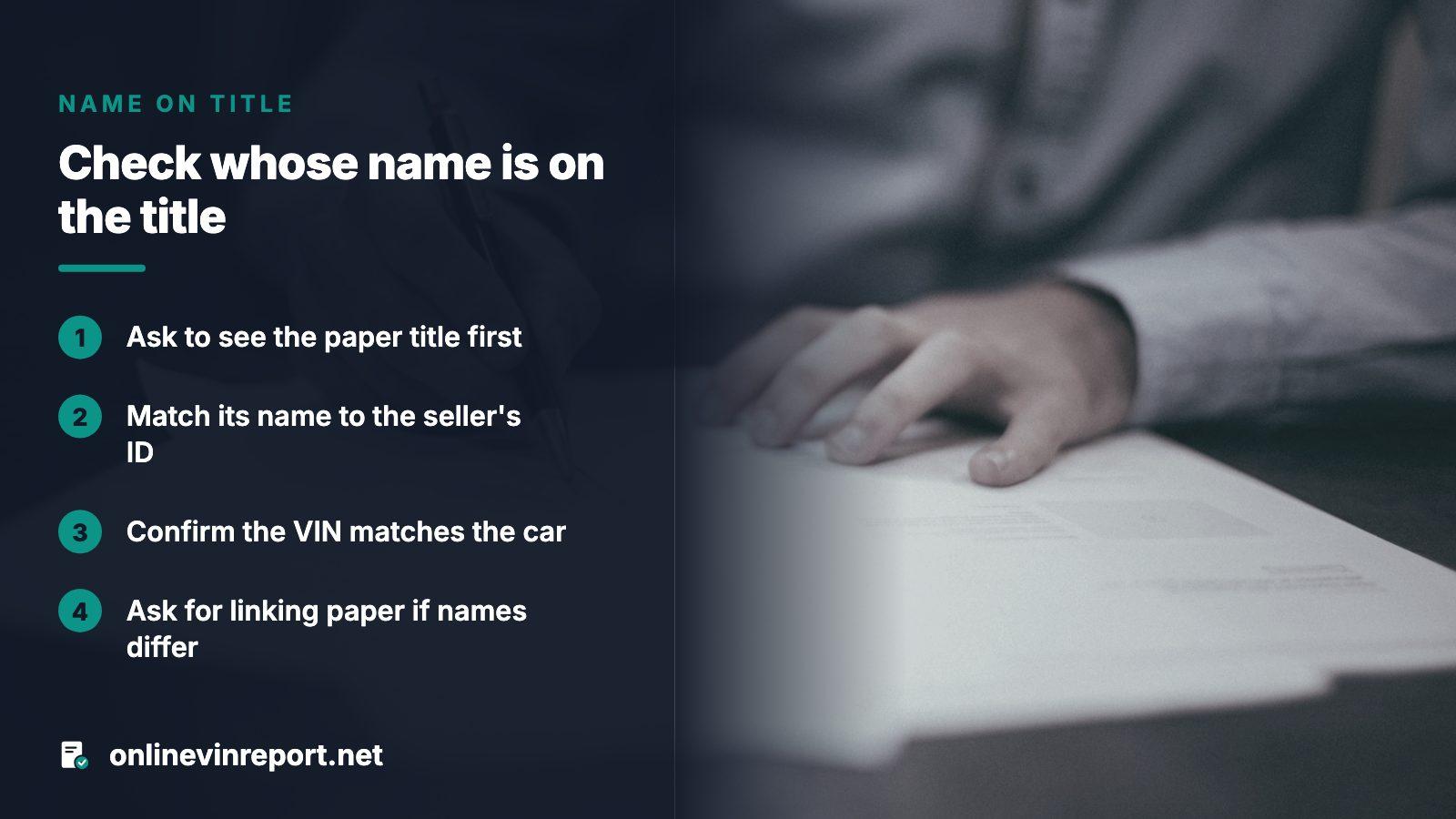
- Ask to see the paper title before anything else, with the seller standing there.
- Hold the name on it against the name on the seller's government ID.
- Look at the VIN the title lists and confirm the car carries the same one.
- If the names differ, ask for the paper that links the two people, and ask for it in writing.
- Stop if the answer is vague. Losing a deal now costs less than losing the car later.
A mismatch is the pattern behind title jumping, which has its own page.
What the VIN search reads in place of a name
The federal title system, NMVTIS, is built around the vehicle. Its consumer version is kept brief, with five signals at the center:
- Current title data, with any junk, salvage or flood brand and the brand history.
- The latest odometer reading that was reported.
- A finding by an insurer or self-insurer that the car is salvage or a total loss.
- Any transfer of the car to a recycler, junk yard or salvage yard.
- Past theft data, in some cases.
On top of title data, OnlineVINReport's search pulls in salvage and auction records, with photos when an auction took any. Start with the free preview. The full report costs one payment and nothing recurs; see the pricing page for the amount.
Where any title search runs out
Coverage is wide but not total. The program's consumer page puts 87 percent of the US vehicle population in the system, and over half of the states supply records. Its holdings include about 20 million salvage and total-loss records. The same page warns that gaps can yield a false negative, so a car can come back without a brand it should carry.
Two more limits matter. A state's own title record can hold details the national system lacks, which is why a state request is worth making on a car you are close to buying. And the insurer-based lookup from NICB, which the FTC points buyers to, only works if the car was insured when the damage happened.
A clean result is one data point
According to the FTC, paying a mechanic to look at the car is still necessary after any history report.
Use the VIN from the first message
Ask a seller for the VIN before you drive anywhere. When you arrive, read it off the car and off the paper; all 17 characters should agree. Enter it in the preview form on this site. A brand, a total-loss entry or a salvage-yard transfer means the title in the seller's hand needs a harder look.
Buy the report once the car makes your shortlist. Read the brand and salvage entries before the odometer history, then put each date and state to the seller and note what comes back.
Sites that promise an owner's name
Some pages claim to turn a VIN or a name into an owner. Read that claim against the law. The agency holding the record is limited in what it can release, Texas says that reselling or redisclosing the information is illegal, and New York says anyone who passes it to a permitted user must log each handoff and keep that log for five years.
Ask any site that offers owner names which permitted use it relies on, and treat a vague answer as a warning. A car's brands, salvage entries and odometer readings are useful without an owner's name, and that record is what this site's search is built to show.
Where this information comes from
- US Code: 18 U.S.C. 2721, release of motor vehicle records — the federal prohibition on releasing personal information, and the permitted uses
- New York DMV: Driver's Privacy Protection Act — which lookups the act restricts and what counts as personal information
- Texas DMV: Open Records — how an owner requests a title history or a list of vehicles in their name
- California DMV: vehicle and driver records requests — own-record and other-person forms, and the owner notice
- NMVTIS: consumer access — what the consumer report covers and where its coverage has gaps
- FTC Consumer Advice: Used Cars — history reports, free NICB and recall checks, and why an inspection still matters
Sources and photos: Facts checked against the sources above in November 2026. Photos by Jakub Żerdzicki, Scott Graham and Richard R on Unsplash; diagrams by OnlineVINReport.
Keep reading
- Car title check online: salvage, flood, rebuilt and junk by VINthe full walk-through of a title check by VIN and how to read each brand
- Title jumping: what an online VIN title check can and cannot showwhat it means when the seller's name is not the one the state has on file
- Duplicate title: what it means and how to check the car by VINthe replacement certificate an owner requests when the paper title is gone
- Check title and lien by VIN: brands first, then who holds a claimhow to learn, before paying, whether a lienholder is still on the record
Frequently asked questions
Is there a way to learn a car's owner from the VIN?
Not through a public tool. Federal law restricts state agencies from releasing owner names except for listed permitted uses, such as insurance claims, court proceedings or notifying the owner of a towed car. With a legitimate reason, apply to the state agency and name that use. In California, the owner is notified when someone else's record is requested.
How do I see which cars are registered in my name?
Ask the state agency that holds the records. Texas takes a request for the vehicles in your name on Form VTR-275, by post only, with a copy of your ID. California sends owners to form INF 1125 for their own record. Other states have their own forms, so start on the motor vehicle agency's website.
Is a VIN title search the same as a DMV title record?
No. The national system's consumer page says it does not hold everything a state keeps in its title records, and it links to instructions for requesting the state's version. A VIN search is quick and reaches across states. The state record is slower and can hold more detail. Before buying, run the VIN first.
Can a private buyer get the seller's name from the state?
A private buyer is not among the permitted uses the federal law lists, so the answer is generally no. Get the name the direct way: ask the seller for the title and ID in person, and compare both with the VIN on the car. If the names differ, ask for the paper that explains why before any money moves.
Can I run a title check before I pay for anything?
Yes. Enter the VIN in the form for a free preview, and decide from what it shows whether the car merits the report, which is one payment with no subscription. The FTC also lists NHTSA's recall lookup and the NICB salvage and theft check as free steps, and says no report replaces an inspection.
Now check the car itself
The guide explains what to look for. The report shows what this VIN has on record.