THE SHORT ANSWER
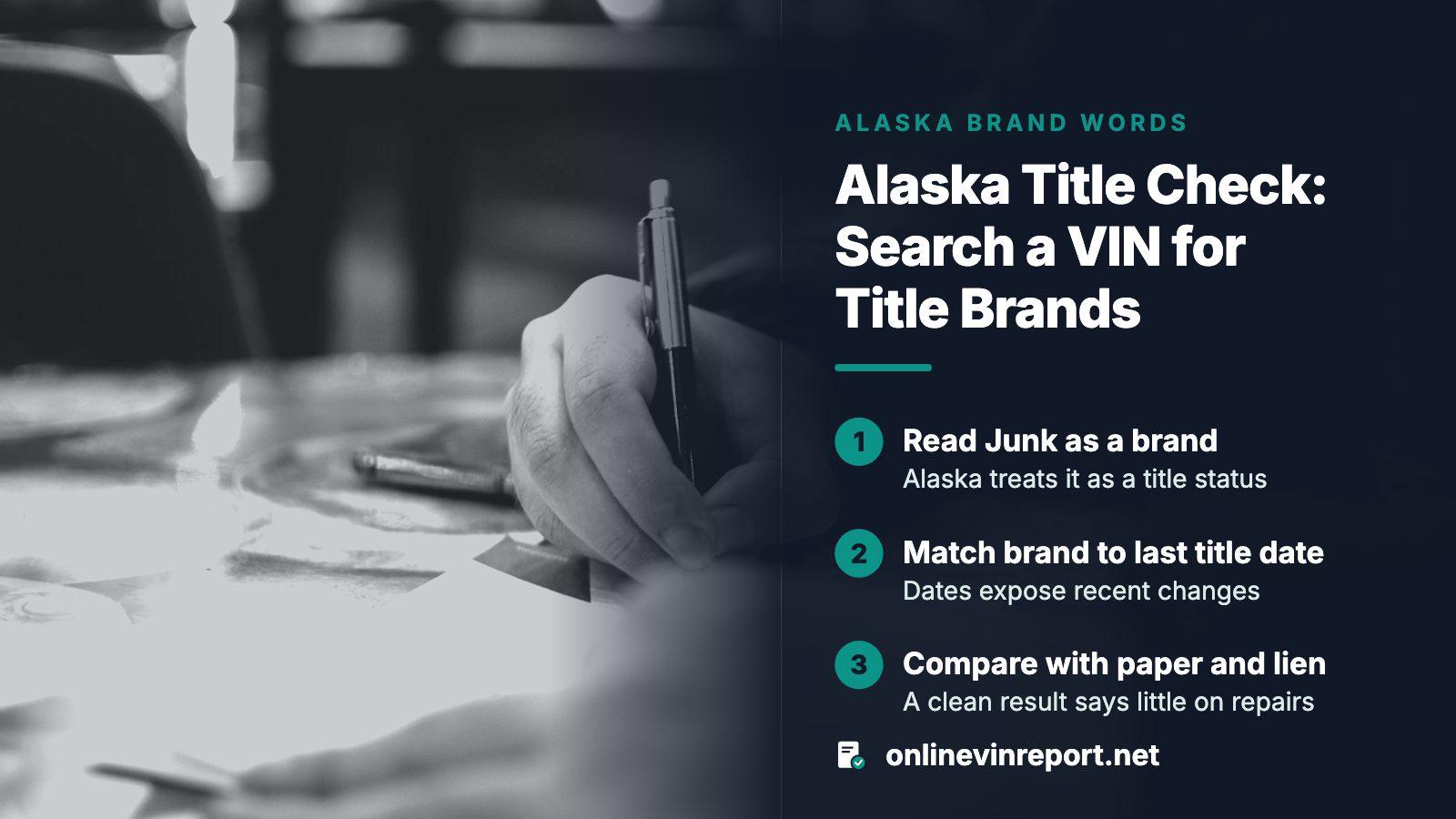
To search an Alaska car's title, enter its VIN and read the brand history first, then the last title date, the odometer readings and any total-loss or salvage-yard entry. Alaska's rules treat Junk as a brand a vehicle can carry until it is reconstructed, so read each brand the way Alaska uses it. A clean result is encouraging but says little about repairs. Set it beside the paper title, the lien status and an inspection.
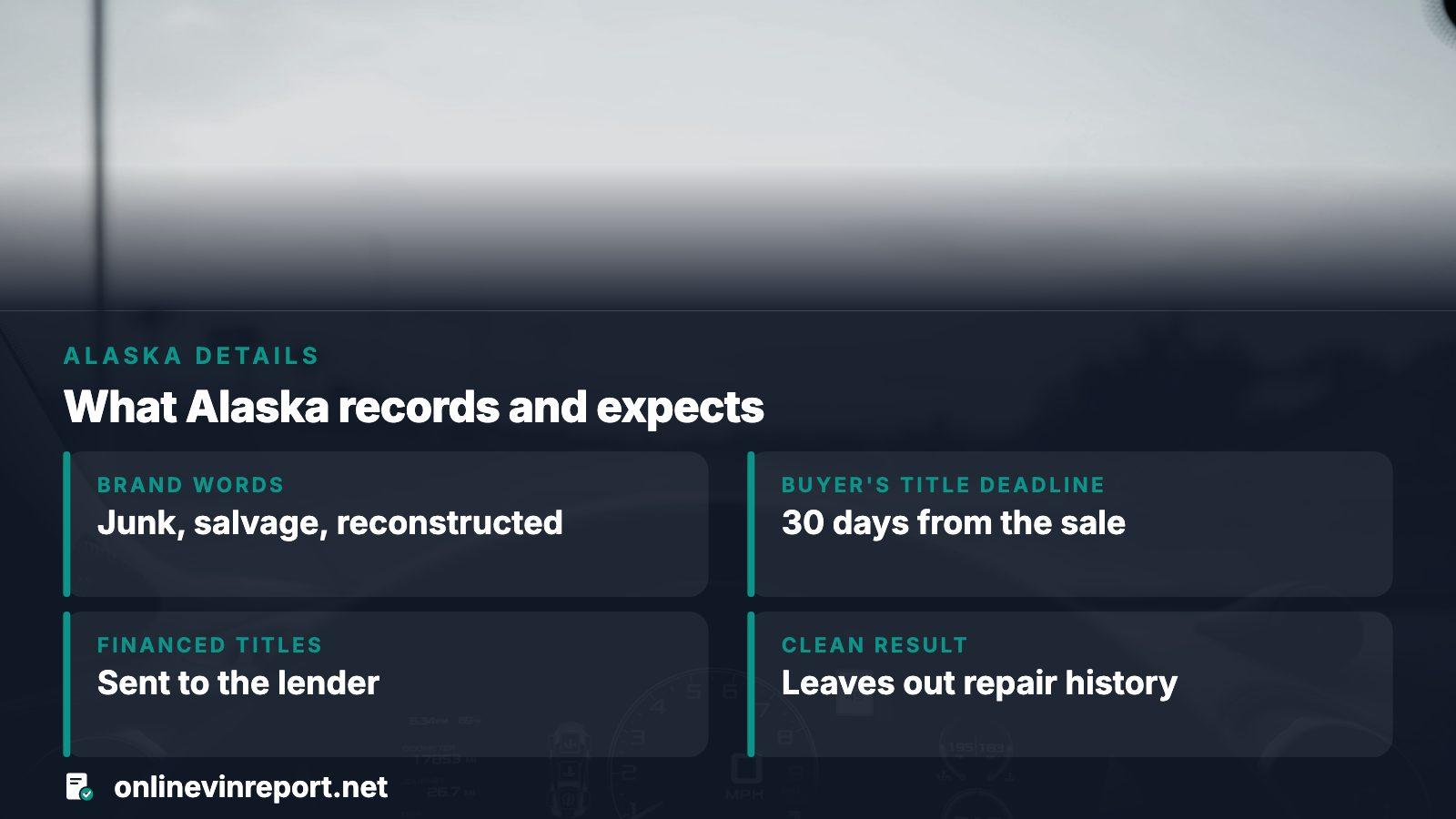
- Alaska brand words
- Junk, salvage, reconstructed, parts-only
- Buyer's title deadline
- 30 days from the sale
- State salvage title fee
- $15
- Preview
- Free, no card needed
What an Alaska title search shows for one VIN
A VIN search follows one vehicle through the title system, not just through the state where you happen to be shopping. Alaska's DMV titles page points used-car buyers to the federal title system for a search, and that system gathers records from state agencies, junkyards, auto recyclers and insurance carriers.
| Part of the result | What it records | Why it matters in Alaska |
|---|---|---|
| Brand history | Junk, salvage, flood and similar marks from any state | A car can carry a mark earned far from Alaska |
| Title state and date | Which state issued the latest title, and when | A fresh title from a new state on an older car deserves a question |
| Odometer readings | Mileage readings held in the title record | A reading that drops between records points to a rollback or a typo |
| Total-loss and salvage entries | An insurer write-off or a yard intake | These can exist with nothing printed on the title |
| Liens and impounds | A bank's claim on the car, or a stay in a tow yard | A loan can outlive the seller's memory of it |
Run the check in six steps before you drive out
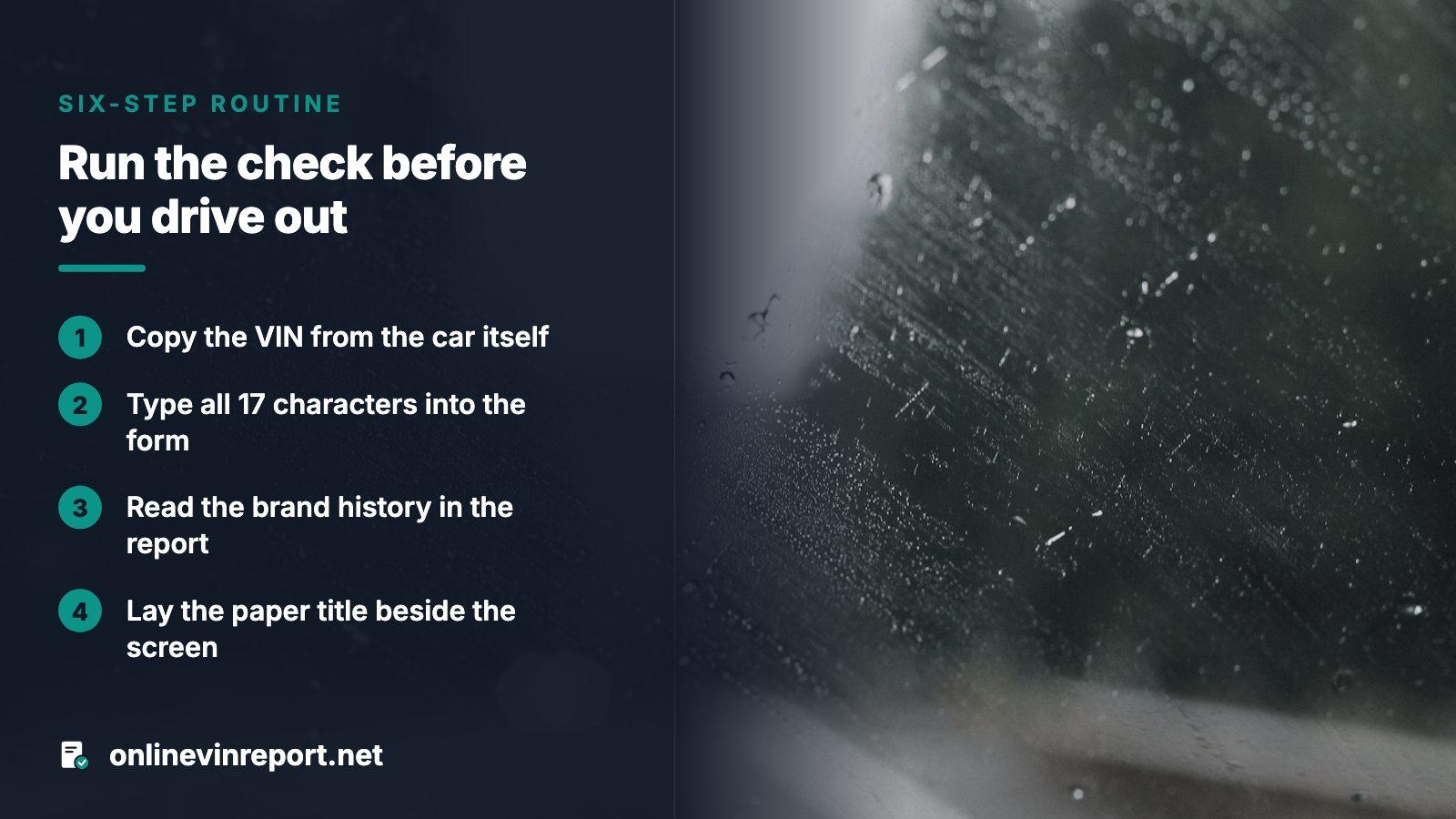
- Copy the VIN from the car, never from the advert. Crouch beside the dash on the driver's side and read the metal tag showing through the glass, then confirm it against the sticker on the door pillar.
- Type all 17 characters into the form on this page. A single wrong character brings up another vehicle or an error message.
- Run the free preview. It needs no card.
- Should the car stay on your shortlist, purchase the report and go to the brand history before any other section.
- Ask the seller to lay the paper title beside your screen. The VIN, the issuing state and the owner names must agree.
- Write down every brand, date and lien, then put your questions to the seller before any money moves.
Alaska's brand words, side by side
The DMV's wording treats a Junk brand as something a vehicle can carry before it is reconstructed, so the word does not always mean scrap. Four designations matter when you read an Alaska title or a report line.
| Designation | What the DMV says | How to treat it |
|---|---|---|
| Junk brand | A current brand carried by a vehicle that has not yet been reconstructed | A wreck until papers show otherwise |
| Salvage title | Since August 1, 2025 the DMV can issue one to a junk-branded vehicle that was never rebuilt. SALVAGE is printed near the top, with a remark that a reconstructed title is needed before registration | Proof of ownership for a wreck, not a car you can register |
| Reconstructed | The frame, body or engine was exchanged so heavily that the vehicle no longer matches how it left the factory; replacing only the engine does not qualify | Ask for the builder's affidavit and the parts invoices |
| Non-repairable or parts-only | Damaged, wrecked or burned until only parts or scrap value remains. The DMV says it can never be titled or registered in the U.S. again | Walk away |
Five results you may see, and what each asks of you
- A junk or salvage brand with a date. The loss is on record. Line the date up with the odometer readings and with the seller's account of who owned the car then.
- A total-loss or salvage-yard entry with no brand beside it. The record draws on insurers and yards as well as state agencies, so a write-off can show there while the paper title says nothing. Price the car as branded.
- A brand from another state on a title that looks clean. The federal record keeps brands from any state, so ask why the title moved.
- A lien that still shows. Alaska sends a financed car's title to the lender, so a seller holding it should produce a release.
- Nothing at all. That is encouraging, since a clean federal record is a good sign, but it leaves out repair history. Go and inspect the car.
What Alaska expects on the paperwork once you buy
The search covers the past. The DMV decides what happens next.
- Get a title issued to you no later than 30 days after the purchase.
- The seller must release the title straight to you, because dealer-style reassignment is closed to a private seller.
- Two owners joined by OR on the title mean one signature is enough. AND, or no word between the names, means both must sign.
- The seller writes the mileage on the title. If the title has no space for it, form V6 covers the disclosure.
- The application, form V1, is signed in ink by the owner.
Liens and lost titles: what a clean-looking file can hide
Alaska records one primary lender on a title and mails the new title to that lender. When the loan ends, the lender hands back the original with its release signed on the front, or sends a notarized letter. A PAID stamp alone is not accepted. A car arriving from another state with an unreleased lien qualifies for registration only.
A seller who says the title is lost can ask the DMV for a duplicate on a notarized affidavit, form 809, and a financed car also needs the lender's release first.
Settle it before you pay
A lien, a missing title or a VIN that disagrees with the paper is for the seller to clear with the DMV. Hold your money until it is.
Impound-sale and reconstructed cars deserve extra questions
When a tow yard sells a car that sat unclaimed for 30 days, the buyer files a notarized form 826, the V1, an inspection certificate on form 811 and a $15 title fee. The DMV's page does not say which brand or title type that buyer receives, so read the report's impound and brand lines for the car's history.
A reconstructed car has its own file. Its builder signs a notarized affidavit on form 829, surrenders the titles for whichever vehicles donated the frame, hands over invoices for major parts, and has an officer or DMV representative verify the VIN in an inspection that costs nothing at a state DMV office. Ask the seller to show you that paperwork and match it to the parts you can see.
Price of the report, and what comes after it
The preview is free and never asks for a card. The full report is billed one time, either as a lone report or as a pack for comparing several cars, and no subscription applies. See the pricing page for what is currently offered. Pair the result with these steps.
- Enter the VIN at NICB's VINCheck, which flags flood damage, theft that was never recovered, and salvage declarations.
- Run the federal recall lookup to see open recalls on that exact car.
- Hire a mechanic to inspect it. The FTC says a history report does not replace an independent inspection.
- Hold the deal if any brand, lien or odometer gap is unexplained.
Where this information comes from
- Alaska DMV: salvage vehicle titles — The August 2025 rule change, Form 857, the fee and what a salvage title is for.
- Alaska DMV: reconstructed or homebuilt vehicles — Reconstruction steps, the builder's affidavit and the parts-only definition.
- Alaska DMV: buying a used vehicle — The title deadline, signatures, odometer and lien-release requirements.
- Alaska DMV: lienholder information — How liens are recorded and released, and the lost-title route.
- Alaska DMV: impound and lien sales — What a buyer files after a towing, storage or mechanic's lien sale.
- NMVTIS: understanding a vehicle history report — The federal title record's indicators, its data sources and what it omits.
- FTC: used cars — Why to get a history report, and why it never replaces an inspection.
Sources and photos: Facts checked against the sources above in November 2026. Photos by Owen Michael Grech, Cole Keister and Dennis Eusebio on Unsplash; diagrams by OnlineVINReport.
Keep reading
- Salvage title VIN check: run it online before you payThe same lookup for any state, with a closer look at salvage and junk entries.
- What is a branded title? How to read salvage, flood and rebuilt brands by VINEvery brand type explained, and how each one changes what a car is worth.
- Check title and lien by VIN: brands first, then who holds a claimHow to confirm that a lender has no claim before the title changes hands.
- PricingReport options, pack sizes and the one-time payment, with no subscription.
Frequently asked questions
Is there a free Alaska title check by VIN?
Partly. NICB's VINCheck is a free screen for flood, theft and salvage declarations, and the preview on this page is free too. The full title history is a one-time payment. Alaska's DMV titles page sends used-car buyers to the federal title system for a search instead of offering a VIN lookup of its own.
What does a junk brand mean on an Alaska title?
It is a brand a vehicle can carry before it has been reconstructed. Since August 1, 2025 the DMV can issue such a vehicle a salvage title, which helps an owner prove ownership when surrendering it to an insurer or recovering it from impound. Non-repairable or parts-only is a separate, final designation.
What is Alaska's deadline for titling a used car?
The DMV says 30 days from the purchase. Bring the released title and a signed V1, plus a lien release if a lender is listed. Run the VIN check before that clock starts, because a brand or lien found after the sale becomes your problem rather than the seller's.
Can a title check show a lien on an Alaska car?
The report's lien and impound lines can flag a lender's claim, but the DMV settles it. Should the seller claim the loan is cleared, ask for the lender's signed release on the title or a notarized letter. A PAID stamp on its own is rejected.
Can a clean result be taken as proof the car was never wrecked?
No. What the federal record holds is brands, total-loss and salvage entries, odometer readings and the title itself, and it leaves out accidents and repairs. A wreck that was fixed without a write-off may never reach it. Treat a clean result as a good sign, then book an independent inspection before you pay.
Now check the car itself
The guide explains what to look for. The report shows what this VIN has on record.