THE SHORT ANSWER
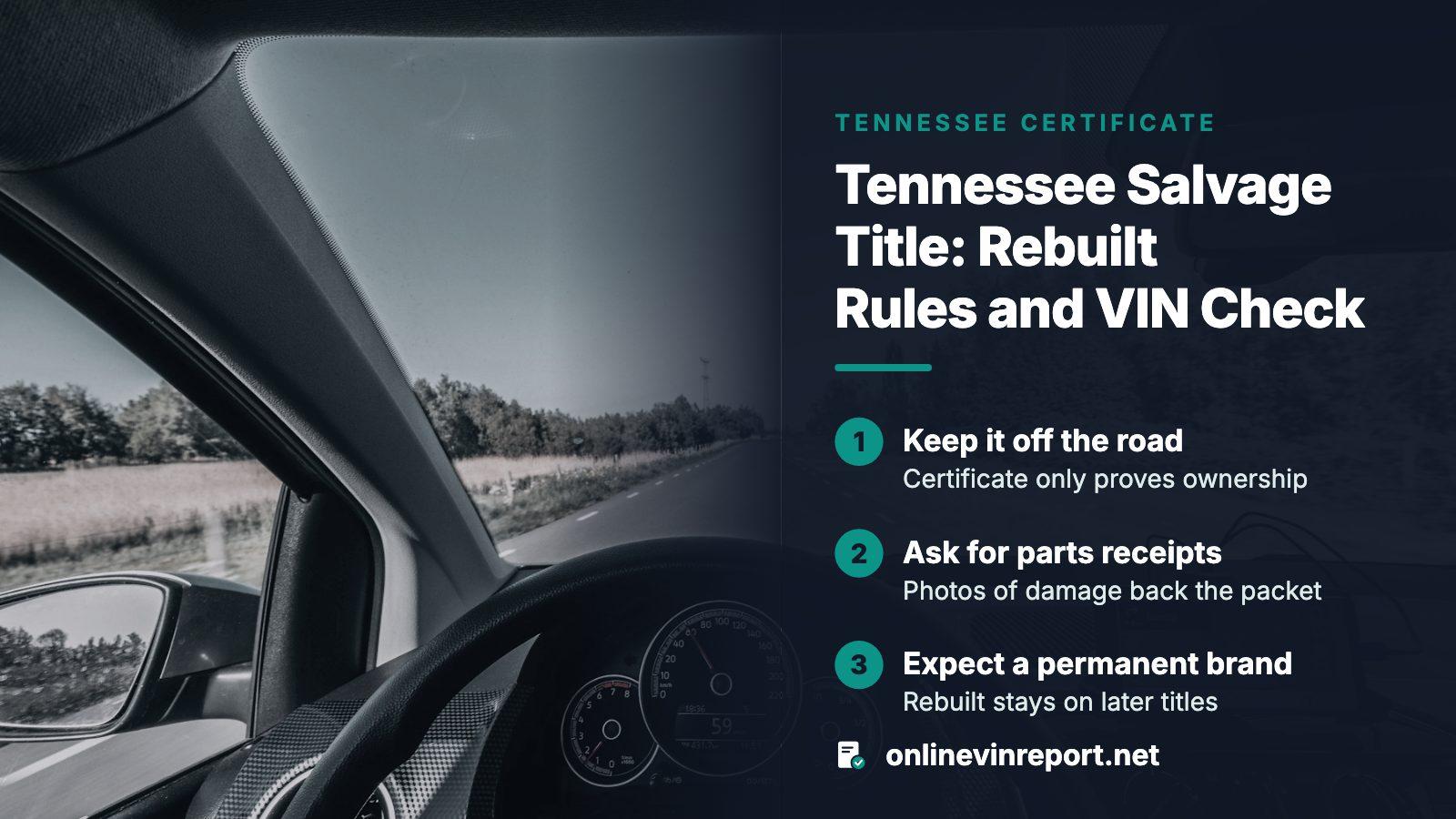
In Tennessee a salvage certificate only establishes ownership, and it has to stay off public roads. To return it to service the owner files for rebuilt status with photos of the damage and receipts for replaced parts, pays a conversion fee, and may face an inspection. The finished title carries a Rebuilt brand permanently, so a VIN search will show it.
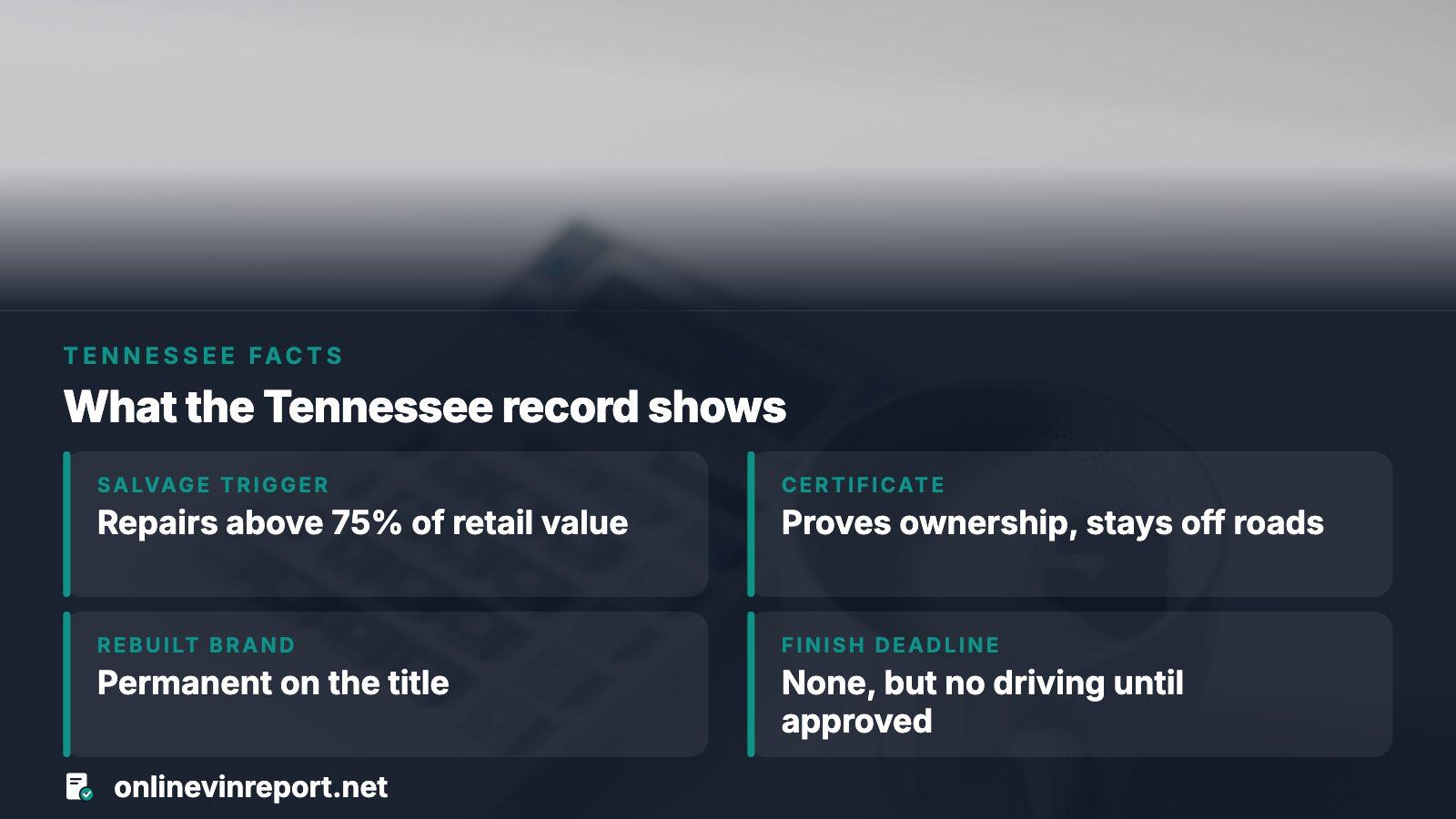
- Salvage trigger
- Repair cost above 75% of retail value
- Salvage certificate fee
- None
- Rebuilt conversion fee (individual)
- $75.00, per a 2023 state page
- Deadline to finish rebuilding
- None, but no driving until approved
What a salvage certificate does and does not do in Tennessee
Tennessee law treats a passenger vehicle as salvage when repairing it would cost more than 75% of its retail value. A second category, non-repairable, covers a car that cannot be operated safely on a road and is worth something only as parts or scrap. Both are defined in Tenn. Code Ann. 55-3-201.
Once an insurer has paid a total loss claim, either the insurer or the owner applies for the certificate. The certificate is free, and it exists only to settle who owns the wreck. Tennessee will not register a salvage or non-repairable vehicle, and it may not run on the state's roads. If a seller shows you a salvage certificate and offers a test drive, that offer alone tells you something.
From wreck to rebuilt title, step by step
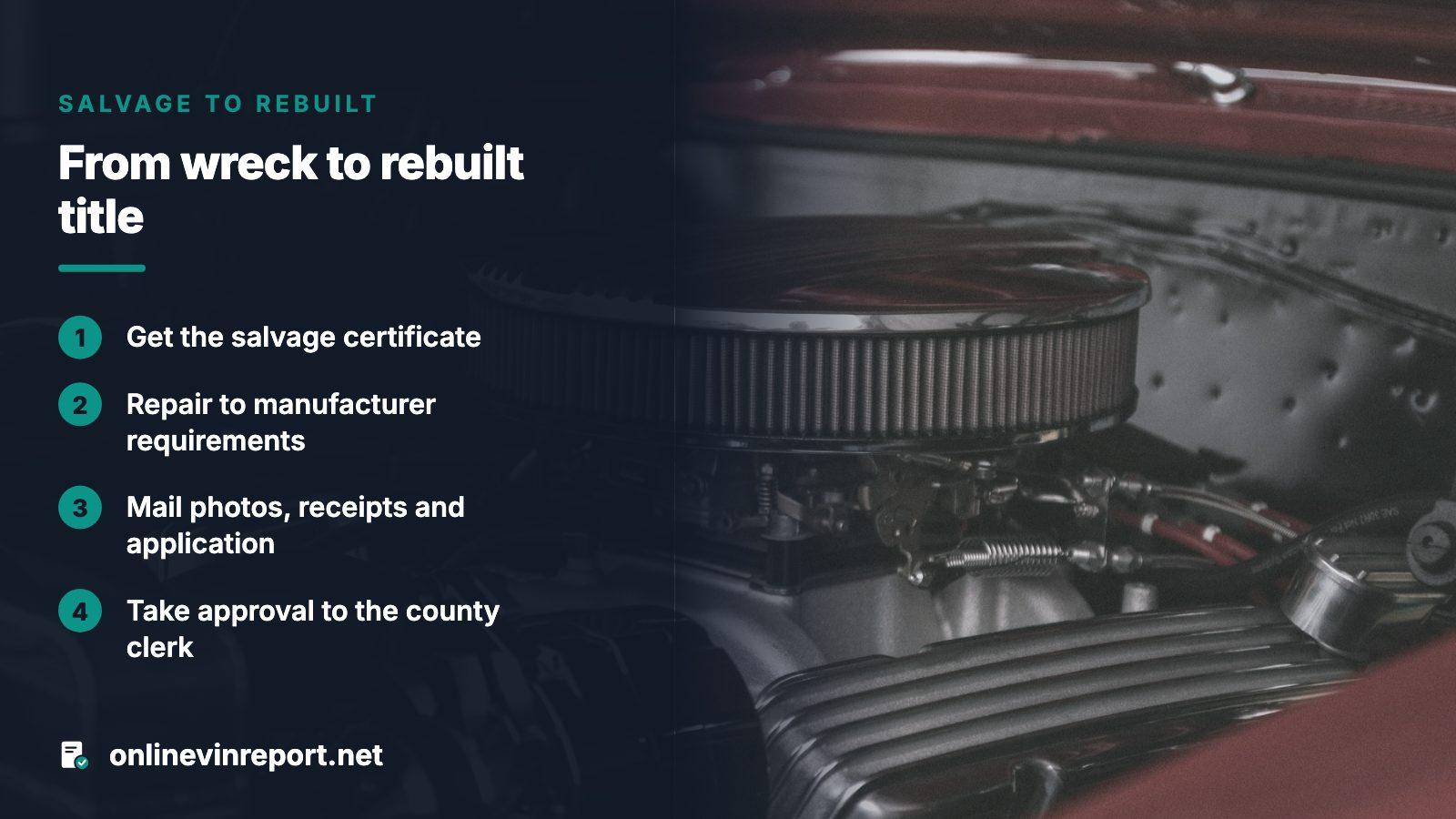
The state calls the conversion pre-certification. An owner who has already repaired the car, or plans to, sends the state's rebuilt-vehicle identification form by mail to the Vehicle Services Division in Nashville.
- Get the salvage certificate, or use an out-of-state salvage title if that is what the car came with.
- Repair the car to manufacturer requirements and department rules.
- Mail the application with the salvage paperwork, color photos of the damaged car from every quadrant, and receipts for each replaced part.
- Pay the conversion fee.
- If the state requires an inspection, meet the agent from the Special Investigation Unit who calls to schedule it.
- Take the approval letter, plus the decal if there was an inspection, to the county clerk for a title branded Rebuilt.
Individuals pay $75.00 for the conversion. Licensed dealers pay $85.50 in total because a title application is folded in. Those figures come from a help page dated November 2023, so confirm them before you rely on them.
The parts receipts are the part of the packet a buyer can judge
Tennessee does not accept a vague stack of invoices. Each receipt has to identify the donor vehicle by year, make and VIN, and carry full names and mailing addresses for both buyer and seller. New or aftermarket parts must be labeled that way. The state also bars any rebuilder other than the applicant from appearing in the ownership chain, which pushes the whole job onto one owner's paperwork.
When you look at a rebuilt Tennessee car, ask the seller what was replaced and where each part came from. A person who actually went through this process has the answers, and the damage photos that went into the application should still exist.
A fair question to ask
Could you show me the photos of the car as it looked damaged, and the receipts for the big parts? An honest rebuilder usually has both.
No deadline, which is why old salvage cars turn up
Tennessee sets no time limit for finishing the rebuilt process. An owner can sit on a salvage certificate for years, as long as the car stays off the road until the state approves it. That is useful to know, because a car with an open salvage record and no rebuilt title can change hands more than once, each seller hoping the next person finishes the job.
The state's own system matters too. A salvage record in its database can force the rebuilt process even on a machine the buyer holds no title for. If a seller says the car is clean but the record says otherwise, the record wins.
Cars that arrive from other states
If another state finished the rebuild and the title that comes with the car says Rebuilt, Tennessee takes it and issues its own title with the same brand. A car with only an out-of-state salvage title does not need a Tennessee certificate first; the foreign title can go straight into the pre-certification packet.
Brand names differ between states. When an out-of-state title uses wording Tennessee does not, Vehicle Services works out which Tennessee brand applies, sometimes asking the earlier state for a letter or a corrected title. A Kentucky red title is treated as the equivalent of a Tennessee non-repairable certificate, and that car cannot be registered here at all.
Flood brands and cars that were wrecked twice
Flood is handled separately. The question is what kind of water reached the car. When the state can show that salt or brackish water was not involved, a flooded car can usually be titled and registered, with FLOOD printed as the brand. Salt water or brackish water is a different matter and the car may not qualify.
A car already titled Rebuilt can lose its status again. If it is under ten years old and gets declared a total loss a second time, it goes back through salvage and rebuilt. Older cars skip that requirement, so the same brand can mean different things on a recent model and on an old one.
Where a VIN title search helps and where it falls short
The federal title database, which the Justice Department oversees, holds brands that any state applies, and a brand stays on the record permanently. It also records insurer total-loss determinations and transfers to salvage yards. Reported flows are wide: about 87% of the nation's vehicles are in it and it holds roughly 20 million salvage or total loss records.
- A brand on the record means the car has a documented history to ask about.
- A clean result is not proof, because gaps can produce a false negative.
- States define damage differently, so a car branded in one state may be clean in another.
- A total loss flag can come from an insurer even when a state never branded the title, and a stolen car not recovered within 30 days can carry one.
The federal page itself urges buyers to pull the state record too. Treat a search as the first filter, then follow it with an in-person inspection.
Running the check before you pay
Our preview shows whether a title brand exists for the VIN, at no charge. If it does, the full report adds the salvage and auction records with photos, plus the damage detail, so you can see what kind of loss created the brand. The report is a single payment, not a subscription; the pricing page lists the options.
Do this before you visit, and again if the seller changes the story. A Tennessee seller who says the car was rebuilt should be able to show the Rebuilt brand on the title, and the search should agree.
What to do with what you find
- Salvage brand, no rebuilt title: the car cannot be registered yet. Walk away or price in the whole rebuilt process.
- Rebuilt brand: ask for the damage photos and parts receipts, then have an independent shop inspect it.
- Flood brand: ask how the water was identified and check for corrosion.
- No brand but a story that sounds off: get the state record and run the search again.
Where this information comes from
- Tennessee help desk article RBLT-1, salvage to rebuilt — definitions, packet contents, fees and inspection steps
- Tennessee help desk article VTR-20, totaled cars on the road — why a totaled car stays off the road
- Tennessee help desk article VT-20, foreign salvage titles — using a foreign salvage title in the rebuilt process
- Tennessee help desk article VTR-21, flood damage — the FLOOD brand and the salt water limit
- NMVTIS: for consumers — brand history, total loss flags and stated limits of the federal database
Sources and photos: Facts checked against the sources above in November 2026. Photos by Sander Jeurissen, Victor Hughes and Ben Wicks on Unsplash; diagrams by OnlineVINReport.
Keep reading
- What is a rebuilt title? What it means and what a VIN title check showsWhat the rebuilt brand means for value and resale.
- Salvage title VIN check: run it online before you payRun the VIN to see a salvage brand before you buy.
- Tennessee title check: salvage, flood and rebuilt brands by VINThe wider Tennessee title picture beyond salvage.
- Rebuilt title inspection: what the state checks and what a VIN title check addsWhat an inspection of a rebuilt car should cover.
Frequently asked questions
Can I drive a car with a Tennessee salvage title?
No. The state treats the salvage certificate as proof of ownership only. It stays unregistered and off the road until the rebuilt process is approved. Moving it on a trailer to a repair shop is the practical route, and the state has no clock on how long that takes.
How much does a Tennessee rebuilt title cost?
A state help page dated November 2023 lists a $75.00 conversion fee for individuals and $85.50 in total for licensed dealers. The salvage certificate itself has no fee. Fees change, so check with the Department of Revenue before you file.
Does a rebuilt title ever go back to clean?
The state does not describe any path back to an unbranded title. Once a state applies a brand it stays on the federal record permanently, so later buyers can see it, and a seller who calls the car clean is not matching the records.
Will my VIN search catch every salvage car?
No. The federal database says gaps can produce a false negative, and states define damage differently. Use the search as a first filter, ask for repair photos and receipts, and pay an independent mechanic to inspect before you buy.
What if I bought an out-of-state salvage car?
You do not need a Tennessee salvage certificate first. The out-of-state salvage title can go straight into the rebuilt application. If the title uses an unusual brand name, expect Vehicle Services to research which Tennessee brand fits.
Now check the car itself
The guide explains what to look for. The report shows what this VIN has on record.