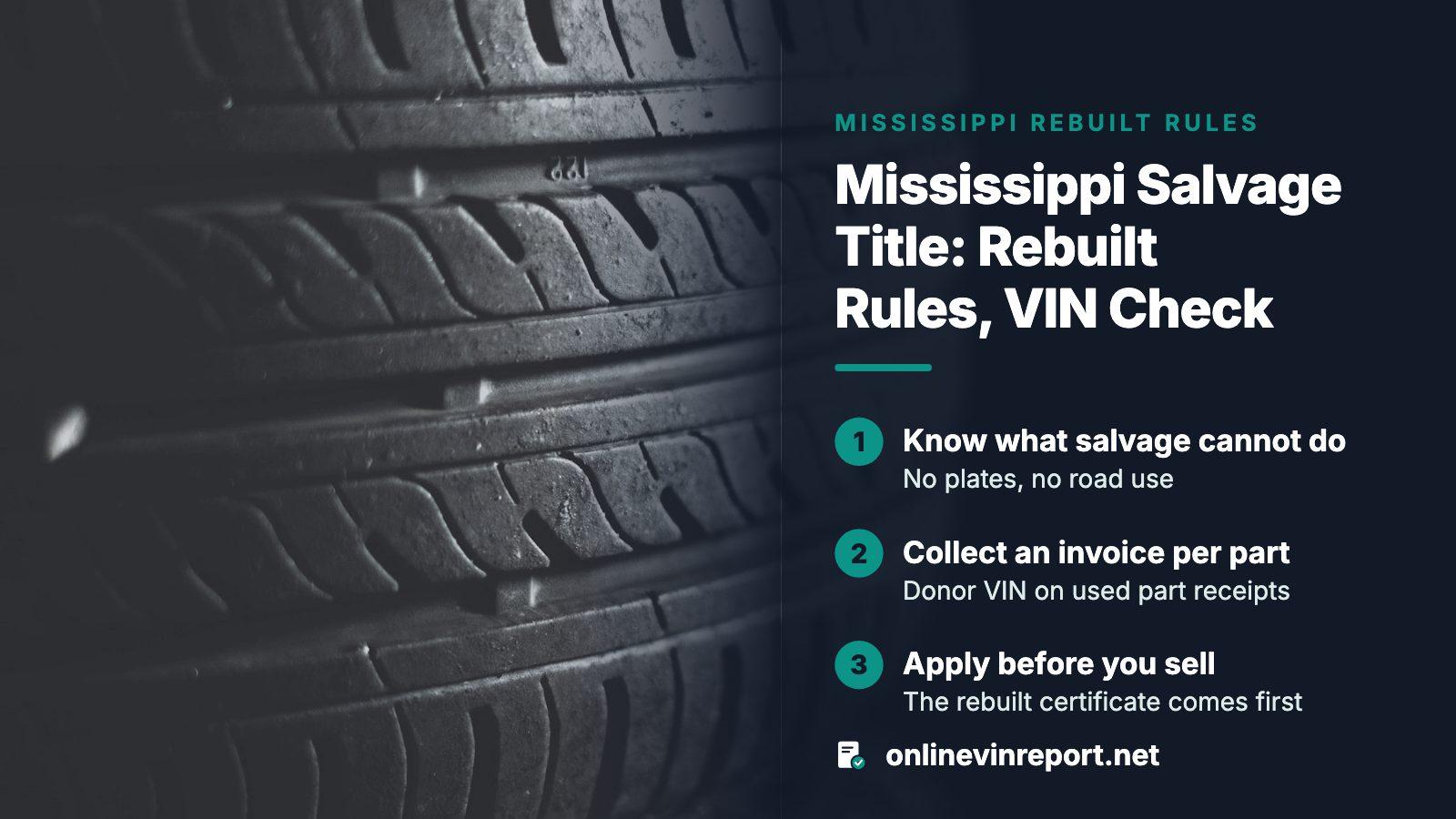
THE SHORT ANSWER
Mississippi issues a salvage title when an insurer takes over a written-off car. Until repairs are done, the Department of Public Safety has inspected the car and the title reads rebuilt, it cannot be plated or driven on the road. Flood brands stay on the title for good. An online VIN title check shows whether any of these brands is already on the record.
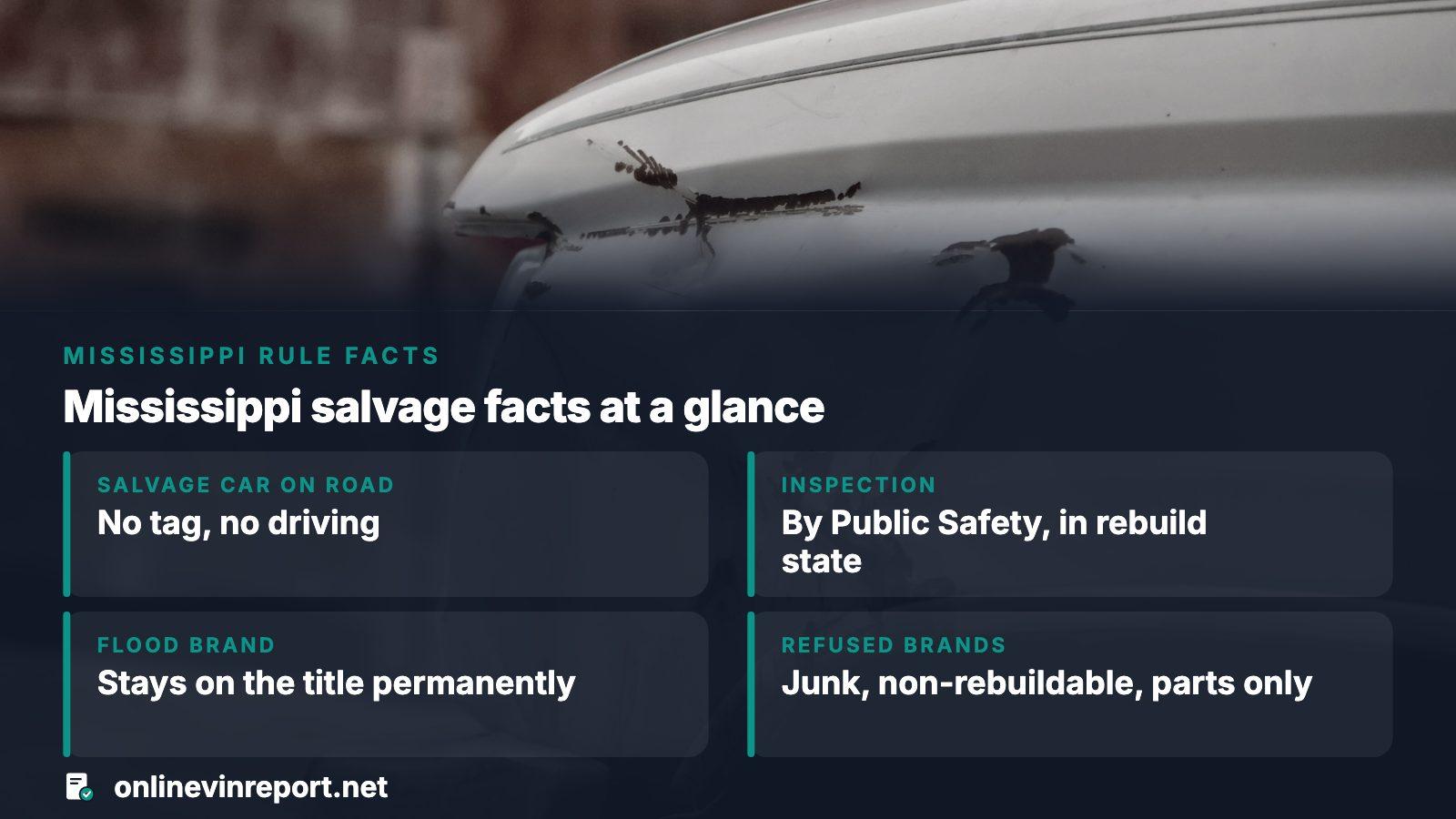
- Salvage car on the road
- No tag and no driving, except to the inspection site
- Inspection
- Public Safety, held in the state of the rebuild
- Flood brand
- Stays on the title permanently
- Refused brands
- Junk, non-rebuildable, certificate of destruction, parts only
What the salvage brand means in Mississippi
A salvage title is a state document for a car that an insurer has taken from its owner after paying out a total loss. The cause can be a collision, fire, flood, hail, an accident, trespass or a theft where the car never came back. The Department of Revenue issues the title to the insurer so it can sell the wreck on.
Two kinds of car fall outside the definition. One is a car aged a decade or more and worth no more than $1,500. The other is a car whose damage calls for fixing or swapping five minor parts at most. If the car you are eyeing has an older, cheaper history, the lack of a salvage brand may be legitimate and not a gap in the record.
Salvage, rebuilt, flood and hail brands side by side
Mississippi's own pages list four examples of a branded title. They tell a buyer very different things, so it helps to line them up before reading a report.
| Brand | What it tells you | What happens next |
|---|---|---|
| Salvage | An insurer paid a total loss and owns the car | Repair, inspection, then a rebuilt title |
| Rebuilt | The car was reconstructed and passed the state inspection | Can be titled, tagged and sold at retail |
| Flood damage | Water damage was recorded | Brand carries forward and is not removable |
| Hail damage | Hail damage was recorded | Brand is applied again on a later title |
What a salvage-titled car cannot do
The restrictions start the day the salvage title exists. The state wants these cars off public roads until someone has proved they were put back together properly.
- It may not be run on public roads, apart from the trip to its inspection appointment and back.
- It cannot be issued a plate of any kind.
- No licensed dealer may sell it before the brand on the title becomes rebuilt.
- Work done in a different state cannot be inspected here.
So a seller who offers a salvage-titled car with plates on it is telling you something that does not fit the rules. Run the VIN before you drive anywhere to see it.
How a salvage car becomes a rebuilt one
The route is paperwork heavy, and the state is strict about it. A rebuilder who skips a step does not get a clean title.
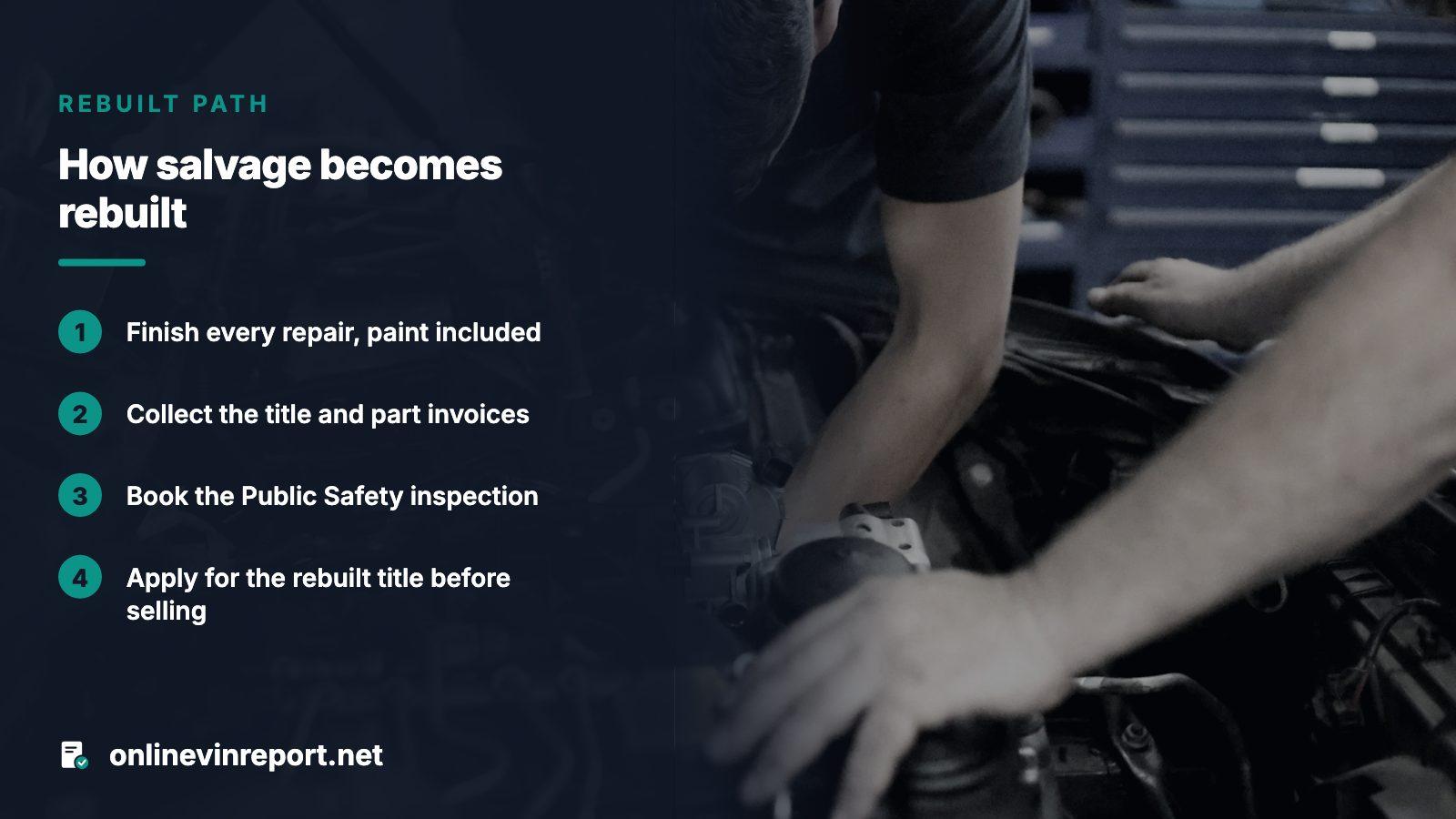
- Finish every repair, paint included. The inspectors will not look at a half-restored car.
- Collect the salvage title in original form (or the retention letter from the insurer), the state's application for inspection, and an invoice for every part. Used parts need the donor car's VIN on the receipt.
- Photograph the car on all four sides before repairs begin, then add a work order. If you did the work yourself, the work order is notarized.
- Book a Public Safety regional office, bring the originals plus two copies, and pay the $125.00 inspection fee by certified check or money order.
- After a pass, apply for the rebuilt certificate of title, and do that before you sell the car to anyone.
The parts test behind a rebuilt brand
The rebuilt brand is not a judgment call. Mississippi counts parts. For an ordinary passenger car, the title gets branded rebuilt when any of the following was repaired or replaced after collision damage:
- a single major part together with five minor ones
- six minor parts on their own
- a pair of major parts, or more than two
- the cowl, also called the firewall
- the front-end assembly and a rear clip, both of them
Doors, the hood, fenders, bumpers and the deck lid count as minor parts. A frame, a replaced engine and the roof panel count as major ones. Collision or hail damage that touches five minor parts or fewer can end with a title that has no brand at all, which is why the inspection photographs matter: if they do not show old damage clearly, the repair of that damage is counted as a part.
Flood and hail cars follow different rules
For a flood car the insurer applies for the flood title in its own name and then assigns the car to the buyer. The buyer supplies four photographs from before the repairs, files the inspection application and has the car inspected. Public Safety states that a flood brand is permanent and outranks every other brand.
Hail works along similar lines: the insurer applies in its name, the buyer brings pre-repair photos, a work order and the application, and the car is inspected. A later title on a hail or flood car carries that damage brand again.
Why this matters when you shop
A rebuilt title and a flood title are two separate warnings. If a Mississippi record shows flood damage, no repair invoice changes that brand. Ask the seller for the paperwork, then compare it with the brand history on the VIN.
Titles Mississippi will not issue
Some brands mean the car is not coming back. The state issues no title and no registration for a junk vehicle, a non-rebuildable vehicle, a certificate of destruction title or a parts-only title. A car that carries one of those brands from any other jurisdiction cannot be titled here either.
Out-of-state cars have their own rule. A car branded salvage in some other jurisdiction has to be fixed and approved there before it crosses into Mississippi, and the title application must include proof that it passed. Brands that reveal a pertinent fact on another state's title are carried forward onto a Mississippi one, so a clean-looking Mississippi paper title still depends on what the earlier states recorded.
Check the VIN before you hand over money
An online title check reads the VIN against brand records and shows whether salvage, junk, flood or similar brands were ever applied, with dates. Start with the free preview on the VIN, which tells you whether a brand is on file. If it is, the full report is one payment and carries the details you would want before an inspection or a negotiation. Prices are on the pricing page.
Do this before the test drive, and again if the seller changes the story. A brand found at that stage costs you nothing. A brand found after the sale costs you the car's value.
What no check and no inspection can promise
The federal NMVTIS system keeps a brand once a state reports it, but its own page warns that not every state reports fully and that a search can come back empty by mistake. About 87 percent of the US vehicle population is in the system, and more than half the states report data to it. An empty result is good news, not a guarantee.
The inspection is not a safety check
Under Mississippi's rule, the rebuilt certification makes no statement about whether the car is roadworthy or safe. The inspector confirms that identification numbers are intact and nothing looks stolen. Pay an independent mechanic to look at structure, airbags and wiring on any rebuilt car.
Where this information comes from
- Mississippi Department of Revenue: Salvage Vehicles — restrictions on salvage cars, definitions, brands the state refuses to title
- Mississippi Department of Public Safety: Salvage Inspection Division — inspection paperwork, fee, flood and hail procedures
- Mississippi Title 35 Part VII Subpart 6 Chapter 05: Salvage Vehicles — the parts test, brand rules and what the inspection covers
- NMVTIS: Consumer information — how brands are kept nationally and where the data has gaps
Sources and photos: Facts checked against the sources above in November 2026. Photos by Benjamin Brunner, Mustafa Sheikhmouss and Everett Pachmann on Unsplash; diagrams by OnlineVINReport.
Keep reading
- What is a rebuilt title? What it means and what a VIN title check showsA broader look at what rebuilt means for value and insurance.
- Salvage title VIN check: run it online before you payHow a VIN search surfaces a salvage brand in any state.
- Mississippi title check: read the brands before you payReading a Mississippi title record before you buy.
- Title washing: how a brand vanishes and what a VIN title check can showHow brands get dropped when a car moves between states.
Frequently asked questions
Can I drive a car with a Mississippi salvage title?
Not on public roads. The state's rule bars driving it anywhere except the round trip to the inspection site on the appointment day, and no tag is issued for it. Until it is repaired, inspected and retitled rebuilt, treat it as a project car that has to be trailered.
Can a dealer sell a salvage-titled car in Mississippi?
Not as it stands. A licensed dealer cannot sell the car until the title has been changed to rebuilt. A rebuilder must also hold the new title ahead of any retail or wholesale deal, so a seller who has no rebuilt certificate in hand is not ready to sell.
Can a rebuilt title in Mississippi ever go back to clean?
Mississippi's rules carry brands forward from earlier titles, so a rebuilt brand stays in the history. The one stated exception is a collision or hail repair that touched five or fewer minor parts, where the new title carries no brand. A flood brand never comes off.
What does the inspection actually check?
The officer examines the car and the parts you listed to make sure VINs and part numbers are untouched, the paperwork is true and nothing looks stolen. A stolen or altered VIN leads to impoundment. The certification does not vouch for roadworthiness or safety.
Will a VIN check show a Mississippi salvage brand?
It should show a brand that Mississippi or an insurer reported, with dates. No report is complete, though, because reporting varies by state and source. Treat a brand as a firm warning, treat a blank result as one input, and still have a mechanic look at the car.
Now check the car itself
The guide explains what to look for. The report shows what this VIN has on record.